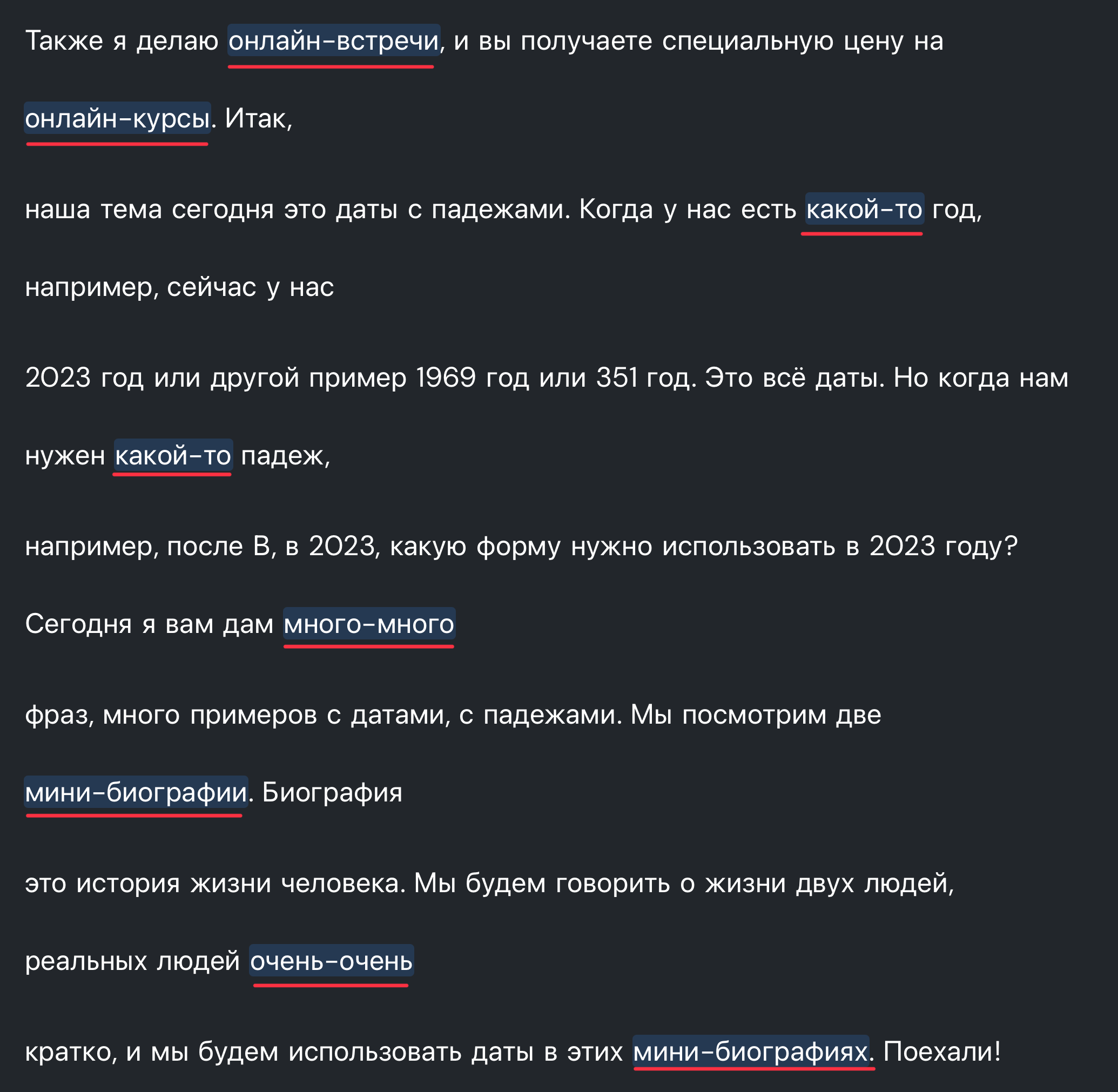
Please consider separating again words connected by hyphens in Polish. This might work differently in other languages, but in Polish you would create too many words that are just the combination of two individual words.
For instance: Niebiesko-biała koszula (The blue and white shirt), it makes no sense to make blue (niebiesko) and white (biała ) one word.
Why not? As a learner of the Polish language, in this case, I would learn that you need to hyphen the two colors to make clear that it is a shirt that is partly blue and partly white. As a learner, I think it is good to know. [Or did I get it wrong somehow?] So I actually think that it makes a lot of sense. If you don’t need the hyphened word, just ignore it.
I get your point, but I don’t agree and I definitely prefer the way LingQ used to treat these words for many years. In my opinion you have a more realistic reflection of your vocabulary through the word separation and you can also get deeper into the analysis. The same would be in German “die deutsch-polnische Freundschaft”. I think it’s a lot more useful to treat “deutsch-polnische” as two words and then you maybe come to the reflection that deutsch has no “e” at the end but polnische does.
But maybe I’m just talking from a point of year-old habits that have grown on me and the fact that many already “cleared” lessons now have blue words.
I remember the integration of hyphens being requested a few years ago, because in some languages the hyphen (or a version of it) is important. Before, when you marked hyphened words as a “new lingq” you were shown the wrong spelling while using the vocabulary review funktion on LingQ.
While the usage in the English language is declining, there are still words with hyphens (mother-in-law, twelve-year-old, baby-sit, …). In the French language I can think of arc-en-ciel, belle-mère, a-t-il and rappelle-le-toi. Some reflexive verb forms in European Portuguese and Catalan also use a hyphen. And in the German language U-Bahn, H-Milch, E-Mail and Make-up come to mind.
Yes, it’s still hasn’t been fixed. It was supposedly going to be fixed on Monday, but now almost a week later there has been zero update or communication about it. Very frustrating.
Alright, I think you set us up with the wrong expectations, saying that this could be a quick fix on Monday (27.04). I see that this is probably more difficult than you imagined, but can you just confirm, please, if this is a work in progress or if it moved to a list of things that LingQ could probably fix once other bugs and problems are solved? Hence, is there still a timeline?
That’s understood, but not really satisfying. In the beginning this sounded like a rather fast bug fix, but now it seems like the fix is a lot more complicated. Can you just explain why the evaluation of the bug fix has changed so much?
This is what makes this so frustrating. This seems to have been a change made intentionally (making hyphenated words one word), after complaints, it was announced that this change would be reverted back and fixed soon. Then we were told it will be fixed on April 24th. Now we are into the second month of this, and now we are just told, “sorry, no updates or info we can give you”, and “we will let you know at some un-determined date in the future.”



 . Any chance of one