The CEO of Air Canada spent 550 hours studying French over six years — and still couldn’t speak it. Here’s why traditional language learning fails, and what actually works.

The CEO of Air Canada spent 550 hours studying French over six years — and still couldn’t speak it. Here’s why traditional language learning fails, and what actually works.
So, Mr Kaufmann learned back in the day Japanese doing the opposite that he claims now to sell Lingq but it is suddenly wrong? I love Steve but I am quite disappointed that lately everything has reduced to “Input is the answer and here it is why to use Lingq”.
I apologise if this comment is taken in a bad way. I love Steve and I really enjoy(ed) his videos, but lately….
So on average he spent:
91 hours/year = 7.5 hours/month = 1.9 hours/week
Only 1.9 hours/week! No wonder he can’t speak it. I wonder if he can read and listen on a B2 level at least. Because then he still has something.
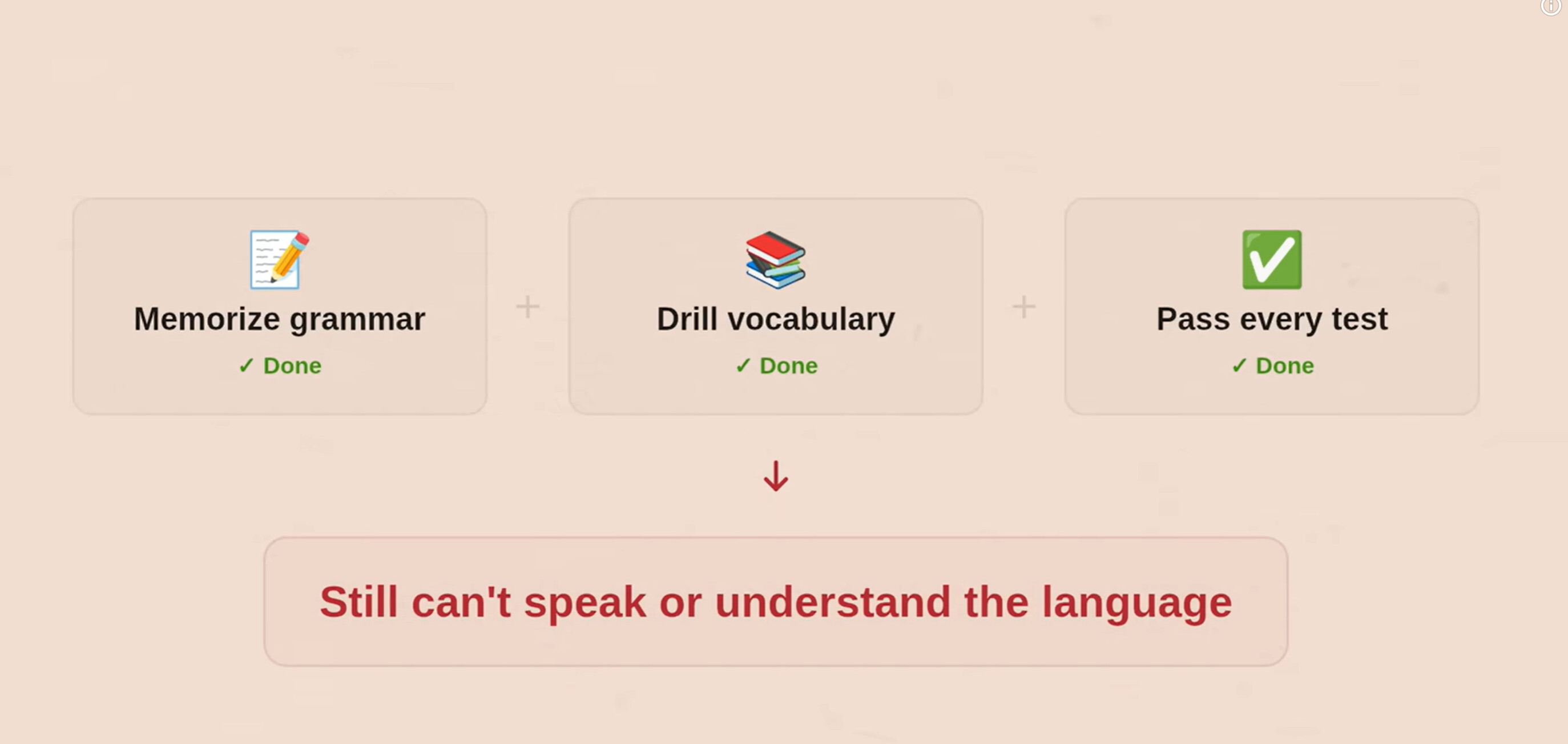
The above doesn’t look traditional. In my opinion, the traditional method is a mixed approach. The diagram is missing the part about reading books, classics, speaking, writing essays, letters and etc.
How does one “pass” every standard test with just memorized grammar/vocab without doing any reading / listening / writing / speaking practice. Those test like TCF/TEF will test all 4 skills.
Not sure what his actual routine is. Maybe he might just be paying (bribing) the PRIVATE tutor to say he has done X numbers of hours so as to keep his job… for awhile…
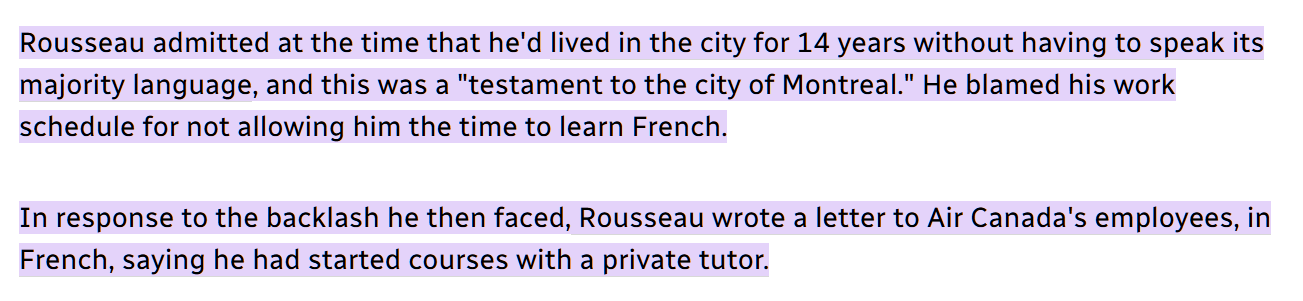
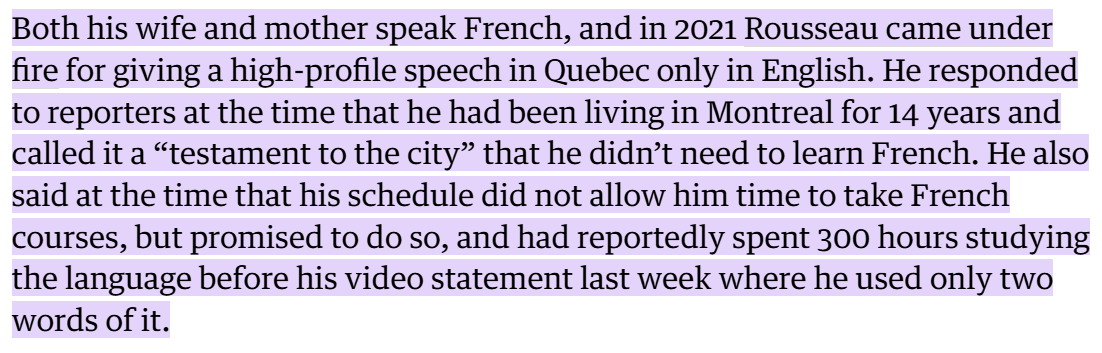
This CEO spent 300 hrs of lesson over 6 years (52 weeks per year) so he spent about 1 hr per week on French. Most of us here are spending 1hr on average per day. At least min 4-7hrs per week.
A learner spending only 1hr/day (1 year) VS one who is spending only 1 hr/week (6 years) with the language. When both reach 300hrs mark I think the 1hr/day learner would be much better at the language due to using it everyday.
It sound like he wants to proof that French is not required, that seems to be his attitude towards French. He just doesn’t want to learn it.
I also had a similar attitude although my job didn’t depend on it. I always failed or just passed (50/100) my 2nd language in school because I never liked learning 2nd language, I felt it was a useless waste of time since everything around me is in English. Even English felt like waste of time, I am already using English in all the other subjects. 2nd language classes were 3hrs per week for 10 years of school. So even with a traditional mixed approach (very little grammar) in class and 3hrs per week over 10 years I still did badly, My attitude towards learning language held me back.
To state the obvious, these are marketing videos. The aim is to discredit language classes, and promote input i.e. LingQ.
I watched this video only because I wanted to comment. Like you Martin, I respect his considerable achievements and incredible hard work, both are admirable. But this video is complete junk, in my opinion. It’s the Krashen theory once again. He even says the classroom is a poor place to learn a language. Richard Simcott has said several times that he enjoys going to language classes early on in his learning of a language. Mr Kaufmann should know better by now.
As for reading being the natural way to learn, children learn their language through first hand involvement in activities with both input and output. They don’t learn by sitting at their desk, reading books. Research has shown that when we are directly involved in an activity, when the language relates to us, then we learn more effectively. They also learn much better from context and use procedural memory far more than adults. In fact their semantic memory is much worse than ours.
As for the CEO, he needs to practice his French, he has some of the language in his head, but it hasn’t been automatised. He needs to do hundreds if not thousands more hours of study, reading, listening and speaking. People routinely underestimate the time required to reach a conversational standard in an L2.
There is a real concern and possibility that Quebec will lose its French language. Some might ridicule that idea, but remember that a few hundred years ago parts of America were french speaking, today only a few hundred fluent speakers remain. Most American Indians have lost their language, Ireland has almost completely lost its language, Wales has fortunately halted the decline of Welsh, Brittany is on course to lose Breton. I’m glad they called this man out, and ‘encouraged’ him to restart his language study.
That’s an interesting comment to be made in an international language learning forum, where people from dozens of countries learning dozens of language communicate solely in English 99.9% of the time. 

That’s mainly due to a tool limitation: if Discourse translated every title and message to the reader’s NL, more of us would write and reply in our mother tongues, like in StarTrek.


Yup that is probably why Canada promotes French language quite strongly. I also noticed the consumer products there have bilingual labelling due to a law requiring it, even outside of French speaking regions.
“Canada requires consumer product labels to be bilingual (English and French) with equal prominence under the Consumer Packaging and Labelling Act.“
So it is surprising he had trouble speaking French while being immerse in French, surrounded by French everywhere and including his wife and mum being able to speak French too. He is also now an example of why immersion alone has its limits.
It’s not, or at least it wasn’t, rare to find monoglot anglophones in Montreal. There has always been a strong English community, no less entitled than the francophones to their culture. There is a sizeable Jewish community and I believe they have the right to educate their children in English only, which created tensions. Many immigrants were educating their children in English, presumably because they saw English as providing more opportunities careerwise. So it’s reasonable for the Quebec government to require immigrant chidren to be educated in French only, and impose some language laws, even though it annoys some anglophones.
As a francophile, I sympathise with their dilemma. There has always been tensions in Montreal, the English were considered occupiers, even though many arrived as immigants alongside French immigrants, and the English tended to be the wealthy class, with the French speakers carrying out the lower paid jobs. Francophone Montrealers tend to speak English if they are in white collar jobs, or the service sector. When I lived there, many ordinary ones didn’t speak English. It is easy to avoid speaking French, sad but true, especially as Quebecois are often very willing to speak English.
I think it would be great to have a section where everyone “must” write in their native language. No sería para mí un problema escribir en español. Es cierto que muchas personas, quizás, no estén interesadas en aprender este idioma, pero hoy en día es tan sencillo como apretar un botón y traducir lo que se está leyendo.
I would also like to have the possibility to post an audio. I am not sure how hard it is to make this done on a forum, though. But it would be great.
Immersion, in and of itself, is simply not enough. I experienced this firsthand while living in Austria and Germany; I was surrounded by what felt like nothing more than white noise. I managed to pick only the bare essentials (when I was forced to speak), such as numbers and a few isolated phrases, but I was not engaging with the language in an active manner. I mistakenly assumed that the linguistic structures would somehow stick to my brain over time through mere exposure (including CI). How foolish I was.
There are countless examples of people relocating to a foreign country and never actually mastering the tongue.
Immersion is only transformative if you already have a solid foundation to build upon.
That reminds me that the natives often prevent you learning their language. As soon as they see you struggling, they switch to English. I’m told that is a problem in German and Scandinavia, and in Montreal of course.
Does canada try to preserve the native languages, languagecof the people who were in canada before the French and English came ?
No hablo español bien. Solo un poco estudié. Desde entonces tiempre mucho passandó. Continuar los estudios me gustaría.
Probably the worst Spanish you’ve read in a while.  It’s really been ages. Although I can somewhat get what you have written, I am more or less unable to produce something meaningful in the language. Not to say something correct.
It would indeed be good if we could encourage people to use the non-English subforums for chatting in different languages than English. I think it would be very useful.
Personally I found the Writing Exchange to be of minor usefulness. It is a rather artificial way of using the language and as there is no standardized procedure of how the correction should take place, the use one gains from it varies heavely.
I managed to improve my English considerable by using it in a forum of a mod I was working on for about a decade. I’ve chatted with both native and non-native in English about both aspects of the modding, including programming, mathematics etc… as well as rather general stuff. Once you’ve reached a considerable level you don’t necessarely need people to correct you. You’ll adapt to the way other people are using the language sooner or later.
I understood what you intended to say, so cheers!
I sometimes write everything but before sending it I check it on an app or with an AI if it is okay. I prefer this, not to generate a false level on the language, in the end who cares what other people think about our level, but because seeing my mistakes right away -and rewriting the sentence- is way more helpful. I do it with every language.
Z.B: Ich habe in Österreich und Deutschland gewohnt. Meine Freundin ist Österreicherin und jetzt können wir ein bisschen zusammen reden. Ich kann natürlich mehr verstanden als kann ich sprechen, aber das ist okay. Wir meistens sprechen auf Englisch. Ich möchte nach Österreich zurückkommen, vielleicht zum Jahresende.
Sentence corrected (AI): “Ich habe in Österreich und Deutschland gewohnt. Meine Freundin ist Österreicherin, und jetzt können wir ein bisschen zusammen reden. Ich kann natürlich mehr verstehen, als ich sprechen kann, aber das ist okay. Wir sprechen meistens Englisch. Ich möchte vielleicht Ende des Jahres nach Österreich zurückkehren."
I’m afraid my answer comes from Mr Google, and thus depends on online resources. You might be able to find better information. Canada has passed laws to support indigenous languages, although I don’t know if they help much. Various universities have created courses, the cynic would say that is their death knell. Some communities are themselves working to preserve or resurrect languages. As I’m sure you know, many American Indian languages were suppressed by governments and I don’t think Canada was any different. Many indigenous Canadian languages are in families that extend into America, or Greenland.
Education in the language is in my view very important. I have no idea which communities have schools that teach through their language.
3 minutes 19 seconds into the video is “The Secret Krabby Patty Formula” lots of listening and reading.
I actually did something similar. I used Google Translator set to Spanish🡒German (my mother tongue) and wrote in Spanish. I changed the wording until the translation somehow resembled what I was trying to say. I did so when commenting on videos on YouTube in Korean and still sometimes do if I am unsure of how I could express something.
My assumption is that if an algorithm can understand me, so can a human. And thus far this assumption has mostly proven to be true.
I’ve choosen Spanish when I decided to start learning foreign languages, not necessarely out of a specific interest in that language, but because I had Latin in school and know quiet some latin-rooted words from both German and English. (A low hanging fruit, so to speak). I didn’t got very far, though (A2~B1 maybe, input-wise). I’d like to continue it some day, as despite my inefficient learning strategies back in the day due to inexperience in self-teaching a language, I made rather good progress. And considering the amount of people speaking that language, I assume it to be useful. At least I see lots of spanish comments on YouTube, some of which I can decipher. So the work already invested wasn’t in vain.
@martin_romangette
To Austrian ears, the phrase “Ich möchte nach Österreich zurückkommen, vielleicht zum Jahresende .” sounds perfectly fine. “Zurückkommen” is actually better than “zurückkehren,” because “zurückkehren” carries the connotation that you left the place where you belong and then returned. ‘Zurückkommen’ simply means coming back to a place you’ve been to before. And I don’t understand what the AI had against this “vielleicht zum Jahresende” at the end of the sentence either.