I’ve been trying to get much more into reading recently to improve my French vocabulary (German will be next).
I already know that I can find most of the books I want online and import them without any issues. However, I have one strict rule: I won’t read a book unless I also have the audio for it.
So my question is: where are you finding audiobooks to go alongside your books?
Ideally, I want to be able to download the audio so I can attach it to the book and use it for reading while listening, as well as for background listening.
Because of this limitation, I mostly stick to YouTube videos at the moment.
I do enjoy reading books, but if there’s no audio available, I feel like I’m not improving my listening comprehension.
Looking forward to your replies.
Thanks,
Jack
Edit: Thank you for all the replies upon having a play around I think I have found something that really works for me.
Convert the audio into chunks using https://www.ffmpeg.org (I use this on a Mac and then do all this within the terminal)
Once I have all the audio broken up to agree with Lingq’s audio import limits, I will then let it transcribe the audio using the Whiper AI (This allows me to have the exact text and follow on feature that I would not have if I imported the book)
Now I have both the audio and the actual book in my Lingq library ready for reading.
We should, of course, buy the books/audiobooks to support the author and performers, but even after buying it, I often get the audio or epub from another site to get around the drm, rather than worry about breaking it myself. There are sites that have such content available for download.
Another option is to find a full audiobook reading on YouTube . YouTube videos are easy to convert to audio files and import. This works best when it is a playlist is I split by chapter to match the epub import. If it isn’t, I’ve also used transcription, but it is subject to error.
A third option is to break the drm, convert to audio files, then import. This can be a pain, and in some cases maybe impractical.
I would guess that there are good AI text to audio options that could be used as well, but the LingQ built in regular tier one doesn’t meet my needs. It doesn’t incorporate natural pauses, so it sounds like an auctioneer. I’m not sure if notebook LM or another one would do better.
I have a (US) Audible subscription so I tend to listen to French audiobooks there, as they have a somewhat decent selection of the most popular French novels. I think there are ways to grab the audio, convert it somehow and import it into LingQ but this seems like just too much of a hassle to me, so I read my book in LingQ and have a separate window open with my Audible audio.
@rufusb I thought of subscribing to Storytel but it looked like their foreign-language catalogs are limited, at least in the US. Do you use a VPN to access a French-speaking country’s catalog?
Epubor has a great Audible decryption tool. It will also automatically split the download into chapters. So you can add the text for each chapter to a lesson and then the MP3 chapter and create the lesson. If it’s longer than about 38 minutes, LingQ will automatically split the text and the audio into two lessons.
Sometimes I have to regenerate the time codes to make the sentences match, but otherwise, it’s quite easy.
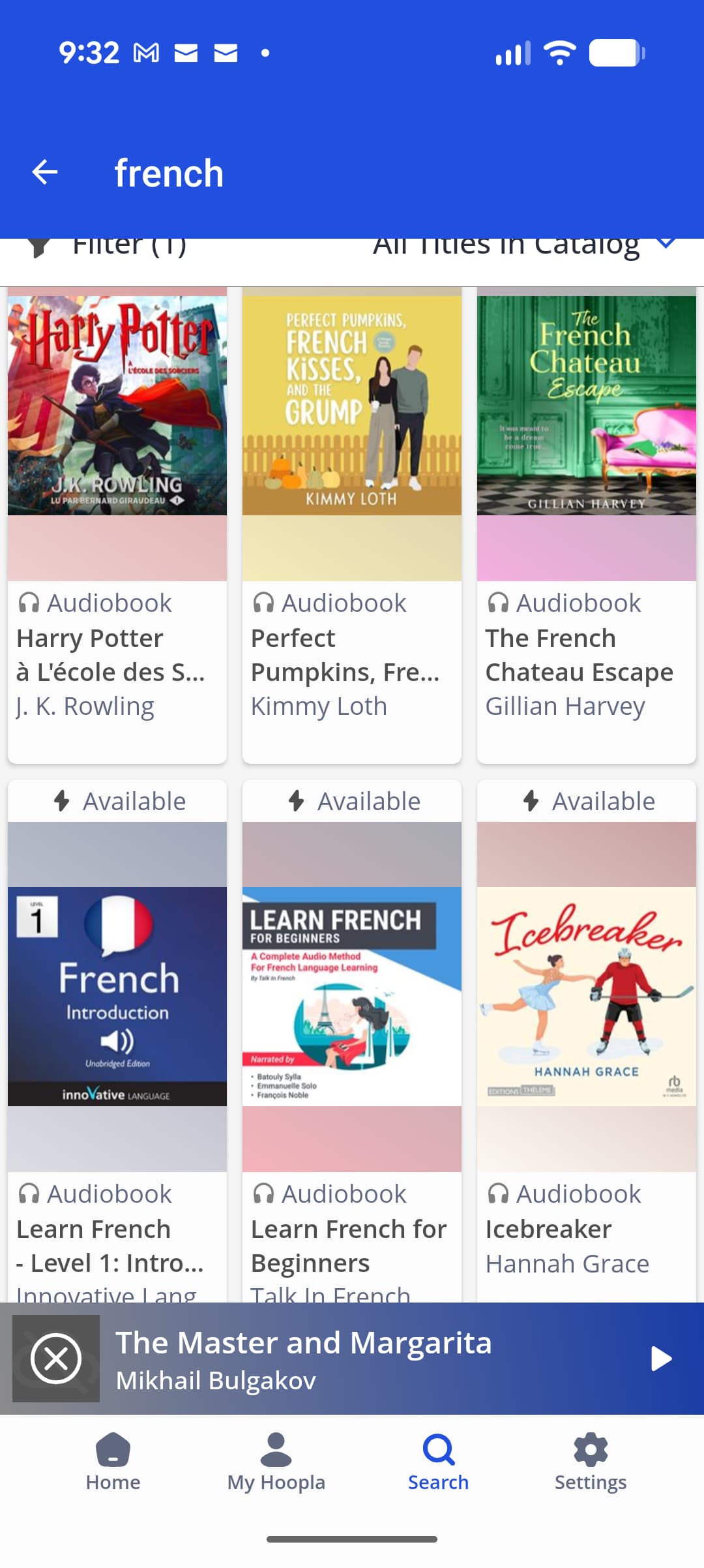
Hoopla is an app for audiobooks and ebooks. However, it is only available through a library card. Since you are living in the US, it should not be a problem making the library card. I live in Dallas, having a permanent resident card, as a foreigner, cost me zero money to make one.
There are like 167 French audiobooks available to choose from upon availability if not borrowed by other users. Here is a screenshot
There is another app, LIBBY, which can also be accessed via the library card. There I found a bunch of German audiobooks. However, while in Germany, I used Storytel to listen to them. The collection of German audiobooks was extensive. Also, audiobooks could be downloaded for offline listening via the Storytel app on your phone. This feature, if my memory serves me right, is not available on website.
@asad100101 - Unfortunately, Hoopla and Libby are both subscription-based, and not all US public libraries pay to make them available to their patrons. The Dallas library system may have more funds available than smaller ones. If your local library does subscribe to either (or both) of them, they can indeed be very useful resources.
@buxey1 - There are public domain recordings and texts available that you can download for free, that don’t have DRM. I use LibriVox for audio recordings, and many of the readers there are quite good and less monotonous-sounding than TTS bots. Many countries have websites with their own similar, free audio recordings in their own languages that can be quite useful. I found them by Googling “free audiobooks” in whatever language I’m interested in.
I enjoy reading and listening to books, short stories, and poetry from the 18th, 19th, and early 20th centuries, so those free sources are great for me. If you insist on something more modern, then the others here have already given you some great suggestions.
I use Audible and use libation to download my purchases for import into lingQ. There is only a few books that I am going to use native audio since they take a bit of time to sync and sometime edit. Hopefully once I am done with those books I am far enough that I don’t need to worry about using native audio.
I also use AI voice for books that don’t have audio, I think so long as the pronunciation is clear it should be fine.
Sometime books like graded readers have their audio freely available online on the official site. You can just download the audio, transcribe and read. https://lff.hachettefle.fr/