What level of Russian have I achieved?

A recent post that mentioned achieving a C1 level in Russian got me thinking. I put myself at B1 level at the moment. A few days ago I found this video that claims to test my Russian level. if I believed the results, I’d say I’m borderline C2. Haha. Very funny. I’m not buying it.

My test is when Russian friends are around and I try to eves drop on their conversation. I’m not C1, I’m quite sure.

I found the question and the discussion quite stimulating and would love to hear more thoughts on the subject. I’m tagging a few users from the other post to see if they are interested in sharing their thoughts in more detail. Hopefully other readers will as well.

@yasmin3awzatng7 @Obsttorte @Josu88

3 Likes

I personally understand why some people like to “rate” their language level. It gives a sense of achievement, like a trophy. But I also believe that it goes without saying that these categories always fall short in accurately describing what someone is capable of in a language.

I have started learning russian a year ago. I memorized a list of the 1000 most frequent words using anki, I read a lot on LingQ, will reach something like 2500 known lingqs soon, I am now able to read easy a1 texts, if they use the vocab that I know and I can follow very simple beginner podcasts if the topic and most words are familiar…

Does that mean I “know” or “speak” russian? No absolutely not. Have I reached a1? Or a2? Could I swindle an exam to reach B1? That would probably be difficult but possible.

I once had a friend from hungary who wanted to study in Germany (my home country) and in order to be accepted he had to have C1 german. He memorized everything that was relevant for the test. All the phrases, all the typical questions and he was able to get the certificat.

Was he able to hold a simple conversation in german when he got here? No, not at all. He struggeled for another 2-3 years before he was able to “be comfortable” in german, which I think is very typical for most learners. Keep in mind that he was living in the country all that time.

I want to “claim” that I have reached A2 russian. But whenever a russian person is around to speak with me, I know a few phrases and then I can’t respond to simple questions. So in that regard I haven’t even reached A1.

Why would I care about a number? It is a very slow and gradual process. A year ago I didn’t even know the alphabet or simple words. Now I can read and listen to quite a lot of content.

Next year I might be able to have very basic conversations. And I will probably be able to listen to more advanced podcasts for learners.

Then a year after that who knows? Maybe then I might be a little more comfortable in talking about certain topics. Will that then be B1?

For me it is more of an interesting phenomenon how much you can achieve by only reading 5-10 minutes per day consistently. But I personally don’t need a label to mark down my progress.

Curious what other people think about this.

6 Likes

I once had a friend from Hungary …

Я согласен сто процентов. Идеальный пример.

I find the descriptions of the levels is helpful with self assessing:

Assessment grid - English

Of course these descriptions doesn’t mean you can pass the test, and as you point out, passing the test doesn’t really mean you can do even what is described in the self assessment because you can study to beat the test. Also you can be at vastly different levels depending on the discipline (listening, reading, speaking, writing).

I also think most people exaggerate their level if self assessing. Not on purpose, but I think they don’t really know what’s required.

2 Likes

I don’t really rate myself in an absolute scale. I assume that I am C1 in English, but I learn and use the language for 30 years now, the last half of that on an almost daily base. So it isn’t really an achievement but more a result of a lot of time that has passed. :slight_smile: My everyday vocab and my ability to understand different dialects is somewhat limited, though, as I use the language mainly in its written form (for example in forums as these) and for information acquisition (reading manuals or scientific papers for example). If you put me into a kitchen, I most likely won’t be able to name 2 out of 3 objects there.

In Korean, which I am mainly learning for the last 2 and a half year or so, I would probably be B1. That beeing said, I am on that level for quiet some time now. (Intermediate plateau and stuff). I started Japanese about 4 months ago and use A2~B1 material there, too, despite surely not beeing on that level. But the language is similar to Korean, making it easier, and beginner content is boring as hell.

So the levels don’t really mean that much, especially as they let it appear as if language learning is something linear in the sense that beeing B2 always means beeing better then B1. Not to mention that they devide a year long process into 6 steps, as if you go to bed one night at one level waking up on the next one the other day. That’s obviously not the intention, but could be the perception especially for those who lack experience.

What could be misleading, too, is that beneath those levels people also talk about beeing fluent in a language, having native-like niveau or sound like a native. These are different things, though. So beeing fluent - a somewhat vague term to begin with - doesn’t mean you have a native-like niveau, having a native-like niveau doesn’t mean you are C1 or C2 (a lot of native speakers aren’t), and beeing C1 doesn’t mean you sound like a native. (A strange goal, imho. Why sound like a native if you aren’t?)

I like to compare myself to my past self, though. So for example making vocabulary estimating tests and see how the numbers changed compared to one quarter ago, or reading stuff at a level I have used previously, like a podcast. Or I try harder material that I struggled with in the past and see how much pain they cause me this time around. :stuck_out_tongue_winking_eye: It’s mainly for motivation or to see where I have improved and where not, so I can adjust my learning methods if required.

1 Like

Thanks for the link! I’m also a borderline C2 for listening comprehension.

The levels in the video seem to correspond roughly to the levels for Russian in the Lingq library.

With something so short, you don’t really have an overall assessment of your skill level, your strengths and gaps in your knowledge. But I suppose it could be useful for getting started out at an appropriate level, either for self-study or with a tutor.

1 Like

I like the approach of this friend of yours, he defined a clear goal and laser focused on it. fluency came later but at least he was able to start his studies in Germany. If he had waited around for “fluency” or “accent” he would have lost 3-4+ years before he could start his study.

3 Likes

Just had a sample session with a new Russian tutor. After five minutes she put me somewhere between A1 and B1. Ouch. However, I’ll be interested in her assessment after more time.

2 Likes

Not to worry on your session with the tutor! :wink:
I’m in about the same place as you for Russian. I’d guess I’d be a low A2 for speaking, with shaky grammar. It takes a while for the speaking to catch up to the passive comprehension if you start by reading and listening.

Also, you have to decide what’s most important to you, In Russian, I figure I’ll listen and read, and not worry about speaking until the opportunity comes along. In Spanish, I can chatter away just fine in everyday life, but since I haven’t invested the time in reading books, it’s tough to read literature past the 8th grade level.

Both Russian and Spanish have a lot of cognates with English for factual and modern academic topics. It’s the expressive, literary, and spoken language that is very different.

2 Likes

For sure, and after four years speaking has become a priority. Even so I find again and again that all the time spent listening is essential and must continue.

Still the tutor had a point: I am using simple language constructs. That’s a necessity at first: find a way to say what you need to say as correctly as practical.

1 Like

Second session went more fluently today. I have no illusions. I still have a lot of trouble with native speakers. In the context of a session with a tutor it’s much easier.

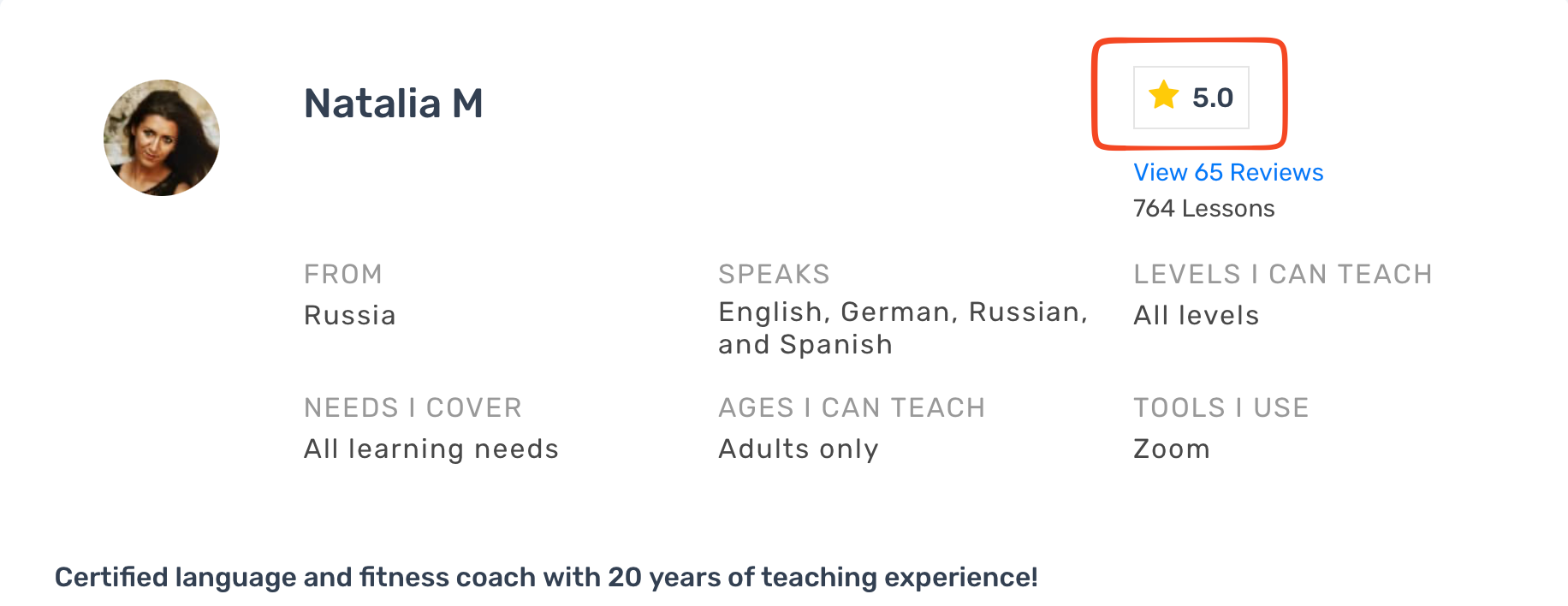
For any of you Russian language students looking for a great tutor, her’s a 5 star rated one I’ve had two lessons with now and she is top notch! Definitely 5 stars. More lessons are upcoming for me with Natalia.

In my opinion, it’s hard to rate your Russian without a Russian professional because for real Russian is a hard language (in my opinion it’s hard more than Chinese). So before I thought like you that I’m going to be C1 but when I do the approved testing I just found that I’m A2 and my grammer is so worth than a child grammer and oh this moment I feel that I spend 4 years for nothing and I have to start from the scratch to find what is wrong with this language. But don’t give up I know that Russian is so hard, but I think you should focus on the grammer because even you know more than 10k words the word is still changed to another word because of the grammer, so know I tried to write and speak it daily and I won’t study it with a ordinary way because I have waste a lot of time on it and really it’s makes me sad so I think in this way you should try another way or the way you feel it’s makes you feel comfortable. And also where did you find Russian friends? really I can’t find Russians to talk with (I tried all of the applications that I can find a russians in there but also I didn’t find there).

1 Like

The role of professional teachers is underrated in the deluge of amateurs teaching languages on Youtube and other platforms. I am so thankful that I found out about a Russian language intensive summer program at the University of Virginia taught “old-school.” There I received a very good education in Russian Grammar. There are logical explications for many of the rules - especially how the spelling rules inform the grammar. After that program, I’ve been able to make progress studying independently.

My wife is Russian and virtually all her close friends are native Russian speakers she has known for years, mostly from her academic work.

If you want to make new friends, give HelloTalk a try. I also have had some success with other language exchange sites.

1 Like

Coincidentally I was listening to this video this morning, and saw some interesting advice regarding professional guidance, and the lack thereof …

«Метод решает все» - the method resolves everything

«Иджлал настаивает, что новички, занимающиеся самостоятельно, должны «компенсировать отсутствие профессионального руководства».

Ijlal insists that beginners who are learning independently must “compensate for the lack of professional guidance.”

1 Like