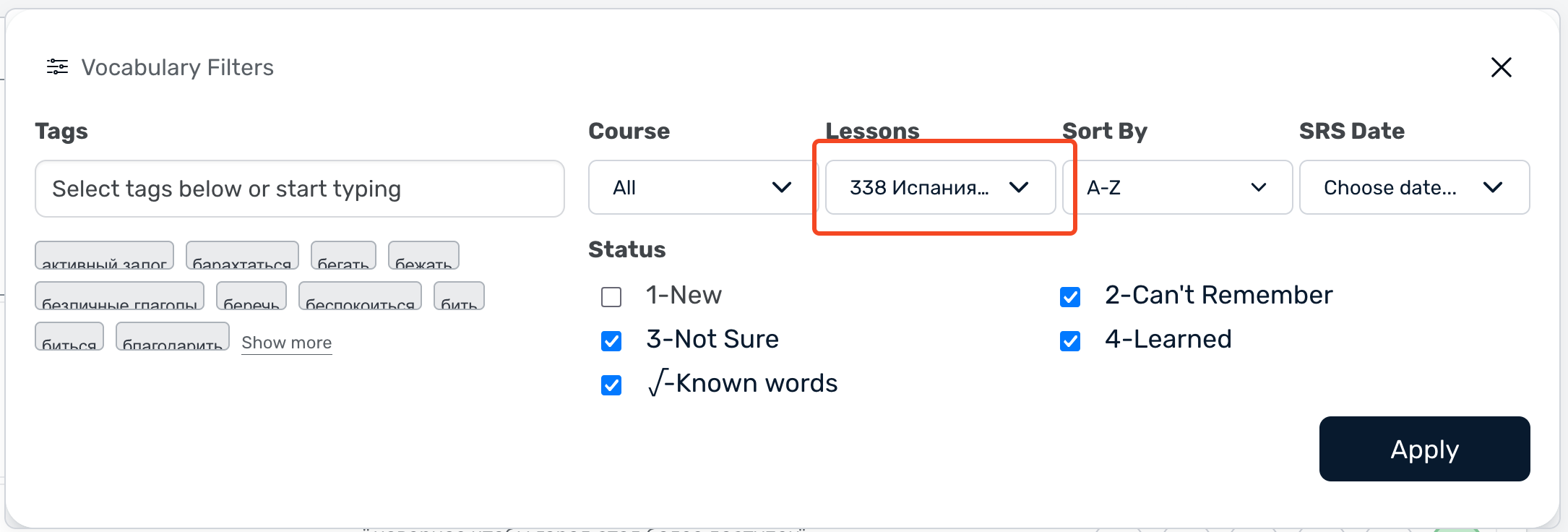
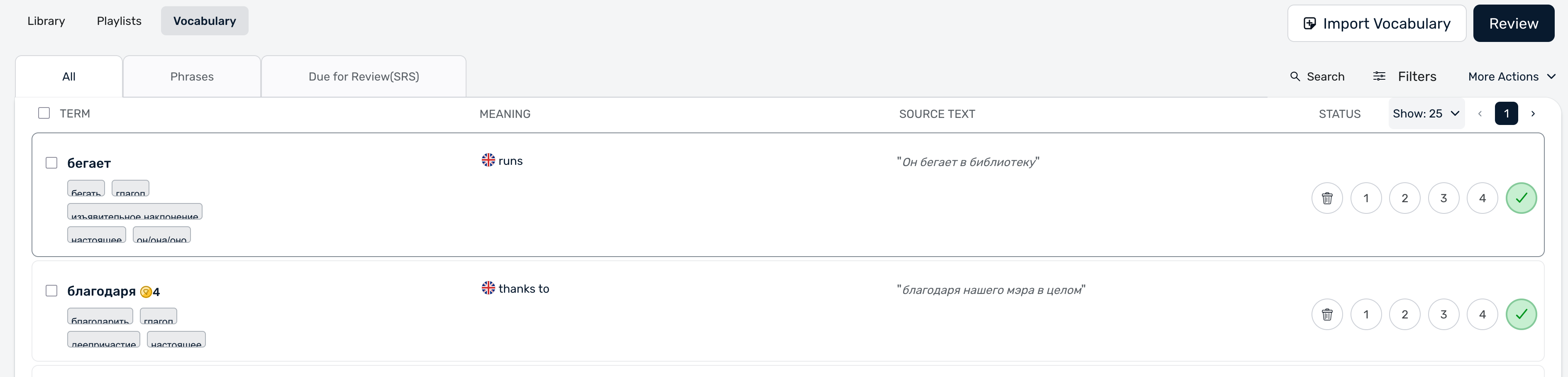
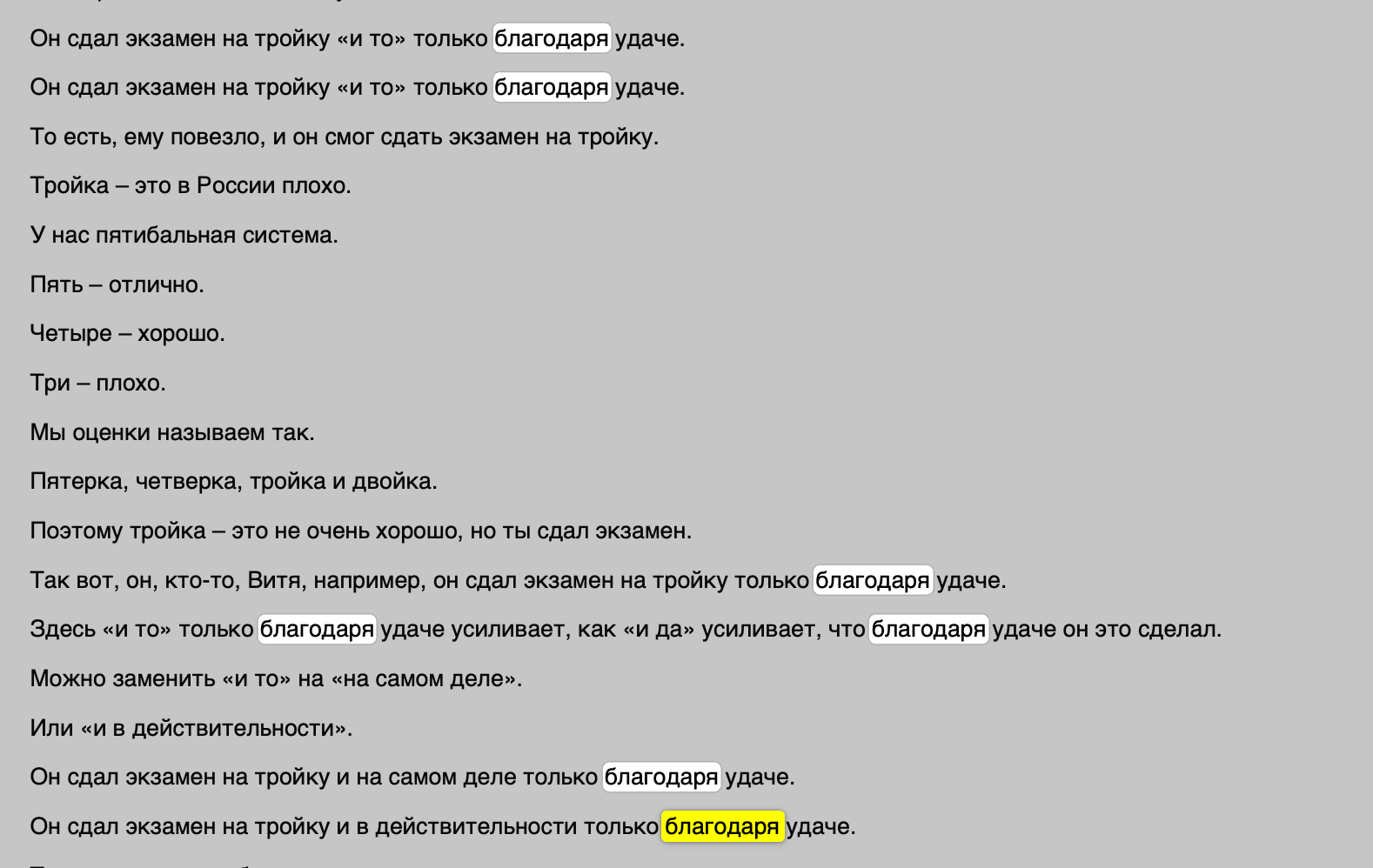
One thing that has for a very long time prevented my use of the vocabulary lists in Lingq is that the context of the word does not seem to come from the lesson or course I am filtering for. Here I am filtering on one uniquely named lesson: “338 Испания чат.” Below I show the filters I have selected and the first two words in the resulting list. In the case of the second word “благодаря”, the source text example shown is “благодаря нашего мэра в целом,” but that phrase is nowhere to be found in the lesson. I show below what is in the lesson which is seven instances of “благодаря удаче” which is what I want to see.
I don’t expect to see every instance of that word, but I do expect to see a usage of the word from the lesson I’m filtering on. My questions are:
How to make that happen?
Am I doing something wrong?
Is this a “feature” of Lingq, and if so, what purpose does it serve?
Final thoughts: the meaning of a word is often determined by the context. Some words are unambiguous regardless of context, but I believe that’s rare. I’ve been using Lingq for 2 1/2 years. I don’t want context coming from lessons I studied many years ago. I want context from the lesson I’m filtering by.
I can’t open thread so I’m posting here. I mostly read but sometimes try the vocabulary section. It doesn’t find my current course (Off-campus 1 - E Sumphonia). That’s the most valuable one. What’s wrong?
When I review vocabulary in a lesson, I find it helpful to see vocabulary from an earlier story that I’ve read, as it refreshes my memory, and provides an alternate context for the word.
For example, I made many vocabulary links from stories like “The Wizard of Oz”, “Cinderella”, and “Goldilocks”, which one practically knows by heart from childhood. When these vocabulary words come up in my reading now, the phrases from the children’s stories make the words easy to recognize.
However, if I were filtering to make a vocabulary deck from a single story, I agree with Vernmartin that I would want the examples to match the current story, not earlier stories I’d read.
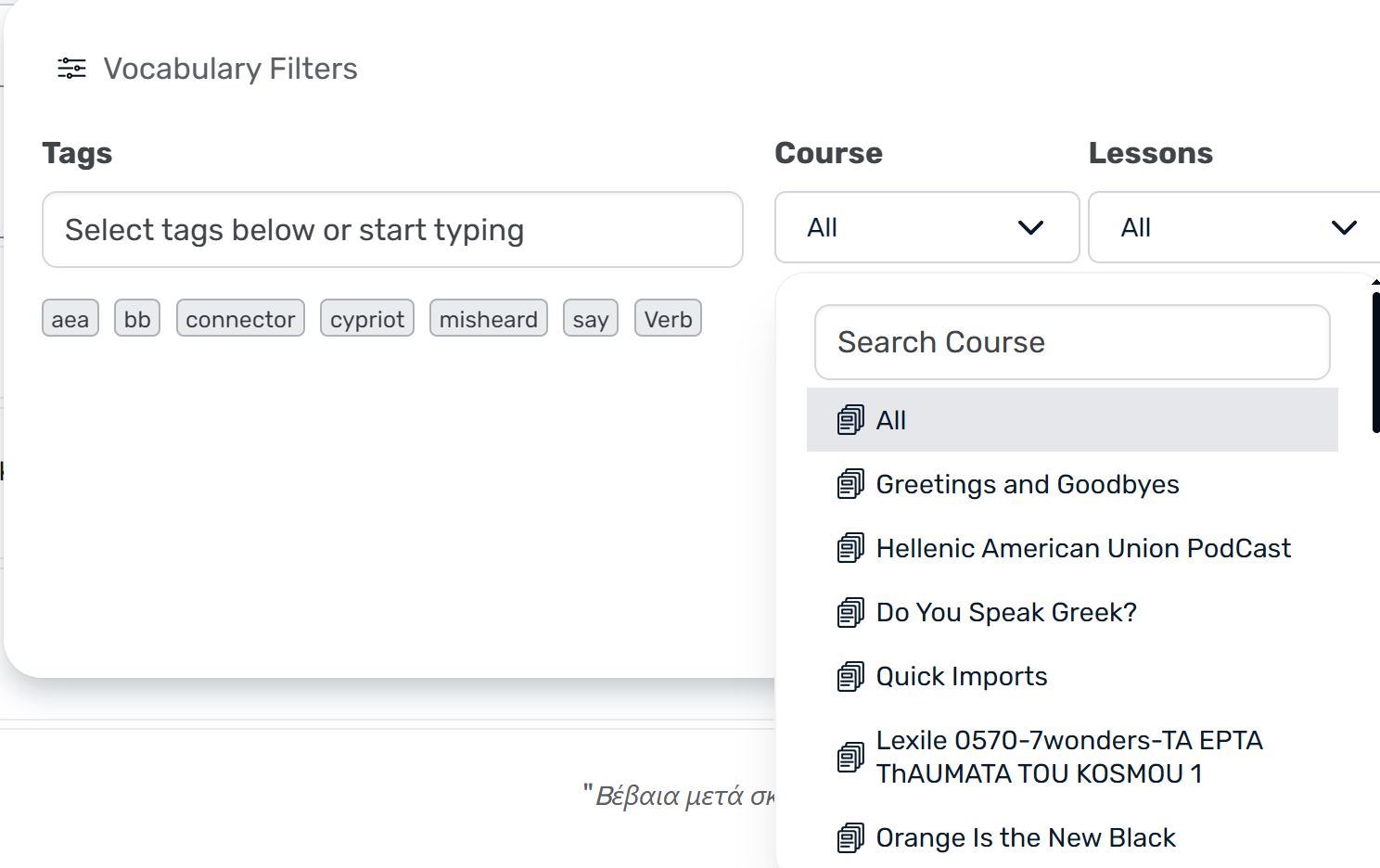
I find the filtering option in the vocabulary tab cumbersome and difficult to use.
Would it be possible to add a button to each lesson that says “Export vocabulary from this lesson”?
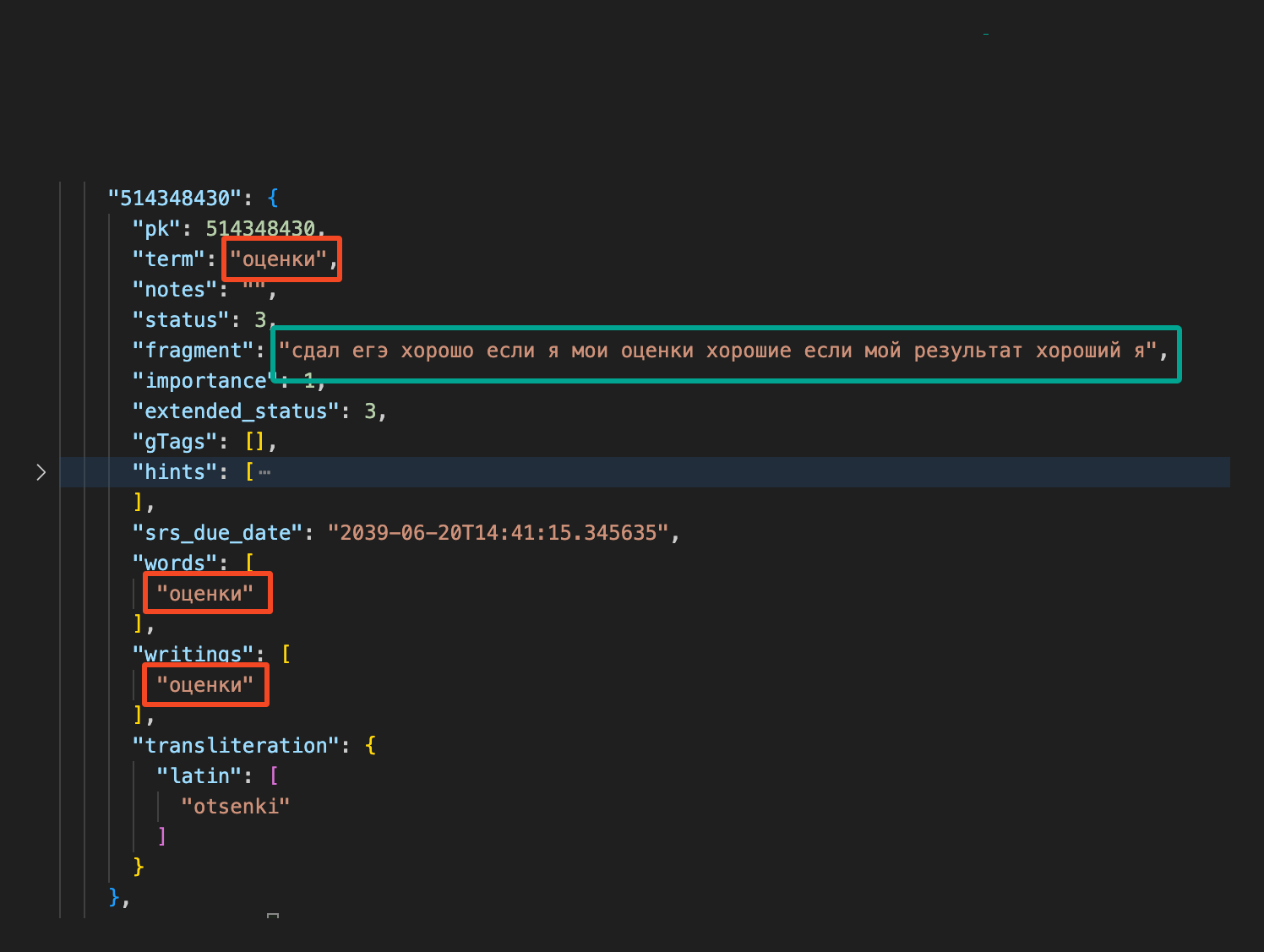
My question still stands: where are the examples coming from? I am analyzing the data that Lingq holds for my lesson. For example, I see the word “оценки” and I see that Lingq has a “fragment” for that word which is: “сдал егэ хорошо если я мои оценки хорошие если мой результат хороший я.” That phrase did not come from the lesson. Where does Lingq get that from?
Good luck, I really want to study very specific songs ive uploaded. Also is there anyway when it post a random sentence, it could have the exact line from the audio/video it comes from?
Guess Lingq can’t do it, but thanks to @roosterburton and his Lingq extensions and some programming on my part, I can create flashcards showing the words I have linked and the sentences those words appear in. That’s useful and gives the proper and correct context of the word from the lesson.
That Russian “sentence” looks so broken that I asked someone Russian, and they hazarded a guess that it is a transcription of someone speaking, where they are kind of changing their mind what they are saying.
Yes. It’s bad and I guess I should have grabbed some other example from the lesson. The problem is that when Lingq filters vocabulary as shown above and shows “SOURCE TEXT,” it appears to be coming from a property in a lesson words object called “fragment.” (screenshot below)
But that’s not terribly important to me. What’s important for me is:
The data for the lesson contains all words and sentences for that lesson.
Any one of those lessons could be pulled for a word in that lesson as an example usage for that word.
It is much more useful for me to see example phrases from the lesson for a word found in lesson that I have lingqed.
I wrote a bit of programming for personal use that will pull all sentences for such wordsfrom the lesson itself and generate flashcards, and now I have something that is truly useful to study.