It was only a short post, not a long explanation.
I’ve tried to find out how he derived his theory, and it seems as if he plucked it out of thin air. It is described in various text books including in Approaches and Methods in Language Teaching by Richards and Rodgers. There appears to be no evidence based support for it.
It’s also often marketed in a deceptive manner, comparing a supposedly traditional way of learning a language based on rote learning grammar and vocabulary with the new, modern, science based approach. In truth that is marketing.
In practice, as you can see if you read the book mentioned earlier for example, there are many theories that address Second Language Acquisition. His theory seems to have attracted some supporters, but I’ve heard several contemporary linguists describe it as discredited. It is still very popular in amateur circles, presumably because its simplicity is highly appealing. but also because it is useful for marketing input based language learning products.
Linguists believe that most language learning takes place subconsciously without our being aware of it. That’s not in question.
Actually he does. See later.
Since you took exception with my post for its brevity, I’ll go through his theory. I’m using the book mentioned earlier as the source of his theory, not his original paper(s). Copyright law allows us to use small samples from a book, for example for review purposes, so I will insert some photographs to avoid having to type it out. The book is excellent and I highly recommend acquiring a copy. It is a university textbook, written in an approachable style, and extremely informative. I’m sure there are other text books that cover some of the same material. The more recent edition is preferred, the differences are substantial.
Krashen’s theory consists of five hypotheses:
The Acquisition Learning Hypothesis
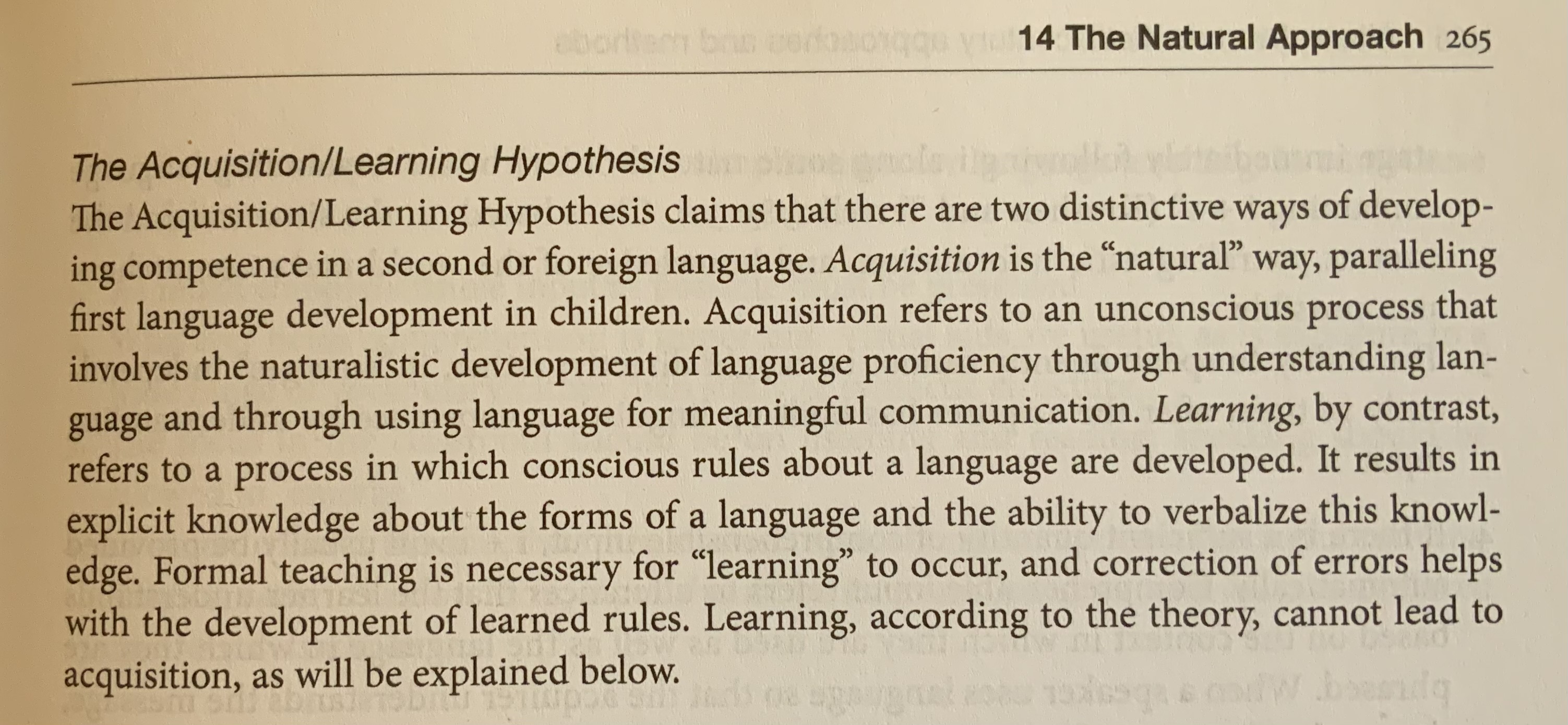
There are two issues here with the above.
The first is that he provides no way to determine whether a piece of knowledge such as a vocabulary item was learned or acquired. That makes it untestable and hence not part of a scientific theory.
Secondly he states that we cannot gain vocabulary through learning such as classroom study. That is patently false. We learn new vocabulary all the while, even as adults. When we attend a course of management say, we learn new words, new phrases and sometimes even new grammar. We do this in a classroom environment. I taught myself the names of many birds in French by explicit study i.e. consciously, and I can effortlessly recall them. They have become subconscious knowledge, they are automatised.
The Monitor Hypothesis
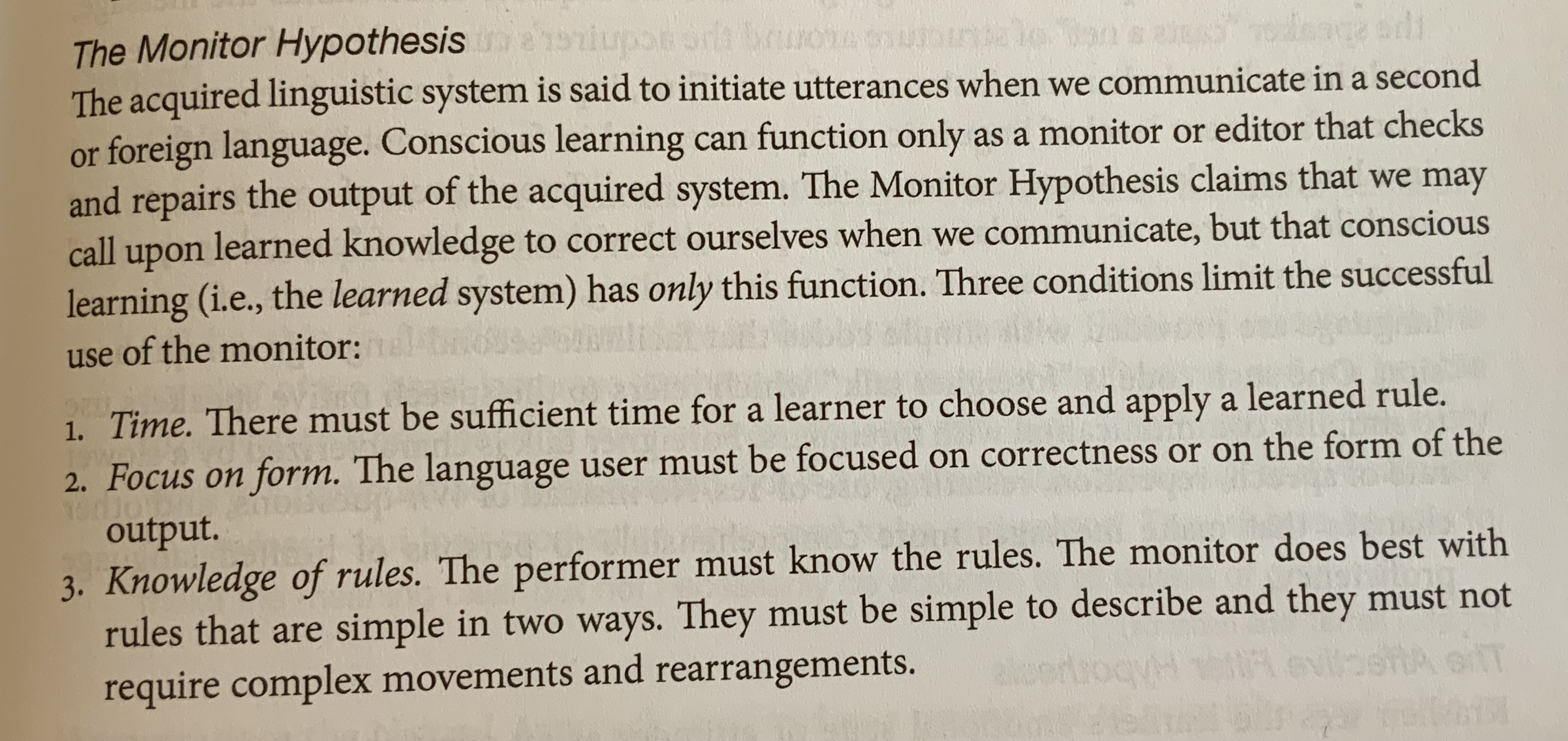
I’m not going to dwell on the above as it ties in with the first hypothesis, and the criticisms thereof.
The Natural Order Hyphothesis
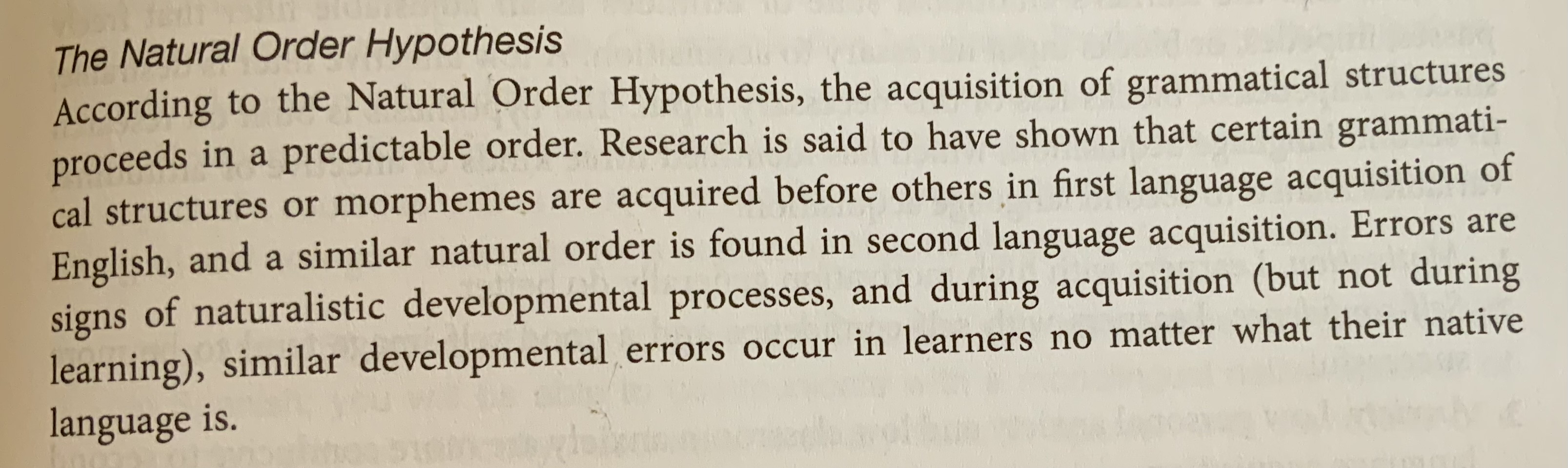
The above was based on very little evidence, just some rather scant research on some morphemes. He generalised that research to the entire learning process which is at best highly questionable.
The Input Hypothesis
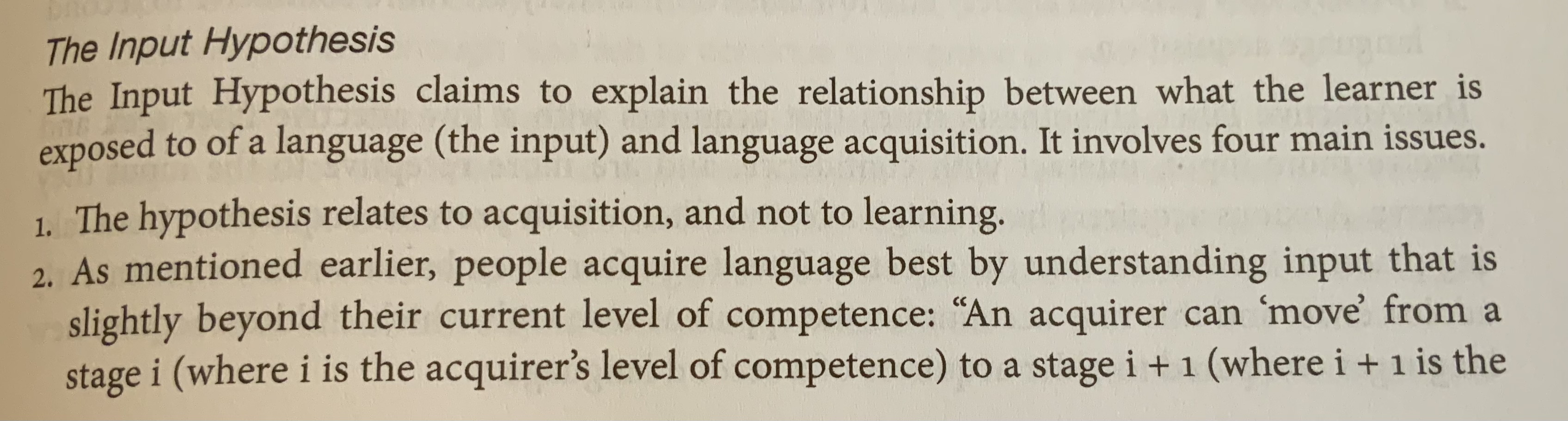

The above is the basis for what people term Comprehensible Input. He often summarises the above by saying that we learn by understanding messages i.e. input. In fact this is not true. I don’t have references unfortunately, but research has shown that for adults input alone is insufficient. Research has also shown that adults do not learn the same way as children. The latter are far more able to learn from context for example. One small criticism is that he does not define what N+1 means.
The above hyphothesis is highly simplistic.
A child learning a language is not subject to input in the form of a book, an audio recording or a video. They have interactions, they have environmental clues, they have language partners such as a parent, or a school teacher. They engage in dialogues, they produce output, as well as receive input. If a child says something to someone, and it does not generate the expected response, because the grammar is wrong for example, the child will start to wonder why. Thus saying “Giving me the pen” might elicit a look of puzzlement when the child should have said “Give me the pen”. And so on and so forth,
Research has shown that children’s brains work differently to an adults. The semantic and procedural memory systems mature at a different rate for example, with children tending to learn via procedural memory, whereas adults tend to use semantic memory.
If someone is familiar with the research associated with childhood language learning and can fill in the details, please do so.
Contrary to Krashen’s claims, we can understand a message without understanding how that message is encoded. For example, if you say something to me, I probably don’t need to understand why you conjugate the verbs as you do, I can still understand what you mean. We can understand without noticing aspects of grammar. Language has a lot of redundancy. When we output language, we are forced to address those ‘superfluous’ elements. Thus output plays a role in noticing, for example.
The Effective Filter Hypothesis
You can read about this one for yourself. It is in many respects a statement of the obvious e.g. motivated students tend to do better. It does though omit important aspects of learning. For example heightened emotional responses, caused by surprise, or an unexpected noise, make learning more effective. If we are gripped by a story told by a parent, we are more likely to learn as we are more engaged.
In summary, Krashen’s theory is largely nonsense, and because it contains falsehoods, it is harmful nonsense because it is misleading.
People tend to create a Krashen For Dummies version of it, which goes something like this:
In order to learn a foreign language, we need lots of input. That input should be graded, so that it is just a little above our level i.e. only some of the words and grammar are new, most is stuff we’ve already come across. Traditional style learning consists of sitting in a class, rote lesrning words and grammar and getting bored stiff. Traditional learning does not work. The Krashen method is based in science, it is modern and fun.
Yes we do need graded input, but Krashen’s theory is nonsense. Research has shown that deliberate study is beneficial, study of grammar can be beneficial, using SRS tools such as Anki can be beneficial. We have lots of tools at our disposal which we should use.