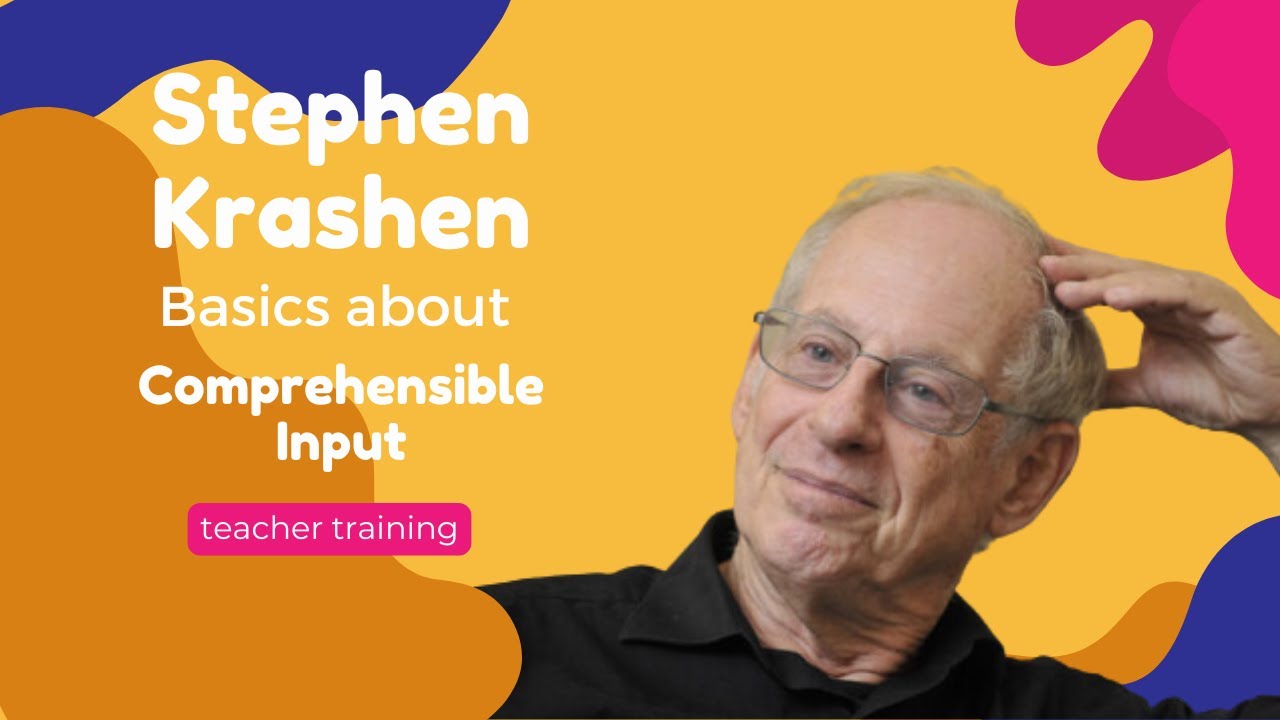
yup CI is essentially a small part of Practice method I described.
I prefer the term Practice which covers much more than CI. Practice covers everything from input, output, grammar, learning pronunciation, even writing of the script/alphabets/characters or anything you want to get good at in the TL.
After some learning/instruction, the Practice method is so incredibly powerful that you can even use it to get good at driving cars, swimming, almost anything really.
According to his friend Professor Paul Nation it would seem that Krashen has moved beyond his strident and seemingly simplistic early views about “acquisition versus learning”. Krashen was probably crusading then because he wanted to get learners (and teachers) away from the “grammar-heavy-front-loading traditional approach” which turned off so many learners. As many of us have found, the standard of school language teaching has often been wholly disastrous, and it was guaranteed to kill any joy in getting to know another language or culture. Krashen was a crusader against that mindlessness.
See generally on a more nuanced approach to scientific language learning your own video with Paul Nation…
Personally I am no fanatic supporter of Stephen Krashen or his theories. But I was mildly objecting to the erroneous statement by Leif Goodwin that Krashen “coined” the term “comprehensible input” (he frequently states he did not!!) and I certainly thought it unfair for Leif Goodwin, even allowing for his occasional acerbic tone, to describe Krashen’s theories as “a con job”, “hokum” and “nonsense”…
One would hope that Krashen, Nation and all of us struggling language learners are simply “seekers after truth”, and that truth here is not an immutable concept but refined with further scientific research.
Krashen in his 500 or so academic publications over a lengthy career covers a lot of ground but I for one fully appreciate the usefulness of some of his ideas and particularly the method of “free voluntary reading” for second-language acquisition. Personally I would not be interested in following Krashen’s tastes in material such as science fiction, comic books and Batman… But then each to his own? And there are no doubt many methods of climbing towards the top of the language mountain?
I may be opening a can of worms here, but am I the only one left entirely cold by the claim that some idea is unfalsifiable…?
I understand the need for falsifiability as a matter of practical necessity in designing scientific experiments. But I remain unconvinced that such a practical requirement should have any impact on my thinking outside the laboratory.
Yes! I also tend to think of Krashen as an evangelist who pushed back against the grammar-heavy establishment, even if his Monitor Model lacks the nuance later added by folks like Paul Nation.
I do feel for the learners with thousands of hours of input but little ability to use the language (as in the “cautionary tale” video I linked above), waiting for near perfect speech to “just emerge" based on a dogmatic take on the idea that “we learn language in only one way…”. To be fair Krashen did not say you couldn’t do any of the other activities, but Dr. Marvin Brown of ALG definitely took the idea to extremes, and promoted the view that activities like studying, speaking, or analyzing the language before the language is acquired can actively harm the learner’s future potential with the language. This idea appears to have gained some traction in the Japanese learning and Dreaming Spanish communities, at least online.
Just from my experience alone, i think just starting practicing speaking when you feel like you want to speak is the good rule of thumb to follow but i would be lying if i said i was not curious about the people who do say it is possible. If it IS possible then i think the sheer amount of hours you would need to put in is far beyond what the typical person would put in normally. Like who has actually spent 10k hours learning a language without outputting at all? My guess is almost nobody so how many people can truly say it doesn’t work? I don’t think i would have the patience for that but its an interesting thought lol Like i said tho im more on the side of just practice speaking when you just feel like you want to. Its just common sense i think.
thats it, im gonna interview a bunch of people to settle this once and for all lol I agree that maybe there is more to some of these stories but also i want to know are there just special people out there? I need to know!
I’ve tried to find out how he derived his theory, and it seems as if he plucked it out of thin air. It is described in various text books including in Approaches and Methods in Language Teaching by Richards and Rodgers. There appears to be no evidence based support for it.
It’s also often marketed in a deceptive manner, comparing a supposedly traditional way of learning a language based on rote learning grammar and vocabulary with the new, modern, science based approach. In truth that is marketing.
In practice, as you can see if you read the book mentioned earlier for example, there are many theories that address Second Language Acquisition. His theory seems to have attracted some supporters, but I’ve heard several contemporary linguists describe it as discredited. It is still very popular in amateur circles, presumably because its simplicity is highly appealing. but also because it is useful for marketing input based language learning products.
Linguists believe that most language learning takes place subconsciously without our being aware of it. That’s not in question.
Actually he does. See later.
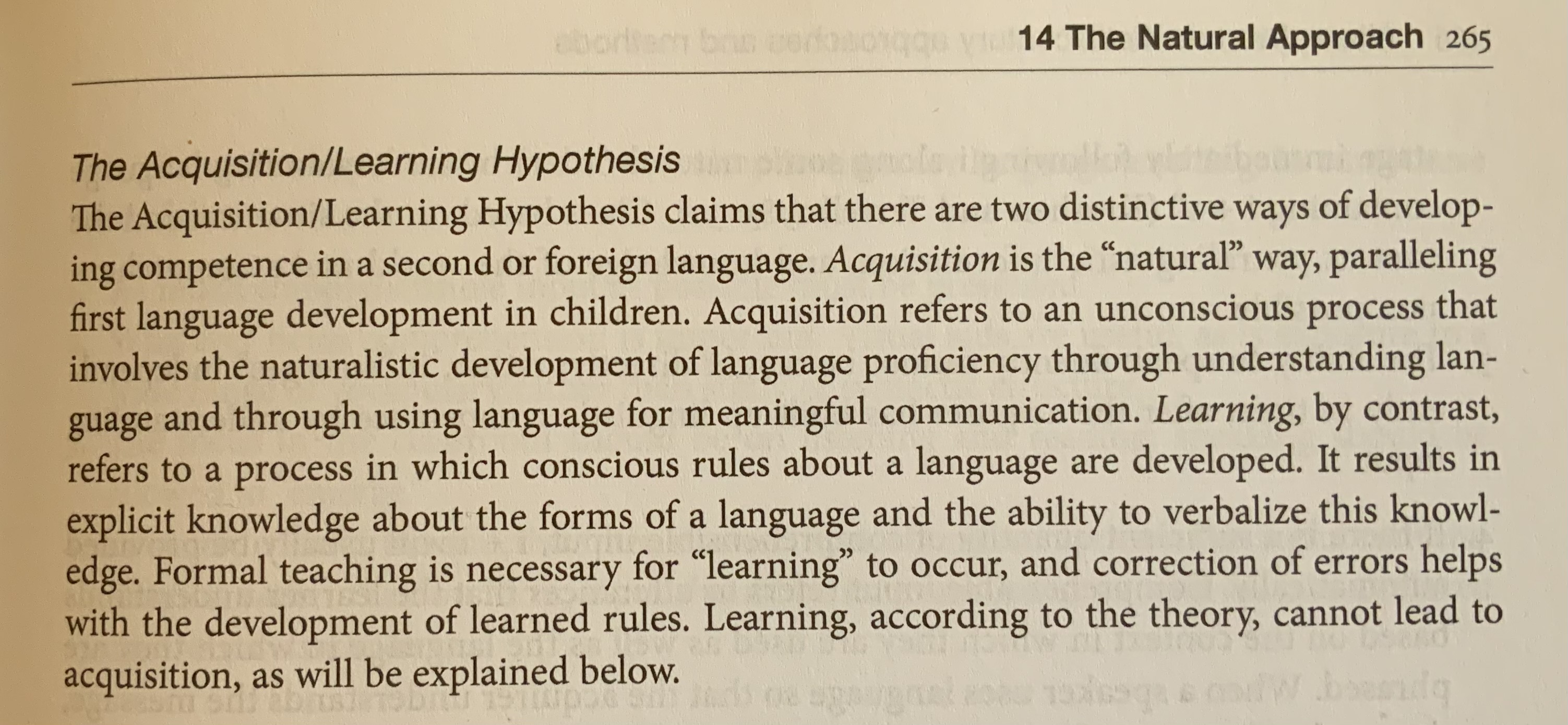
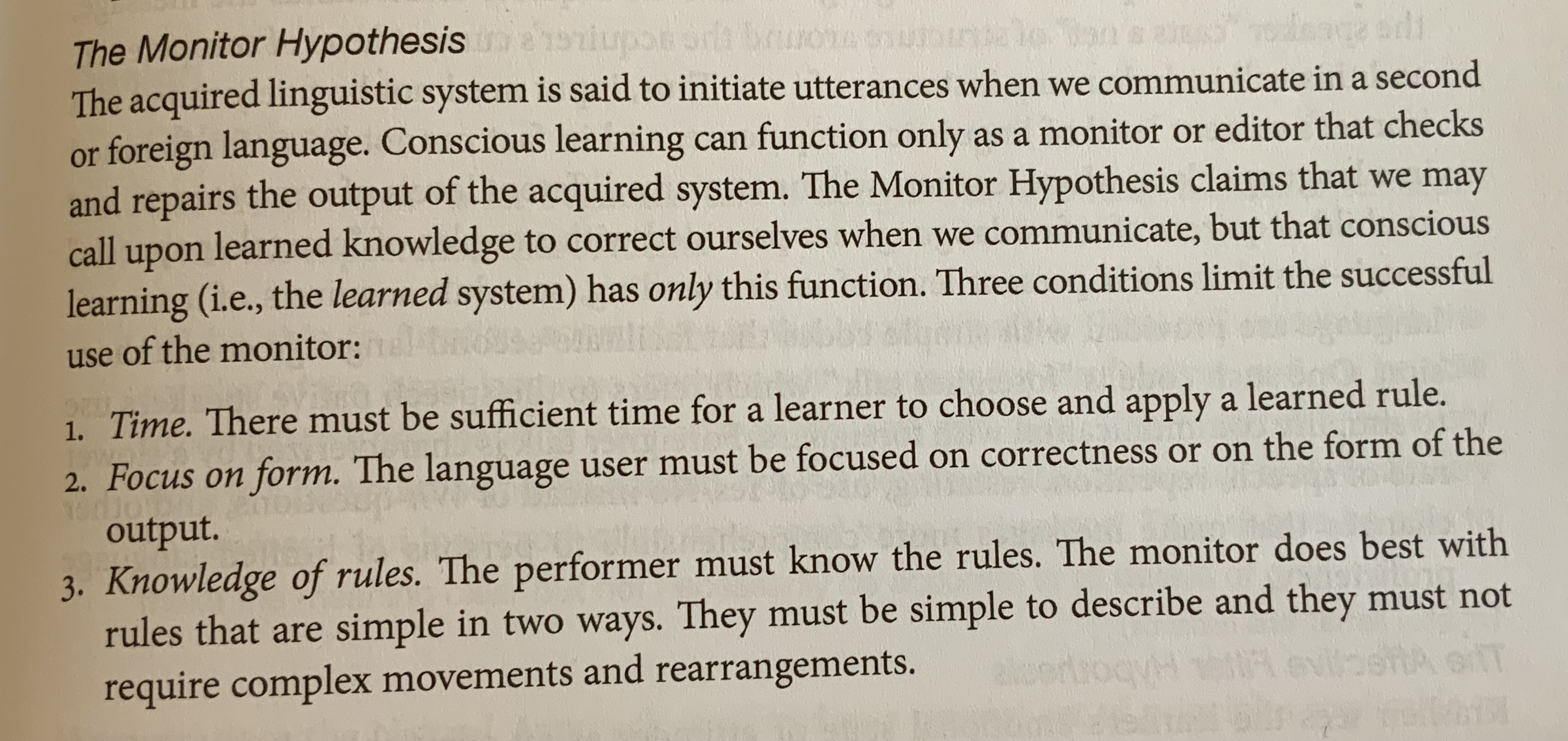
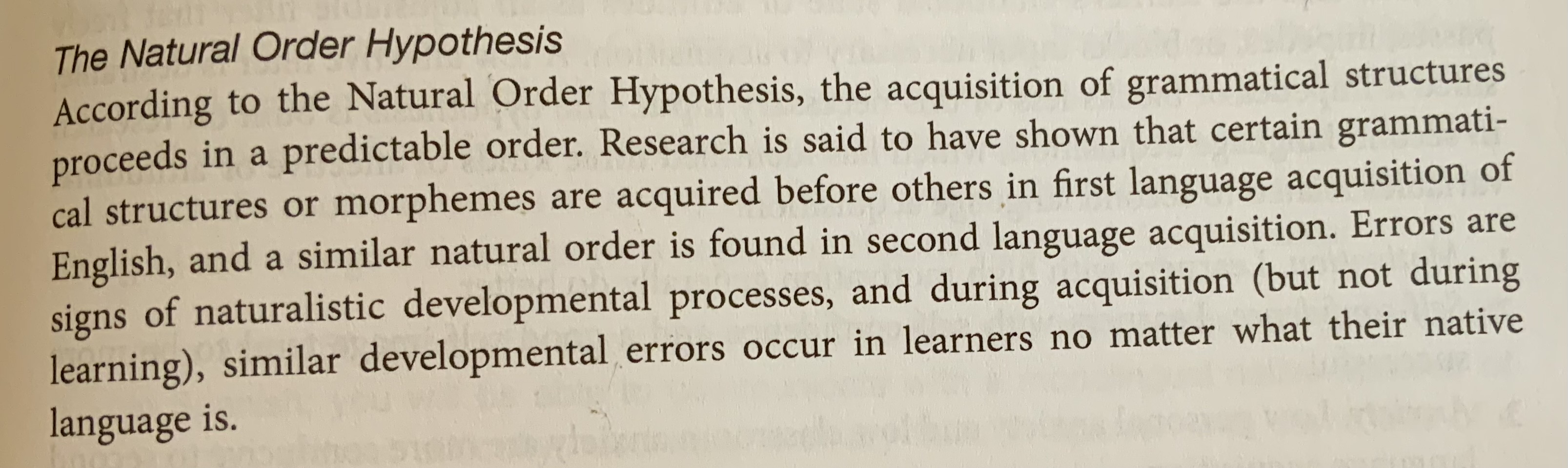
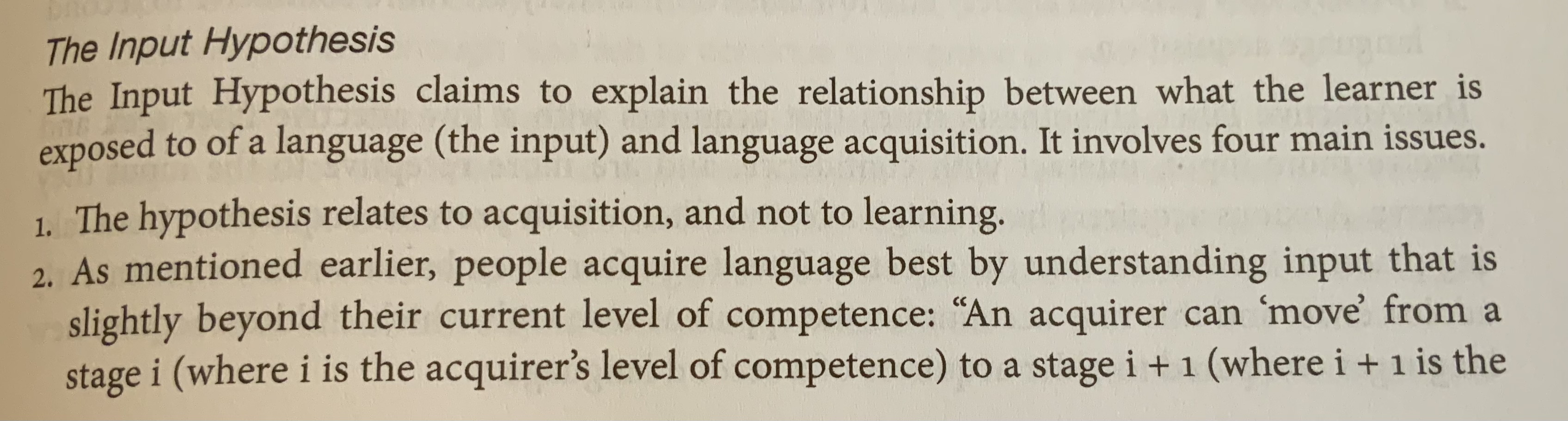
Since you took exception with my post for its brevity, I’ll go through his theory. I’m using the book mentioned earlier as the source of his theory, not his original paper(s). Copyright law allows us to use small samples from a book, for example for review purposes, so I will insert some photographs to avoid having to type it out. The book is excellent and I highly recommend acquiring a copy. It is a university textbook, written in an approachable style, and extremely informative. I’m sure there are other text books that cover some of the same material. The more recent edition is preferred, the differences are substantial.
The first is that he provides no way to determine whether a piece of knowledge such as a vocabulary item was learned or acquired. That makes it untestable and hence not part of a scientific theory.
Secondly he states that we cannot gain vocabulary through learning such as classroom study. That is patently false. We learn new vocabulary all the while, even as adults. When we attend a course of management say, we learn new words, new phrases and sometimes even new grammar. We do this in a classroom environment. I taught myself the names of many birds in French by explicit study i.e. consciously, and I can effortlessly recall them. They have become subconscious knowledge, they are automatised.
The above was based on very little evidence, just some rather scant research on some morphemes. He generalised that research to the entire learning process which is at best highly questionable.
The above is the basis for what people term Comprehensible Input. He often summarises the above by saying that we learn by understanding messages i.e. input. In fact this is not true. I don’t have references unfortunately, but research has shown that for adults input alone is insufficient. Research has also shown that adults do not learn the same way as children. The latter are far more able to learn from context for example. One small criticism is that he does not define what N+1 means.
The above hyphothesis is highly simplistic.
A child learning a language is not subject to input in the form of a book, an audio recording or a video. They have interactions, they have environmental clues, they have language partners such as a parent, or a school teacher. They engage in dialogues, they produce output, as well as receive input. If a child says something to someone, and it does not generate the expected response, because the grammar is wrong for example, the child will start to wonder why. Thus saying “Giving me the pen” might elicit a look of puzzlement when the child should have said “Give me the pen”. And so on and so forth,
Research has shown that children’s brains work differently to an adults. The semantic and procedural memory systems mature at a different rate for example, with children tending to learn via procedural memory, whereas adults tend to use semantic memory.
If someone is familiar with the research associated with childhood language learning and can fill in the details, please do so.
Contrary to Krashen’s claims, we can understand a message without understanding how that message is encoded. For example, if you say something to me, I probably don’t need to understand why you conjugate the verbs as you do, I can still understand what you mean. We can understand without noticing aspects of grammar. Language has a lot of redundancy. When we output language, we are forced to address those ‘superfluous’ elements. Thus output plays a role in noticing, for example.
The Effective Filter Hypothesis
You can read about this one for yourself. It is in many respects a statement of the obvious e.g. motivated students tend to do better. It does though omit important aspects of learning. For example heightened emotional responses, caused by surprise, or an unexpected noise, make learning more effective. If we are gripped by a story told by a parent, we are more likely to learn as we are more engaged.
In summary, Krashen’s theory is largely nonsense, and because it contains falsehoods, it is harmful nonsense because it is misleading.
People tend to create a Krashen For Dummies version of it, which goes something like this:
In order to learn a foreign language, we need lots of input. That input should be graded, so that it is just a little above our level i.e. only some of the words and grammar are new, most is stuff we’ve already come across. Traditional style learning consists of sitting in a class, rote lesrning words and grammar and getting bored stiff. Traditional learning does not work. The Krashen method is based in science, it is modern and fun.
Yes we do need graded input, but Krashen’s theory is nonsense. Research has shown that deliberate study is beneficial, study of grammar can be beneficial, using SRS tools such as Anki can be beneficial. We have lots of tools at our disposal which we should use.
I see that as part of the marketing deception, both by Krashen and by his supporters. In truth the establishment was not grammar heavy. That’s not to say that there weren’t people who did view grammar study as the be all and end all of SLA, but it wasn’t the norm by any means, at least not in the west. There are some famous British authors who went through military language training in the fifties and sixties, learning Russian for example, and the methods were probably not so different to those currently used by the American Foreign Service Institute. The American military also used various techniques for training staff with zero knowledge of a given L2.
Thanks for doing a lot of research on criticisms of Krashen, but he still seems to me to have plenty of sensible things to say.
And if you still seem to believe he “coined” the concept of comprehensible input then check out his 2025 video at
Professor Paul Nation points out a need for some “deliberate learning” (25% or so) and particularly of core vocabulary and grammar patterns, and that certainly chimes with me, but I have to say that in my experience Krashen also makes a good point when he says “you don’t learn a language, you just get used to it…”
Anyway, this predictably all stirred up the proverbial hornet’s nest!
[Off tomorrow morning on Eurostar from London to Rotterdam and then onward to Austria, so plenty of language immersion - but in the latter destination not always entirely “comprehensible” to me… All the best…]
Krashen’s original work goes back to the 1970s, long before social media. It is an intuitively appealing concept, its empirical validity has been challenged (e.g. Lydia White at McGill University). But I don’t follow these academic bunfights anymore.
Research has also shown that adults do not learn the same way as children.
That is true. babies also have coordination problem with their muscles and speech muscles. That is is also why they don’t walk right away or speak right from the beginning. They will start making sound, babbling, speaking as soon as their muscles get developed. Babies don’t follow any silent period theories.
I created a new theory called Mingle No. 5.
A little bit of grammar in my life
A little bit of vocab by my side
A little bit of reading is all I need
A little bit of subtitle is what I see
A little bit of listening in the sun
A little bit of writing all night long
A little bit of speaking, here I am
A little bit of immersion makes it mine (Ha)
This isn’t the first time this argument is hold and it seems to me that there is always the same basic misunderstanding between the Pro-Krashen and Anti-Krashen faction (please don’t take these labels too serious).
Whether some theory can hold up to scientific standards and is empirical validated or discarded repectively, or whether something contains some useful ideas that might prove beneficial to some is a completely different matter.
Of course there are some points made by Krashen one can incorporate into ones language learning. That a lot of exposure, for example in the form of input, is needed to learn a language, and that it might be beneficial if the materials choosen doesn’t overwhelm the student, thus beeing somewhat comprehensible, should be a no-brainer. That beeing said, Krashen wasn’t the first person to come up with this and he also made up this very wrong idea of “traditional” language learning methods, presumeable consisting of translation exercises and grammar drills, which simple isn’t true. And for those of you who say this has been the case for them:
Consider the possibility that you may simple had a bad teacher
Note the amount of time that may have passed since your time in school, and that humen tend more to keep the negative things in their memory. So you might remember especially the translation and grammar exercises, simple because you didn’t like them, and forgot about the rest. (I allready pointed out in past discussions that my L2 lessons in school where completely different, which presumably can be seen in my English skills and those of a lot of Germans[1])
Don’t forget that you are currently learning a language because you want to, and that you are now an adult. Back than you were a kid who had to learn the language, and you did so in a very irregular manner (only a few hours a week with interruptions due to holidays in between).
The major point for me is that when I start something new, I usually spend about a tenth of the time learning how to learn something, so the didactics. I do so both by checking what science has to say as well as what the average jack on the internet might have to say, and it appears to me others do so as well. The difference is, that if some random dude says something, most of us would think it might be worthwhile to try out, but might not work for everyone. If someone like Kaufman or Olly Richards says something, we might also take it with a grain of salt, considering that they are trying to sell us a product at the same time.
Stating something to be a “scientifical proven universally applicable model of language learning”, which in essence is what the Pro-Krashen faction and Krashen himself do, while at the same claiming that other approaches are less useful, can actually do a lot of harm. People will take this very seriously, as can always be seen in the discussions on the matter, and they may start to neglect the learning methods not tied to comprehensible input, possibly harming their learning progress in a way that may even lead to them to giving up.
So yes, you can follow Krashens theories when learning a language, but it would be good to put him into the random dude category he belongs to. This way what he has to say might benefit some, without harming anyone.
[1] I have often heard by native English speakers, mainly US citizens, how surprised they are on how well many Germans can speak English. And a lot of them living in Germany actually live here for years without really needing to learn German, because they can live their life here using English. (Of course this isn’t what one should aim for when living in a different country). From a german perspective, many other Europeans are even much better with the english language. In Germany all movies and series get dubbed, so you don’t need English in everyday life. That’s not the case in most other european countries. However, English is the world’s lingua franca, so it is extremely useful in career, science or when trying to find information in the internet or connecting with people from other countries.
In contrast, this isn’t the case for native English speakers. They don’t really need a second language for those purposes, and the wealth of the countries they are from isn’t so dependent on them speaking another language.
So maybe those presumeable bad traditional language learning methods are simple englishmen’s language learning methods.
Ullman developed DP Theory as a general model of language learning, the idea being that language learning evolved using parts of the brain that already existed. It’s not a model of childhood language learning per se.
The textbook Theories In Second Language Acquisition, An Introduction, edited by VanPatten and Williams includes a chapter on DP Theory, along with descriptions of other models of SLA.
I never claimed him to be one. I didn’t even mention him.
However, I am not quiet sure what the purpose of linking that video is. Nothing mentioned their stoods in contrast to what has been written in this post and he isn’t bringing up any points in favor for Krashen’s theory. He actually stresses that hypothesises, such as made by Krashen, are basically assumptions which need to be empirically verified, which he isn’t doing. He just explains the theory.
The criticism brought up has been very specific, both in this as in other threads discussing Krashen’s hypothesises. You are free to disagree, but maybe you should bring up counterarguments instead of asking rhethorical questions.
This is a side note to ObstTorte’s post. Jones did a PhD in linguistics, but he is not a professional linguist. His current work includes consulting on, and teaching, diversity and inclusion. He appears to have no professional experience in the field of SLA research, his interests including Black American English. That is not to knock him, merely to point out his experience.
Linguistics, unlike linguini, is a broad field and an expert in one area probably knows little about other areas. In contrast, if someone can cook a mean linguini dish, we can probably assume their penne is pretty good.
CI is about input (let’s say reading & listening) interesting/ compelling things at high volume where it’s highly comprehensible (people talk about 98%).
If you’re reading interesting stuff when you understand 98% of the words without translations, yes, I’d say it’s CI.
I prioritise interesting things, such as Harry Potter. If Lingq says I 20% words are new and I’m generous about marking words as known or put to Lingq, then my natural recognition of words may be way below 98%. But if I use sentence mode, I do understand in a supported sense.
So I choose that as a close enough and agood balance of interesting and comprehensible but the %s aren’t always great and CI research probably isn’t thinking about translation support.
Still, words go into my brain faster than other methods and eventually I have them available to me easily.