I’ve hit a point in my language learning journey where I really want to talk about the hidden mental strain of the process. It’s not even about the mechanics of the language itself, but rather how it makes you feel that heavy sensation where your brain just feels full, or like it suddenly refuses to hold onto new words.
Right now, I’m an A2 Spanish learner trying hard to break through to the next level, but I feel completely plateaued. Lately, my ‘one step at a time, one day at a time’ philosophy is really being tested. I’ve recently started exploring LingQ, which has been a great tool, but honestly, I’ve realized I need a complete reset. I’m tossing out most of my old routine and trying to refresh my entire approach partly to make the experience feel new again. I need a new approach to my learning,
I’d love to know if others experience this kind of cognitive burnout. How do you deal with the feeling that your brain has simply run out of space, and how do you push through a major plateau?
Learning a second language is probably the hardest thing I’ve done in my entire life. It’s all fun and games when you start and you can get a lot done in moments of mania but eventually you realise the scope of what is still in front of you.
I think burnout largely stems from a lack of routine and unachievable goals. Think about all the things in your life that you’ve started and then given up on for one reason or another.
Maybe you need to ask yourself what your goals are for Spanish and ask yourself if you can commit to the years of dedication required to achieve them.
The road to learning a second language as an adult is tedious and there is no finish line.
If you want to be as close to native as possible then are you prepared to shadow (listen while reading) for the next 5-10,000 hours and then re-evaluate? Are you ready to maintain a strict daily routine for years to achieve something that has little to none monetary value?
Are you ready to dedicate your life to it?
With the same amount of time and effort you could obtain a doctorate, become a guru in whatever field you choose, create something wonderful and relevant.
Maybe you just want to learn Spanish as a hobby, a few hours here and there, making a steady slow progress for as long as you want to.
There is an infinite amount of words and an infinite amount of content you could do.
Another user on this forum wanted to be able to understand everything on Netflix. That is a goal with ultimately a finite amount of content and something that can be achieved an episode at a time. You could tick off an episode and say, okay only 3500 to go or whatever.
The choice is very personal and only you know what you want and only you know if you have what it takes to get there.
Struggling with our own expectations for results is a normal part of the language learning process.
I’ve been working at my Spanish for 6 years and well over 2000 hours. I’m doing well, but I still have plenty I would like to improve, so I’m still working at it.
From A2ish, is where I remember it starting to get fun. In my opinion, you can pour your energy into learning through exposure from that level. I used RWL (Reading While Listening) with translated versions of books I had enjoyed in English to get lots of exposure that I could follow, assisted by LingQ and by my prior knowledge of the context. I also used podcasts with transcripts when I could find them.
Instead of production metrics, I just shot for improved comprehension and words read milestones of 100,000 at a time. This doesn’t have to be the way you do it. I’m just offering one experience.
What milestones are you setting for yourself? What expectations are you putting on yourself that you feel like you have plateaued?
Rooster advice about goal is most important because language learning never ends. You need to know what you your destination looks like.
When you are having trouble holding on to new words it mean you are doing too much new things. So if you are doing 2 new speaking lessons per day day you can switch to 1 new lesson and 1 revision lesson. So morning do a revision of previous day lesson and evening a new lesson. I had to switch to this way when I started to get less than 80% right per lesson in a speaking course I am doing.
You could also do a 4-5 lesson review once a week instead of always pumping new material into your brain.
One of my tutor once said that all the technical stuff (grammar and etc) will only be until A2 after that it is mostly about consuming, practice and using the language. So I think there is a switch in approach/focus to get to B1 and above. You might be right that you probably need adjustment to your routine.
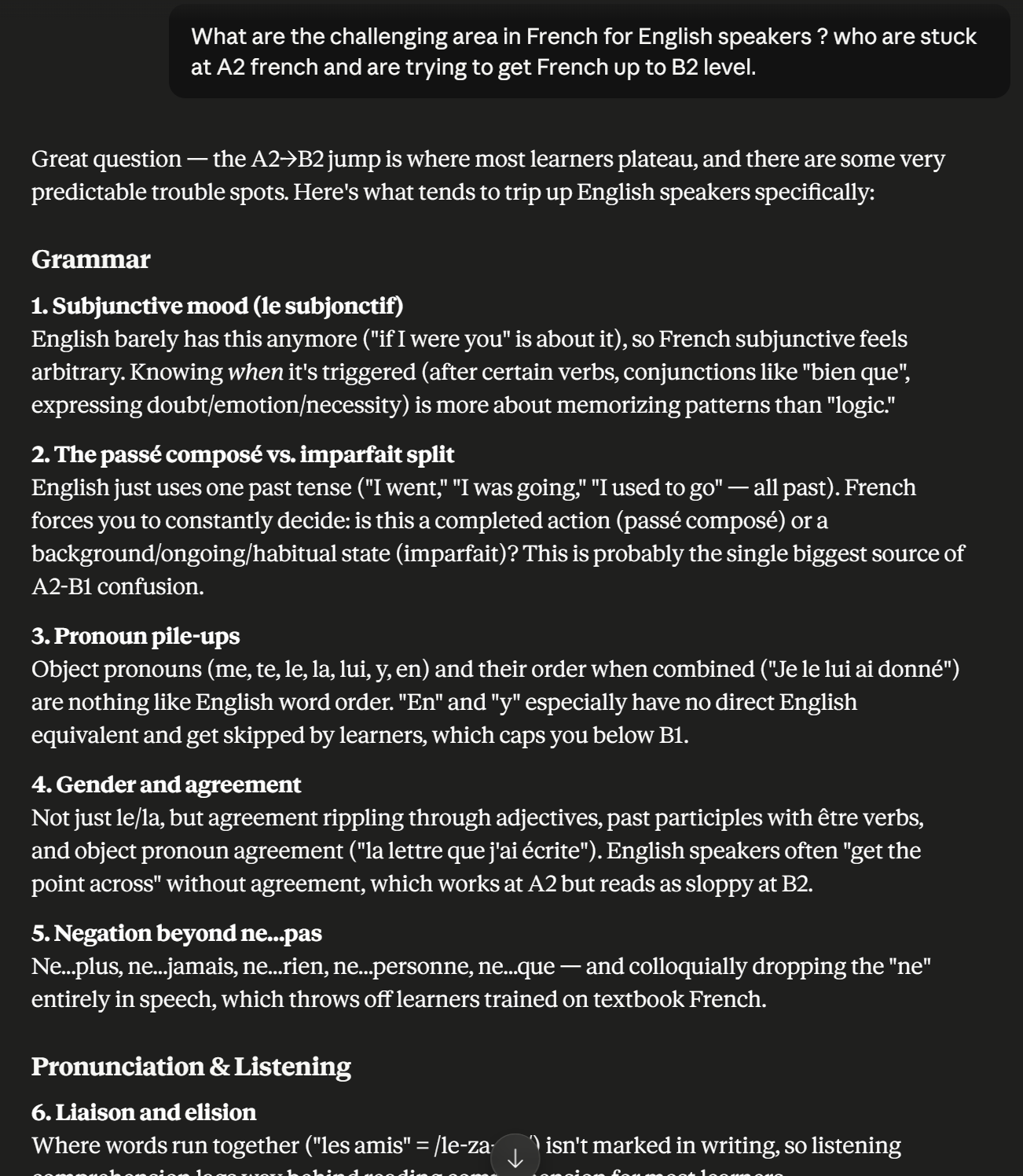
You can also look more into books that talks about mistake English speakers usually make in Spanish ? I asked similar question to AI for French a while back and It was quite accurate. In this way you can focus your efforts.
note I am also at A2-ish but I can read B1 materials.
current goal :
Bring my other neglected skill (speaking/writing) up to my reading skill, The other goal is just to get to 5 million word of native content read.
I think these will help with moving me to B1 and above.
Honestly, I’ve hit my first wall. I’m focusing more on the summit than enjoying the climb. Despite putting in the same effort, my progress has slowed in my speaking group due I think to limited airtime, and I need a plan to regain momentum.
To clarify my goals: I don’t need native fluency. My primary goal is practical conversational Spanish for travel in Spain and Latin America. Long term, I want conversational fluency by age 53–55 as an option for semi-retirement work (I’m 47 and a solid A2)
Right now, I feel a bit aimless. While my listening has improved over the last two months, I need clear focus areas to step into B1—like introducing new past tenses, rather than staying stuck in A1/A2 patterns. It’s just a lot harder for me to see improvement recently as it’s mainly my comprehension to reading and listening, rather than my speaking.
This is good thing to be clear about to narrow down your focus. For me I am not interested in having a native accent, so long as my pronunciation is clear and I can be understood I am done.
So far, what have you done in term of speaking ?
How much time do you spend on speaking per day ?
If you haven’t done it, Language transfer is free, you can do it while figuring out your next steps. I think the first 30-40 lessons will be easy for you.
You can also make your response in the language transfer prompts more challenging by adding on to the replies. So if the teacher ask How do say " I want to eat ", you could reply in Spanish correctly and add [because I am very hungry, I have not eaten the whole day].
My brain said stop, after I finished the sixth week in a 6-week intensive course that was tought in the target language. I started with no knowledge at all and had 5 hours of school a day and the afternoons and evenings were filled with studying. It went very well up to the sixth week, when I passed the A2 test. I realized then, that my brain had no time at all to repeat anything I learned, because there was so much new input every day. I would not have been able to continue the course on that level. So I stopped and for about 4 month just revised and consumed A2 material for maybe 1 hour a day. I think I needed that time to “process” everything I learned. When I felt like I was able to continue, I went back to the course, but this time just chose a 4-hour standard course. And I really felt like all the previously learned stuff was settled somehow. That’s how I was able to contine the course (in the target country) for another 12 weeks. Without a break from the huge input every day, that would not have been possible. And I needed another break after these 12 weeks!
I learned then, that I need revision time while studying! So I changed my way of learning for the languages I learned next by including enough revision time.
(I have to add, that I already had learned three languages, when I started the intensive course, so I kind of knew what worked for me. But another weird thing happened also while I was participating in the B1/B2 course: My brain switched off the capacity to speak in my second and third language! I would start a sentence in English while talking with American tourists and I’d switch to my new language without realizing. Sounds maybe weird, but it felt like my brain just concentrated on that new language and had no RAM left for anything else. I was able to use these languages as normal again around the time I was comfortable with my B2 knowledge in the new language.)
You are all ‘working’ at languages in ways that seem to strain you.
The Comprehensible Input approach suggests (adapted to Lingq) is about reading
●things that are genuinely interesting. For me this is Harry Potter, Lord of the Flies, a Roal Dahl book; something with a proper story. AI isn’t there yet. Maybe Olly Richards.
●that’s mostly comprehensible. Mini stories are the start. AI can produce short, simple sentences. You may need to trade off interest and readability in some languages.
●Do a minimum each day and have a higher goal.
Don’t worry about grammar. Pay attention to what you can. Over months, some things become clearer. You will reconlgnise and get to know words in whatever way you brain chooses.
Is sentence mode if you need it with audio and translations.
Greek is horrendously difficult but I am years in and have read millions of words. It is getting better.
It workds and you will read good books.
Once you ‘get the language’, do other things (talking etc.).
When I hit a wall a month ago, I decided to research “Burnout” — in my native language, in my target languages. It was fun, and I immediately felt relief. Somehow accepting the situation and exposing myself to the ideas of others helped immensely. Good luck on your journey.
6 intensive weeks (1.5months) to A2 that is good, I assume it is all 4 skill set. After 4 months a 2nd non-intensive round of 12 weeks (3months) you were at B1/2 level ? Maybe I should look more into these intensive programs when I have the time in Nov/Dec. Thanks for sharing.
Thank you! As I said, it was a lot of work. I thought at that time, I had to cramp everything I could into that time frame. [I finished with B2 and yes, at the exams all four skills were tested, but it took me a few more month at home with interesting input and regular speaking sessions to feel comfortable at that level.]
As was already discussed in other threads, directed language courses are not for everyone. And the teaching style of teachers/courses vary a lot. But I try to take them whenever I can. And in the second course I mentioned, I also met students, who were there for 12 month to complete A1-B2 through the standard course, so they did not study that much every day, because they had time. But who is able to take time off work for a whole year? I’ve been very lucky to be able to use all my overtime hours to participate in several intensive language courses over the years. In fact, I just applied for another 2-week intensive course, because I like the challenge, I love the atmosphere and it is a break from my usual study routine.
In terms of speaking, this is an area I need a switch up and I’m on with it. Ive learnt almost constantly in group lessons and find now at this level. With the other students, now - they can all hold the mic for some time. This limits my speaking (and theirs) in each lesson. I dont think it offers great practice for speaking any more, although this is a reletively new revelation for me. However, in terms of listening comprehension, it’s been fantastic. The other students come out with all sorts of random subjects and to follow is a skill.
I have been speaking every week during a real conversation. Additionally I do practice a little speaking out loud every day and also have a little instagram channel although I have less viewers than my personal space on there, I use it as a one take - all mistakes stay. I say what I say blog.
I’m convinced I need more time to speak so I’m now looking for a 1-1 and unfortunately my teacher that Ive been with doesn’t teach in the evenings so I’m having to look elsewhere. I want evenings to be an option so I have more flexibility. Additionally I think it’s important that I hear new accents, new voices.
At that level you are still trying to absorb massive amounts of information in a session. You are pouring 10L of water into a 500ml bottle. And you don’t get to pick what portion of that you retain at the end of every day.
Make the content work in your favor, stick in one topic domain until you know the high frequency vocabulary and grammar it offers. Then at least you are taking from the same 10L every day instead of taking from a new jug every day.
The “streak” can work against you, sometimes your brain just needs a day off. Learning streaks are a marketing hook not a language efficiency one. If you absolutely have to maintain that streak do something different like a day of listening instead of reading.
Streaking is something that does keep me in check. I have a lengthy ‘weekly’ streak on my flashcard app. This literally tells me how many weeks it is since I started to learn. LingQ has my other streak. I dont have any probs with some apps or resources dropping a streak but I do keep those two as a no matter what. No matter how tired I am - I do this every day. For me consistency beats talent every day of the week and routine is the foundation of consistency.
Some confidence gained this week, I had a 30 min convo with a stranger in Spanish!. This was a a great reflection of how far I’ve come.
Additionally its a case of listening to you’re heart. I think my group classes we’re holding me back in that I need more time to speak out loud - Ive moved on from them now and I’m actively trying to find 1-1s but also I’m not in a rush.
I am starting to feel a little better. Firstly having gratitude for the routine, teachers and classmates that have got me to where I am ! Acknowledging how far I’ve come is actually pretty good and a shoutout to any A2’s out there. We might have a lot to learn but we can converse in our target language even if it’s a little disjointed at times.
I also acknowledge that I’m needing a new pathway now. Changing my routine. Pinpointing my goal for now to September, making a goal for September to December.
I write this as a record of my frustration and the journey out of it, there’s zero chance that this is a wall I won’t overcome.
I can echo @roosterburton, learning a second language is the hardest thing I’ve ever done. Due to the enormous opportunity cost, and lack of reward to this point, I continually wonder whether it may also be the dumbest thing I’ve ever done. It would be hard to quit, but if I don’t, I may be falling for the sunk cost fallacy. Make sure your ladder is leaning against the right wall before making the effort to climb it, as this is an extremely tall ladder if you’re aiming for fluency.
It is important to manage expectations. It doesn’t help that some sugar coat the difficulty due to a conflict of interest with whatever language learning system they’re selling. For example, you don’t just magically start speaking no matter how much input you consume. That hypothesis is not only wrong, but also frankly rather silly.
You are battling multiple monsters on your exhausting quest: The Boredom monster, The LingQ bug monster, The Vocabulary monster, The Grammar monster, The Doubt monster and the list goes on. Will it be rewarding or will it be a fool’s errand. For me, the jury is still out but I remain concerned whether my ladder may be leaning against the wrong wall. I think the worst of these monsters is the Vocabulary monster. There is a ludicrous number of words. And for each of them you will need to be able to read them, understand them when you hear them and produce them actively in real time speech. To compound the problem these are markedly different skills. And that is just one of the monsters.
It is good that you are refreshing your approach. Variety can help you battle the Boredom monster. Consider lowering your expectations on what you can accomplish per day to deal with burnout. It is OK to rest and be kind to yourself and not just persist.
Exactly. If they wanted streaks to be useful, they would tell you your percentage e.g. you worked 199 out of 200 days in total. That would be much more useful. But it wouldn’t satisfy the business requirement that you become addicted. Unfortunately these apps tend to focus on business and marketing goals, sometimes to the detriment of language learning. Too much hard work and the brain can get into a rut. A short break can paradoxically be beneficial.
@ianmc: Language is arguably one of the most complicated things you will ever do, so tiredness is normal. Languages are hard, very hard. I’m pleased to hear that it is going better for you.