I believe implementing a feature that allows for the selection of non-adjacent words (perhaps by holding ‘Ctrl’) would be a game-changer, especially for handling German separable verbs. It is a vital addition for anyone studying languages where the meaning of a sentence is split across different positions.
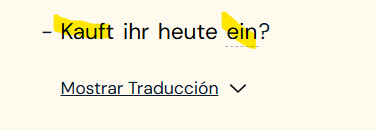
A simple example:
I’ve always felt this might be tricky to implement but would be amazing for languages like latin, I’d love to see it done
This has been brought up on several instances and I have already posted on this matter before, but I cannot remember the thread or thread creator anymore, so excuse me if this is redundant. But I’d like to give some thoughts from a native German speaker’s perspective. (I cannot comment on other languages that might possible benefit from your suggestion, but thus far I think German was the only one ever mentioned).
Seperable verbs consist out of a verb and a preposition. The verb contains the main semantical information, the preposition is merely a modifier. That beeing said, it is probably a more useful approach to actually handle those as two seperate words, as you would do in English, for example. Note that the only differences between English and German are that in English you don’t write those words together and that the positioning doesn’t change in subclauses. Still you probably wouldn’t learn run to, run from, run away etc. as individual words, as they all have to do with run, and the prepositions only modify the meaning, in this case the direction.
Another thing is that even as a native German speaker you will not know the preposition until it occours. So in your example, when reading Kauft, I cannot know whether or which preposition will come until I read to the point where it comes or can hear a speaker saying it. I only know that the verb works with and without a preposition and have a more or less complete list of possible prepositions in my head that may modify the words meaning. It is probably not the worst idea to get used to that kind of thinking.
Thank you very much for your insights.
In my personal experience, I have found it much easier to learn English phrasal verbs—like put off’/put out—as a single unit rather than as separate words. I tend to focus on phrases and ‘chunks’ of language rather than just isolated prepositions.
That being said, I will definitely give your method a try, as I’ve noticed that each language requires a slightly different approach. For instance, writing has proven to be far more helpful in my German studies than it was for English.
If you have any other suggestions, I will gladly take them into consideration. Thank you once again!