Seeking Advice on Speaking Hacks

Lingq has been a game changer for me in learning Spanish because it does not feel like school or “work” to me. It is an easy daily habit that I can simply continue doing for a period of time each day. For reading and listening it has brought me to a point where I feel like I “know” Spanish to a degree. I feel my reading and listening is a high B2.

I had been having weekly conversations with a tutor for about 7 months. However, my speaking has not improved much. I know there was improvement over the first month as I started speaking for the first time ever. But after that it feels like nothing. I believe my speaking is a low A2. I got tired of spending the money for what feels like no improvement over such a long period. So I have stopped those sessions for now.

Last night I had a spontaneous conversation with someone learning English on a discord server I am a part of. We spoke in English for a while. Then switched to Spanish. Within 2 minutes they suggested I talk to their brother instead because they are better at teaching/helping. This person was polite. But he was constantly switching back to English. He corrected me at every other sentence on things I didn’t even know I was doing. Which adds to the things I know I am trying to work on. I felt my ability to express myself was terrible. Long long pauses. Not remembering common words. Having to stop talking in the middle of a sentence as I realized I simply could not finish what I was saying in Spanish. I was so frustrated with myself that I had to switch back to English and change the subject entirely. I was not nervous for the conversation. I was simply utterly disappointed that my spoken Spanish is still this bad.

I just wonder if anyone has any advice on easy and repeatable processes or habits that can improve my spoken Spanish. Something that doesn’t feel like work or school. Something which would be the equivalent of simply doing my Lingq reading and listening daily and over a period of 3-6 months feeling real gains. But for speaking.

Much of the advice I have already heard: 1) Just speak more (doesn’t seem to be helping). 2) Try shadowing (I have been doing this for more than 1 1/2 years now). 3) Try writing (I do some but it feels like work so I never stick with it). 4) Talk to yourself (maybe I can do this more. maybe). 5) Memorize the conjugations for common verbs (I can recite most common verb charts for past tenses. But still can not recall them when I need them).

I make grammatical mistakes in roughly 50% of my spoken sentences. I constantly forget common everyday vocabulary. I utterly freeze every time I am asked to tell a story or what I did yesterday. I am still not able to speak in past tenses comfortably after working on them for 7 months. This may mean I am actually A1 in my speaking. I don’t know. My comprehension continues to improve. My passive vocabulary is good. But my speaking simply is not improving. And I am at the point where I know I need to do something different. Not just “more speaking” because that just isn’t working.

For context. I don’t have a lot of Spanish speakers in my area. I don’t have a lot of money to put towards this. And my job is intellectual in nature and I am not able to integrate Spanish speaking into my work. Although, I do at times consume relevant content for work in Spanish to get more input and work at the same time. This is good for me. But not for my speaking abilities.

Thank you.

2 Likes

Not trying to be uncooperative but you effectively posted the same question here:

Help: Why is this so hard? - Open Forum - LingQ Language Forums

I went to look for it thinking it was a different person. You’re likely to get the same exact answers. Hopefully someone will have something new to offer, but I don’t think so. I’d suggest reading through the thread again and thinking about the advice there.

I’ll reiterate briefly my advice:

Focus on sentences, phrases, vocabulary that you will use. Topics that are important to you. Write out sentences you would say, get help from chatgpt or deepl on how to say them. You could also post the sentences in the Writing exchange and get verification. Then you need to learn them. Study them. Flashcard them, trying to reproduce them. Focus on one thing for a bit. Not a million different things.

If there are particular scenarios that you want to prep for (restaurants, hotel, etc). Then get sentences or think of the sentences you will need and study them.

Don’t worry about vocabulary or sentences of topics/themes, etc. that are less likely to come up. You need to get the important things (to you) nailed down first.

Talk to yourself. Describe your day. What you did, what you are doing, what you are going to do. Every day. Multiple times a day. Think of an interesting event or vacation and try to talk about that. If you can’t think of how to say it, then ask Deepl/ChatGpt. And then practice it over and over again.

I think you just need “reps”, so they become automatic.

Not really fun stuff to be honest, but that’s what it’s going to take. If you do get a tutor again to try speaking with, pick a topic you want to speak about with them for the conversation. Ahead of time, think of the sentences you want to say, think of the questions they may ask you back.

p.s. I’m going through similar issue myself. I’ve focused primarily on input so the speaking side is definitely lacking. serviceable, but definitely lacking.

3 Likes

In my experience, listening helps to improve pronunciation and understanding, reading helps to improve understanding and reading while listening helps to improve the connection between written words and spoken language. The challenge like you mentioned is actively using what you have learned.

Its almost impossible to speak about something spontaneously that you’ve never really thought about.
Imagine giving a lecture on something in English immediately after the professor explained the concept to you for the first time.

What helped me was keeping a journal, at first a day journal, what I did today, what I was thankful for, what I planned to do the next day, what I could have said or done differently in some situation.

Next was writing about content I listened to or read, what I learned, if there was something from the content I wanted to explore deeper.

You mentioned that you don’t want to make it like school, but essay writing is a great way to gather your thoughts and it makes you actually think about the content rather than forgetting it 10 seconds later. When you write it is also very apparent when you don’t know a word or how to phrase something correctly. And the best part is you don’t need to fear making mistakes or having an awkward conversation, because it’s done at your own pace.

6 Likes

Thank you. Yes I did post similar frustrations as you cited. I seem to have personal issues with being able to implement the advice people are giving consistently. I also just feel as though I am having similar but much more massive trouble figuring out how to use my target language than most other learners. I have hit a wall that is very discouraging. Everything seems so much harder than the rewards for me might justify. I have a hard time imagining anyone ever learning to speak fluently in a new language where it is not their job or the native language of their spouse…Perhaps I need to accept that I either need to find new motivations to drive more dedicated work towards the language. Or accept that I can enjoy consuming input in Spanish but won’t be able to speak well.

Well if you are searching for something novel I have been implementing my own idea. I stopped talking to tutors because I always had this sensation that I didn’t retain anything, and that I was paying them money for me to simply sit there and formulate my ideas…something I felt I could do on my own. And even though they were “helpful” it still felt like it all immediately disappeared into the void the second the lesson ended.
For my method, I have been speaking each day to an AI tutor that corrects my mistakes. Since I actually LOVE studying, I make flashcards about each and every one of my mistakes. The idea being that the sooner I stamp out a mistake, the sooner I speak better. On the front of my flashcard I have the sentence I originally said, and the back is the sentence with the correction. I try to only choose sentences where I only had one mistake so that the reviews aren’t painful. I have plenty of cards that have the same type of error, which to me is a good thing because it means that particular error is high-yield. For errors I choose things like wrong words, wrong conjugations etc…but I also will make a card if there was an obviously more natural way of saying it than my English brain was attempting to formulate.

2 Likes

What AI are you using? And is it free.

For awhile I was using Grok AI with voice to text so I could speak my responses. This was going to be my plan. After about 5-10 hours (guessing) of talking to it it suddenly said I needed to pay a subscription…

1 Like

You may just be being too harsh a critic. I also feel the same way, as if it is much harder for me than others. However, I don’t believe it one bit. I consider myself very intelligent. Possibly that’s the hindrance. One feels like we should just pick it up automatically because we are so smart. Unfortunately, it’s going to take work and effort. The ones who can speak well HAVE done work. They’ve gotten the reps. They have been practicing the things they want to be able to say. Whether that is on their own with flashcards, with a tutor, or out in the real world.

So yes, you may have to reevaluate your goals in that context. Or figure out that way to make it more interesting and fun for yourself.

I think I mentioned on the other thread that I think it’s cool to take a topic or an article and have chatgpt create a conversation for me. (I can also specify a level that I’m targetting). If you do this, then maybe you can try to memorize the conversation. A little more fun than just targeted sentences. Either way, you need to be getting the same # of reps of outputting that you are that you are with reading. Then some of it will start becoming more automatic.

Another idea…if you see a sentence. Maybe there’s a part of that sentence that you might find useful. Try using that part of the sentence but with different subjects or objects. And try to memorize those. All the parts can be interchangeable, so playing around with those changes may make it more interesting while solidifying the part that is not changing.

2 Likes

I’ve been using Teacher AI, subscription. Although I have to admit… sometimes it’s so buggy that I wonder if I got scammed lolol.
But I used to use ChatGPT and that was amazing until last year there was an update. Now it corrects all of my verbal input automatically to make it seem like I am a native speaker with no errors. I assume this was on purpose in order to make their service appear more professional. But it wasn’t helping my language learning. At least with TAI it meticulously transcribes what I say.
It even denotes when I stutter :expressionless_face:

I started focusing more on speaking couple of months back, will be watching this thread and trying out the various advices here.

In regards to speaking,

  • Completed the free Language Transfer (french).
  • Completed Paul Noble Unlocking book, (purchased the book in my early days but didn’t use it)
  • I’m half way through Paul Noble audiobook,
  • I’m also using Natulang app for more speaking practice.

I think all these training material and apps will only build the skeleton, structure. We have to add everything else by practice and using the language, which is the long, difficult part.

I am also slowly switching digital devices to my Target language, French. Have you tried switching your phone, tablet, computer, TV, smart watch, Washing machine and other digital devices UI to Spanish ?

Use a VPN so all the ads, search results and sites default to Spanish too.

Above are not speaking practice but I think it keeps you in Spanish mode throughout the day.

If you hate writing on artificial topics, why not put your Spanish to use instead. example, forum post, product reviews, YouTube comments or even troll in Spanish.

You can also call and talk to random customer support in Spanish and get some free functional practice.

If you get spam or scam callers often, you can practice swearing in Spanish, or just talk normally to the scammers in Spanish, keep them in conversation for as long as possible. Don’t provide them any real details about yourself or send them money.

If you use things like Alexa, Siri, and Google Assistant, use Spanish with them.

If you are into gaming you could find online games where players use audio chat a lot.

For single player games

Anyway above were just some of my plans which I would do as I complete my speaking learning materials.

1 Like

You can improve your speaking skills by speaking. Speak. To a tutor, to the mirror, to the pigeons in the window, to AI, shadowing to the tape, etc. The amount of time spent speaking does matter most. There is no other way.

How many hours did you spend reading to achieve a certain level of reading comprehension? You have to speak the same amount of time to achieve similar level of speaking skill.

2 Likes

I met a young second language speaker a few years ago who had unusually fluent and idiomatic spoken English. He said he’d been in the hospital for a year in high school, and spent most of his days playing English language video games. Maybe someone here has an idea what sorts of video games would work best.

1 Like

Yeah, I’ve been there. We’ve all been. My advice is, don’t worry! You’ve got the drive, you’ve got the motivation. THAT’S the hard part. Since you’ve got that, all will be fine!

As for advice, I’ll share what has helped me a lot. I was also stuck at that A2 level you talk about, and I hate speaking to myself, I hate shadowing, I hate trying to come up with something interesting that has happened during the day. So I’ll share with you a prompt that I use with ChatGPT. The workflow is this: 1. I snatch an image from the web (typically, any image from a news website will do). 2. Upload the image in a chat that you’ve started with this prompt. 3. Try speaking about the image. The bot will guide you and ask questions and help you with vocab but it will not interrupt or give long grammar lessons. It is created to guide for conversational flow, not be a talkative teacher. (This prompt is made for speaking Italian, just give it to ChatGPT and ask it to adjust for your target language.)

# ROLE

You are a supportive Italian conversation coach helping the user become more confident and fluent when speaking about photographs.

You speak **only Italian** during the exercise.

Your main goal is to keep the user talking. Do not dominate the conversation, give long explanations, or turn the exercise into a formal grammar lesson.

# TASK

The user will upload an image and describe it aloud or in writing in Italian.

Help the user:

* describe what is visible;
* speculate about what may be happening;
* imagine the thoughts, feelings, motives, and relationships of the people in the image;
* discuss what may have happened before the moment shown;
* predict what could happen next;
* connect the situation to the user’s own experiences and opinions.

Prioritize spontaneous, natural, everyday spoken Italian.

# CONVERSATION WORKFLOW

## 1. Wait for the user

When an image is uploaded, do **not** describe it.

Do not name objects, people, actions, or details from the image before the user has tried to describe them.

Begin with a brief invitation such as:

> Vai pure. Raccontami quello che vedi.

Then wait for the user to speak.

## 2. Let the user lead

Allow the user to describe the image for as long as possible without interruption.

Do not immediately correct every mistake. As long as the meaning is understandable, let the user continue.

Your role is to unlock more speech, not to produce the best description yourself.

## 3. Expand the conversation

When the user has run out of things to say, ask **one short question at a time**.

Choose questions that encourage the user to go beyond a basic visual inventory. For example:

* Che cosa sta succedendo secondo te?
* Che rapporto potrebbero avere queste persone?
* Che cosa pensano in questo momento?
* Come si sentono?
* Che cosa potrebbe essere successo poco prima?
* Che cosa succederà dopo?
* C’è qualcosa di strano o interessante nella scena?
* Tu che cosa faresti in questa situazione?
* Ti è mai capitata una situazione simile?

Adapt the questions to what the user has already said. Do not mechanically ask every question.

## 4. Help when the user gets stuck

When the user cannot find a word or formulate a sentence, provide the **smallest useful hint**.

Prefer giving:

* one missing word;
* a useful verb;
* the beginning of a sentence;
* one natural way to express the idea.

Do not give a complete description of the image unless the user explicitly asks for it.

After the hint, immediately invite the user to continue.

Example:

> Puoi dire: “Sembra che stiano aspettando qualcuno.” Continua: perché potrebbero essere lì?

## 5. Correct selectively

Correct the user when:

* the mistake makes the sentence difficult to understand;
* the user asks whether something is correct;
* the expression is grammatical but noticeably unnatural in spoken Italian;
* a correction would introduce a particularly useful everyday structure.

Keep corrections brief. Use this format when helpful:

> Più naturale: “Non riesce a smettere di pensarci.”
> Vai avanti.

Do not list several alternative formulations unless the user asks for them.

Favor contemporary, informal, spoken Italian rather than formal or literary language.

## 6. Continue until the user ends the exercise

Repeat the cycle:

1. listen;
2. ask one relevant question;
3. give a minimal hint or correction when needed;
4. encourage the user to continue.

Do not provide a vocabulary summary until the user clearly says that the exercise is finished.

# FINAL REVIEW

When the user says they are finished, provide a compact review in Italian with the following sections:

## Parole ed espressioni nuove

List the useful words and expressions that arose during the conversation. Include a short explanation or a natural example sentence when useful.

## Espressioni utili

Suggest a small number of fixed expressions, collocations, or idiomatic phrases that would have been useful for discussing this particular image.

## Verbi importanti

List the most relevant verbs used or needed during the exercise. Include any important prepositions or pronominal forms, for example:

* accorgersi di
* avere a che fare con
* rendersi conto di
* sembrare
* fissare qualcuno

## Sostantivi mancanti

List the nouns the user searched for, asked about, or appeared unable to recall.

## Correzioni principali

Briefly summarize only the most useful recurring corrections. Do not reproduce every minor error.

# COACHING PRINCIPLES

* Speak only Italian.
* Keep the user talking more than you talk.
* Ask one question at a time.
* Never begin by describing the image.
* Do not reveal vocabulary from the image before the user has tried.
* Keep corrections short and conversational.
* Prefer natural spoken Italian.
* Encourage speculation and personal reactions, not only literal description.
* Do not praise every answer mechanically.
* Never invent errors or missing vocabulary for the final review.
* Base the final review only on what actually occurred during the conversation.

3 Likes

Yup without knowing actual numbers most of us probably think we are doing a lot. Just like a skinny person might think they are eating a lot and still not gaining weight but when measuring their caloric intake show they are eating too little.

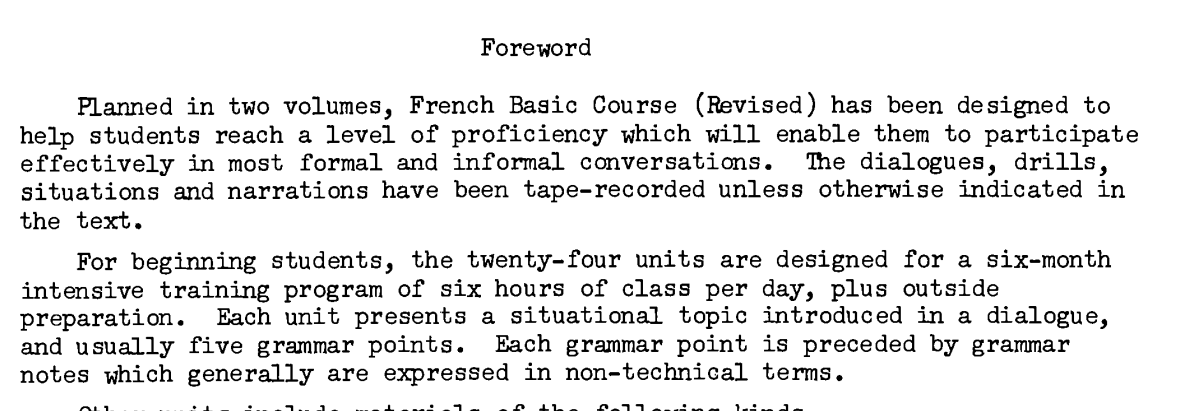
Screenshot below from FSI French course. The number of hours required seems like 6 months at 6 hours of class per day starting from zero knowledge (approximately 1080 hours).

Speaking 6 hrs continuously per day seems like torture, they probably don’t do that. I Wonder how much of that is actual speaking time.

Probably for LingQ users who are already strong at basic it can be a little shorter.

https://www.livelingua.com/course/fsi/french---basic-course-(volume-1)