Hi everyone! I’m Josh and I wanted to start sharing updates on my language learning.
I speak English as a native and German at a C1 level.
I’m currently learning Russian, Spanish, French, Portuguese and Croatian, all of which have different levels of ability.
I believe that when taking on several languages at once, you have to have a plan and also your reasons why. So I thought I would share my goals and time expectations below.
| Language |
Goal |
Time |
|
| Russian |
B2 - 15,000 known words on LingQ - At least 4 hours of speaking per month |
End of 2026 |
|
| Spanish |
B2 - 15,000 known words on LingQ - At least 4 hours of speaking per month |
End of 2026 |
|
| French |
B1 - 7,000 known words on LingQ - Heavy focus on input with reading and listening |
End of 2026 |
|
| Portuguese |
B1 - 7,000 known words on LingQ - Heavy focus on input with reading and listening |
End of 2026 |
|
| Croatian |
B1 - 7,000 known words on LingQ - Heavy focus on input with reading and listening |
End of 2026 |
|
|
|
|
|
Russian and Spanish remain my priority for 2026. Having studied both languages previously with Spanish being the strongest of the two, I am really pushing to improve as much as possible. I would like to go into 2027 with a strong foundation in French, Portuguese and Croatian and I will then decide if I wish to continue with all three of them or to replace one with Polish.
Which languages are you learning at the moment? And how are you going about learning them?
2 Likes
Hey, nice to see another detailed multilingual journey post!
I’m currently in a similar phase with Russian as my main focus. I’m sitting at ~2,400 known words right now and have set some clear milestones for the next few months:
3,000 words → around June 28th
3,500 words → end of July
4,000 words → mid-to-late August
5,000 words → end of September
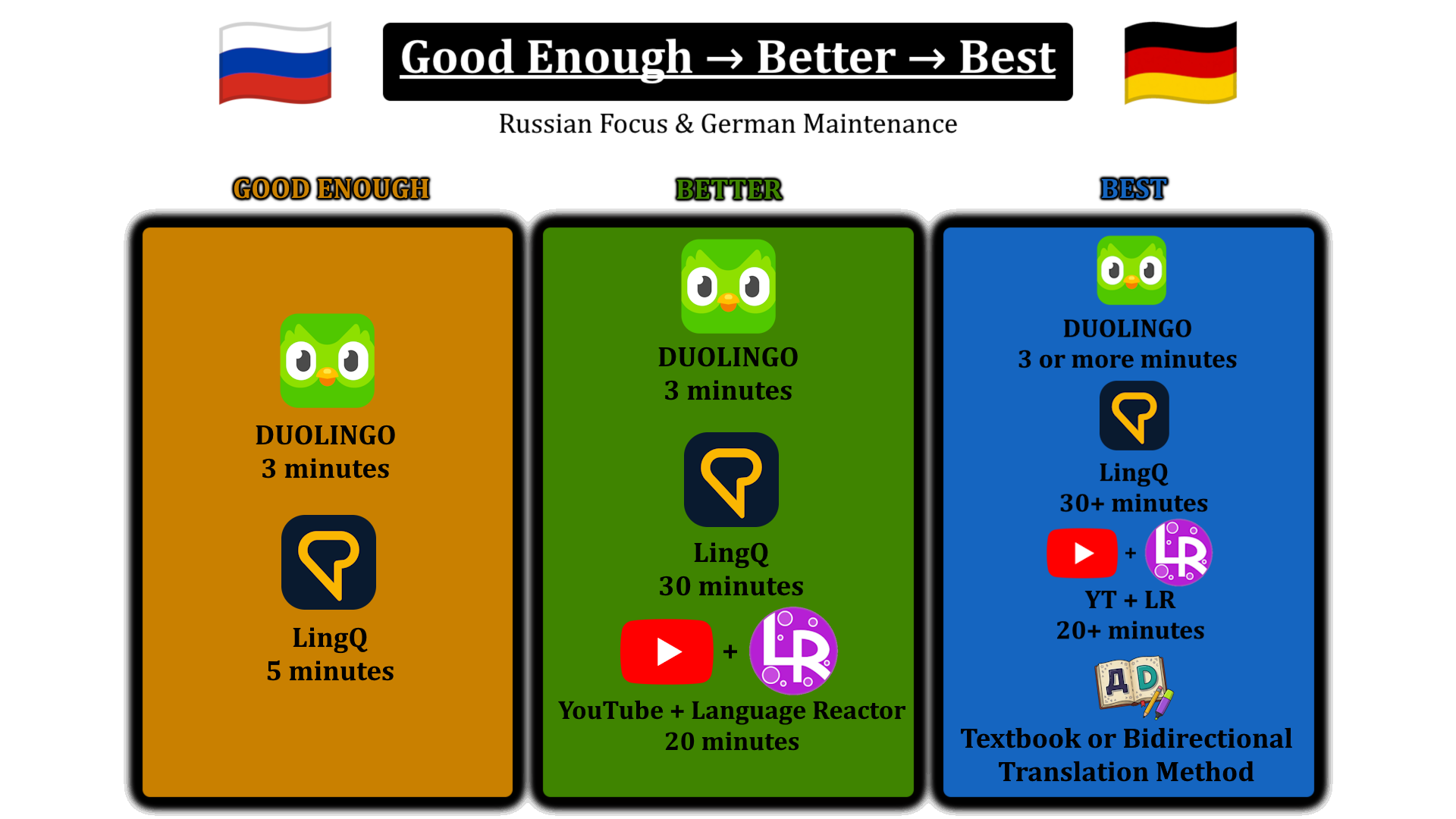
Instead of obsessing over daily word counts, I’ve been focusing more on maximizing consistent time with the language. I made this simple tier system to help me stay realistic depending on my energy levels each day:
Russian is the focus language, German is on maintenance. The goal is to build something sustainable instead of burning out halfway through these 90-day challenges here at LingQ, which you should join.
Really enjoyed reading about your journey — best of luck, and keep us updated!
1 Like
That is a huge effort and will take a lot of time, effort and venturing into the unknown. I think the ultimate question is why? Maintaining even one additional language takes so much time, and after years of doing so I feel like It would be a waste to stop.
I’m very skeptical about word counts in general. I have several hundred thousand LingQs and thousands of hours of practice but still often stand there with a dumb look on my face when someone talks too fast, has a strange accent, speaks for a long time or when it’s my turn to speak. For me the real progression isn’t in the word count, but understanding people in daily life and trying to practice for situations you may find yourself in.
I think prioritising content with a feedback loop is very beneficial, ask question, get answer, get asked a question and give an answer back. Repeat 1 million times. AI is great at this back and forth and has become a real staple in my current learning plan, mixed with a native tutor to occasionally touch grass and put the learning in perspective. I believe progress can be made very fast with this method, maybe you won’t have the vocabulary to pickup any book and read it cover to cover, but great for acquiring useful conversational vocab.
5 Likes
Thanks for the comment.
You raise a valid point in that I am venturing into the unknown and it does take a lot of time and effort. However, I feel confident enough with my German and to a degree with my Spanish that I can venture out into different languages without losing much of what I’ve already achieved. I don’t believe I would be wasting anything. Especially because my job as a tutor requires me to use German with some of my beginner English students on a daily basis. This also being the case with Spanish.
As for Russian, I am now approaching my 2nd year of “studying” the language and I feel I have a good grasp of the language to make progress quite quickly, despite learning Croatian, French and Portuguese. You could argue that I would progress faster if I focused solely on Russian, but I would argue that burnout from concentrating on Russian alone would ultimately slow down my Russian progress. I’ve also found that in the past when I have taken time away from a language by focusing on another and then returned to it, I actually perform better.
Finally, in regards to word count. I understand that LingQ known words are not an entirely accurate picture of my progress, particularly when many of my known words are variations of the same verb or noun. However, I find it useful to have a rough idea of my progress.
2 Likes