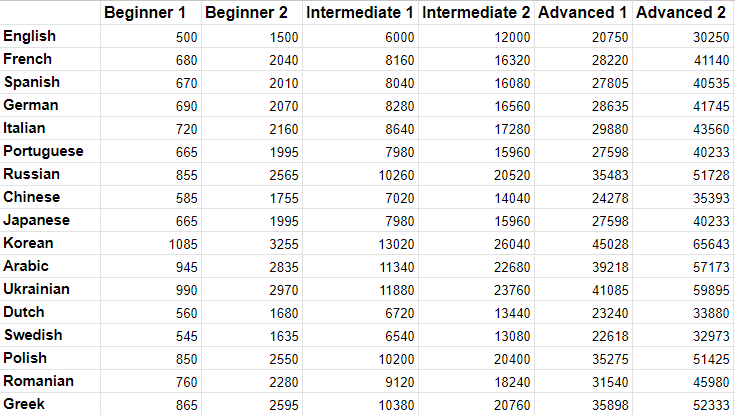
Someone did some work at LingQ in this regard a while back. I have no idea what the methodology was, but they put some effort into setting up known word levels for each language. They seem to think the word counts are closer. I linked posts about this chart and one about comparing LingQ levels and CEFR below, for your reference.
While there is no perfect metric or test to gauge your fluency in a language, Known Words is a very useful approximation. In LingQ, your Known Words count determines your level in the language. When you reach the new target, you move to the next level in that language.[image] Why are the level targets lower or higher for some languages?In some languages, a word with essentially the same meaning uses different endings. For instance, in English, the verb “learn” in the present tense has only two va…
In follow up to my previous posts about clearing up definitions about CEFR ratings like B-2, C-2 etc., I’ve decided to run a little experiment to compare how LingQ’s levels from Beginner 1 to Advanced 2 might compare to the vocabulary requirements on CEFR tests from A-1 to C-2.
I also wanted to find out what results casual self study through reading on LingQ might get you in the academic testing environment.
The experiment:
1.) Spanish: Having recently completed Intermediate 2 level in Spanis…
2 Likes