If someone is a native English speaker and learns Spanish, and wants to learn some other Romance languages, is this a reasonable way to compare the LingQ numbers between them, in terms of same comprehensibility as Spanish?
Spanish: baseline starting point, assume 10k words known on LingQ
French: 20% higher LingQ numbers for same comprehension b/c of more synonyms to learn and many small filler words.
Italian: 10% higher, same reason to a lesser extent.
Portuguese: 10% lower, identical vocab, only minor verb differences.
Catalan: same level
Romanian: 40-50% higher (b/c of cases, declensions, etc)?
So for example, someone with 10k known words in Spanish would have the same reading comprehension as that person with 12k known French words. Do these numbers seem somewhat accurate?
Reason I ask is I’m trying to get to B2-C1 level reading comprehension within one year in a few of these languages, so I would like to stop focusing on one once it reaches a decent threshold, so having ballpark numbers would be helpful.
In my admittedly limited experience with Italian, I would say that the word count should be substantially higher than French (my best non-native language after English) as they use a lot more suffixes.
As for the baseline, I would personally triple or quadruple those for B2-C1 reading (30-40k) level. I stopped needing LingQ to read books fairly comfortably after around 45k known words, but we all have different requirements as to when a word is considered “known” so take that with a grain of salt.
Hmm, not sure Italian would need more than French, but that’s just a hunch on my part.
I am just using 10k as an easy number to estimate from, I plan on getting to 25k minimum for Spanish, then some of the others based on what % is more or less for same level.
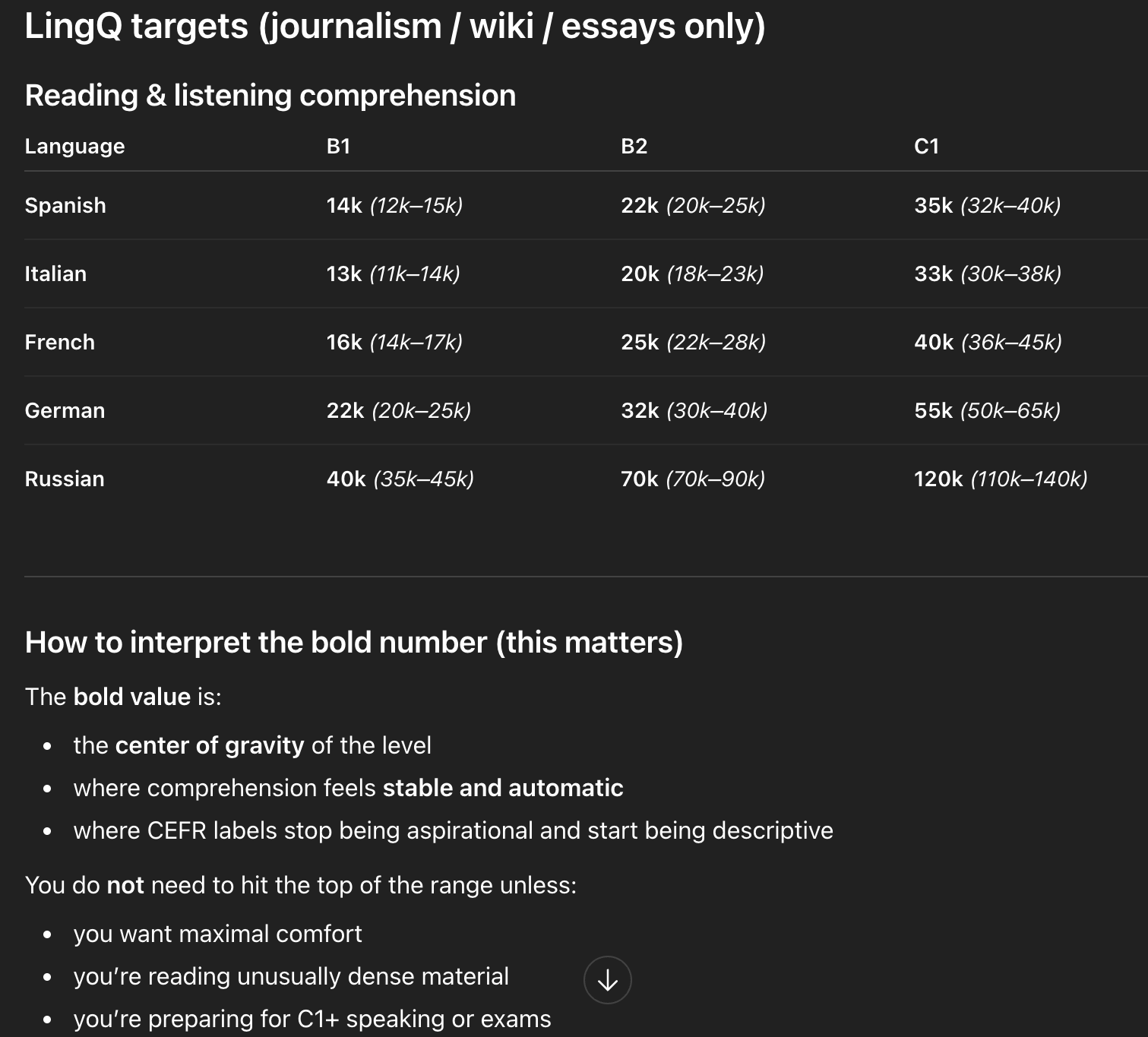
I did ask ChatGPT what numbers would be considered good for LingQ compared to CEFR levels for reading Wiki articles, journals, and long form essays for some Romance and other languages. This is what it gave me, seems reasonable enough. Maybe on the lower end for B2-C1?
The French numbers from ChatGPT seems about right in my experience. I wouldnt consider myself past B2 in Italian (currently at 24.5kish words) so would increase those closer if not above French like I said, but might underestimate my level?
Curious to know why you think Italian is as hard as French, reading-wise. I may have the wrong idea of it being on par with Spanish, instead of it being “harder”.
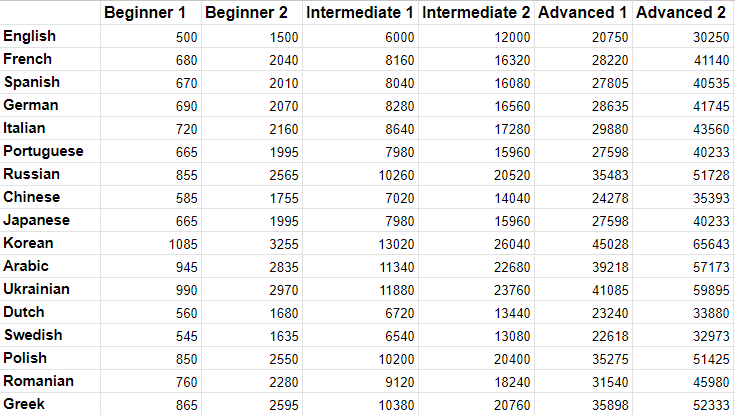
Someone did some work at LingQ in this regard a while back. I have no idea what the methodology was, but they put some effort into setting up known word levels for each language. They seem to think the word counts are closer. I linked posts about this chart and one about comparing LingQ levels and CEFR below, for your reference.
You have piqued my curiosity. I have not really used known words as a metric, but I have them in my LingQ history. I also have test data. It isn’t a full DELE / CEFR test, but the italki test uses Emmersion which is 3rd party evaluation tool thought to assess receptive ability well, and is not just a subjective self assessment. I pulled both my known word numbers closest to the test dates, and the test results for your reference:
Known Words
Speaking
Grammar
21039
B1
B2
29608
B1-B2
C1
43920
B1-B2
C1
51552
B2
C1
Edit: for Spanish, I am native English speaker
Of course, YMMV for known words vs performance. I mark words as know when they are passively known (since that is what LingQ develops).
Nice data, what language is that? Seems like 30k is the number for most romance languages outside Romanian, to get to fairly competent level of reading comprehension.
Ha! Sorry, that would be key information. That data is for Spanish.
As with anything like this, take it with a huge grain of salt. There is a lot under the hood.
After 30k known words, I’m skeptical that new vocabulary acquisition was a primary driver of improvement for me. I think the words read and hours listened stats are more useful.
If I wanted to achieve fluency with a minimum number known words, I could focus exclusively on topics I want to comprehend or expect talk about.
I read and listened to anything I found interesting, including a lot of novels, which was certainly less efficient but I think more fun!
Probably quite similar if you were to start all individually without prior knowledge from others. Having background in one makes the others easier to learn, but also word count might be less relevant. But I don’t think it makes sense to learn french to just read it, but you’d better also concentrate on listening/pronunciation from the start. Otherwise I fear your brain is already fixed on the reading and it’s harder to learn how to pronounce. That’s why french might be hardest of those, even if word count might be still accurate.
Personally I used lingq for spanish untill 40 000 known words before moving to actual books and other native content. Portuguese I had 12 000 known words before I couldn’t find suitable contemporary books and the old books that were there were written a little too difficult language to make them interesting. I later borrowed a contemporary book from library and I would say reading it wasn’t that different as reading first actual book in spanish. But there is difference as in spanish I had 2 million words read and in portuguese 300k. So even if words or the language aren’t any more difficult per se, it takes a little longer for brain to process as it isn’t as automatic yet. I would say starting french was harder even if I had little help from portuguese aswell. Overall the words differ more, and even if many are related, it takes little more time to process. Italian I don’t have experience of, but I would expect it to be easier to learn now than french.
I could recommend spanish as the first to learn. It’s probably the easiest romance language to learn for english speaker and a good stepping stone to other romance languages. Plus it’s the most spoken of the romance languages. But I wouldn’t try to learn as many over shor period, but take one to get to level where it is “fixed”. You also learn one faster as several and if it’s your L2/L3 there is still considerable effort needed when you don’t have as many helping languages. Words known might be 30 000 or 40 000, but that’s quite irrelevant. Once you can read actual books without too much trouble the languages aren’t that easy to mix. Debending how much time you have at your disposal, it might take 6-12 months for the first, but then 2-4 months for the next. That would still require several hours a day to achieve.
As a background, I’m already a B1-B2 speaker in Spanish, but my vocabulary was lacking. Also never tried reading Spanish, just used it for travel and work.
French/Italian I actually started learning both last year, mainly through podcasts and YouTube videos. So I have plenty of listening input already.
I discovered LingQ only recently, and so that’s why I’m mainly focused on getting my reading comprehension up to a high level. I have a good foundation for listening in all 3 and speaking in 2 (Fr/Sp).
I’m not starting from scratch. My levels are currently B1 Sp, A2-B1 Fr, A2 It.
I’m excited to see how one year at LingQ with dedicated practice daily (30-60 mins per language) will do to my levels.
I’m also starting German , so technically I’m “learning” 4 languages at the same time, but like I mentioned not all of them are A1.
As for Portuguese and Catalan, I plan on getting those in too, but at the very end. I don’t anticipate it will take more than 6 months to get to a decent level in each after having high levels of Sp,Fr.It.