It didn’t work for you. There is plenty of research supporting it and very educated proponents. Please stop calling it nonsense.
Could you provide sources for research that supports the Krashen theory? It has been discussed a lot here, so I’ll refrain from going into detail, but the theory was discredited by linguists decades ago.
It is harmful because it tells people that various widely used methods for learning a language do not work. Thus it says for example that study is of no benefit. And the adherents routinely denigrate classroom teaching. Encouraging people not to use useful learning techniques is bad.
That is why I call it junk science.
1 Like
First point I would make is that Ollie to my mind has 0 credibility in the language learning space as he promotes ridiculous idea like learn a language in 6 months and promotes obvious fake stuff like the cleaner he promoted in one of his videos that claimes to speak 40+ langauges. It is obvious that Ollie only want to promote the idea that language learning is easy and you need only buy his products to become good at language learning.
Second I think that language learning at school would be a great idea .Obviously if a kid is not motivated or interested it won’t help .If so don’t do the course.However, if a child is interested it could spark and interest in them to seek out more material to increase their language ability. I don’t really see a down side unless you think one tool,app, or strategy is a silver bullet to improving your language skills.
Third I would say that just imput alone does not work very well. Don’t believe me then go to evildea website and check out his Spanish ALG challenge and you will see that imput alone is not the silver bullet .Useful and neccessary but you dont magically have great speaking skills if you only do imput . Instead you develop you listening or reading skills,.You actually need to practice speaking , listening,reading and writing seperately if you want to get really good.This should be obvious but there are too many “its easy to learn languages” using one special method BS out there.
4 Likes
Sources supporting Comprehensible input (CI) broadly
●vast amounts of input. I assume this means millions of words over years.
●high % of work should be input rather than grammar, speaking etc. Matt from Japan uses 90%. I’ll estimate Liam Printer uses 70% as he uses classroom activities.
Bill Van Patten (Patton?). ex University lecturer. in youtube
Liam Printer, advanced academic (masters?) plus Motivated Classroom podcast c x 100+ episodes. Cites importance of competence (CI has in-built comprehension so no one is lost) motivation and relatedness. Adapts CI but does it in the context of keeping teenagers attention and relatedness. Low grammar. Quite a few interactive games. Some teacher led listening
Common Ground book
Is input enough book.. Explained here at length. Strong examples but population is about 100 and in a particular context.
Krashen himself.
My tangible proposition is that reading
●great books
●with Lingq (sentence mode, audio,translations if needed) for millions of words (3000 a day is a million a year). I note this is an adaptation of CI. Most people talk about CI in classrooms, not self reading. A pity as CI Greek teachers are rare if they exist, despite attempts.
●where it is comprehensible (using g translations or mix in easier texts like ministories)
will build 20000+ recognised words where some come to the student at a speed necessary for conversation.
With high vocabulary and good vocabulary recall, I suggest a mix of non- CI activities such as more serious conversations and grammar if you like.
This approach is working for me for Greek, a language regarded as difficult, and it is the only approach that has given results over time.
Language Jones (youtube) who I like, issued a weak criticism of CI. He does advocate for repetition of words (he advocated flashcards), a bit of reading aloud (my approach allows a bit of that), extensive input which CI does, review (in-build in CI as words come up again in books) and awareness of meaning (again, in-built into CI).
Luca L and other polyglots have different approaches. Fine. Often they show what works with easier languages than Greek.
As context, I am saying this on holiday in Cyprus where the Greek has a strong dialect and is too fast for me to learn much. Below a certain point, exposure is noise. CI deals woth that as high comprehension is there by design.
I am not saying the approach above is the only reasonable one, but that it will work for most people and is supported in principle and that the adaptation of using Lingq supports CI.
I am focusing on ‘building the system’, not use of it once the student knows a reasonable amount.
…
Without input, none of those gaps would be filled. In other words, output might help learners realize what they need from the input, and in that sense, you could say that it is facilitative of language acquisition. But when we produce language, we are accessing the system, not adding to it. Output doesn’t build the system; only input does, and that is why Krashen maintained that input was sufficient for acquisition (i.e., for building the system).
Henshaw, Florencia G.; Hawkins, Maris D.. Common Ground (p. 137). Hackett Publishing Company, Inc.. Kindle Edition.
Keating (2016) provides the clearest description of the role of output in language development: “Output hones a learner’s ability to access the implicit system with accuracy and speed” (p. 22). If our goal is to help learners develop communicative ability in the target language, then both input and output should have a place in our curriculum because they play important, yet different, roles in language acquisition and development: One builds the linguistic system, and the other helps with the skill of accessing that system.
Henshaw, Florencia G.; Hawkins, Maris D.. Common Ground (p. 138). Hackett Publishing Company, Inc.. Kindle Edition.
Ollie produced an Irish book which is a great level for Comprehensible Input. No one else has.
1 Like
Input is essential to language learning, and that is well supported. No one argues we that shouldn’t do input.
However, in the 50 years since Krashen’s version that “we acquire language in only one way”, research has shown that that picture is incomplete.
In the YouTube space, we see a lot of folks advocating for Krashen’s input-only type of thinking, but there is also a lot of empirical support for other activities, including the traditional ones Krashen dismisses. ( output, interaction, feedback, deliberate study/practice).
Matt vs Japan is an interesting example. First, he had years of traditional classes, massive amounts of flash cards, so he is not really a “Krashen CI” example. Further, he is an example of issues that occur without sufficient feedback and interaction. He did not notice pitch accent in his input or flash cards and so failed to acquire it even with massive later fixed that through —> deliberate study. This is an example of a common occurrence with input only approaches where aspects that are novel to the learner may be less likely to be idea is well supported by research. ( Schmidt, VanPatten, Long, Swain, Flege , Norris & Ortega, etc)
You give Luca as a counter example, but Luca also says input is absolutely essential. He just cautions against “input obesity” because he knows from experience that other activities also play an important role.
1 Like
We ‘acquire language in only one way’ is referring to unconscious taking on of a language. Nobody says you can’t learn grammar rules or role learn things. It’s about whether that is using the conscious side of the brain, very analytical, much less intuitive and basically limited. It’s how I least French and it wasn’t great. The argument is whether you would be better to use comprehensible input.
Luca can speak better than me in Greek and I am impressed with that.
Matt (Japan) rates audio first methods to really nail some audio aspects. Great but comprehensible Greek audio doesn’t exist despite some attempts. My ambition limits me to being understood. I am not arguing that CI makes one fluent.
Paul Nation advocates multiple modes (reading, listening, speaking, writing). I liked his Italian audio course at first and then it was unpleasant grammar style.
Another point. One teacher said ‘of course we intend our classes to be comprehensible’. Lovely, but that can be a long way from all students understanding the meaning of what is going on and most of the words.
I am arguing that Lingq can provide a very good approach, consistent with CI and mostly supported by research and it can get a student to recognise thousands of words and eventually be ready to access them at conversational speed and ease. That’s a lower bar that native fluency or 'all that is needed.
1 Like
I was pleasantly surprised when I saw the curriculum for Spanish classes that my sons took in high school recently. They incorporate much more input than they used to.
Of course, there aren’t enough hours to acquire language in school. It seems to me that the countries that more successfully produce capable speakers of L2’s, also have inherent incentives, either socially or professionally for speaking these languages, whether that’s English in Europe or a second or third language in India.
Both in terms of numbers and my subjective experience. Argentina seems to do better at producing English speakers within Latin America. I’ve asked Spanish tutors from various countries about how they are taught, and I haven’t noticed a significant difference about how they’re taught in school.
I don’t know, but it seems that perhaps the specific type of instruction isn’t the only factor in play.
Still, I support teaching kids foreign languages in school.
1 Like
We ultimately agree that input is primary and that you can do other things to enhance your learning. I also agree you can’t memorize rules as a primary path (your french experience)
In a purely academic difference, I’ll point out that while Krashen did not say you “can’t” do other things, such as grammar study, getting feedback, or practicing output, his model argues that these things do not contribute to acquisition itself. As you point out, he claims they can affect conscious knowledge and monitoring, while acquisition comes only through comprehensible input.
Subsequent research has challenged that stronger claim. The distinction between explicit knowledge and implicit ability is real, but research suggests that the other activities I referenced can also influence what learners notice and take in from input, as well as the development of more automatic language ability, not just conscious rule knowledge. All while acknowledging input as the primary driver.
2 Likes
I do not believe you .A lot of other too.
Science doesn’t care what people believe. This isn’t science but a lot of research supports some form of Comprehensible Input as effective (engaging, Comprehensible input helps people acquire a lot of a language).
More here.
My Greek experience is that the characters, words and volume is totally overwhelming. In a sense, I don’t want more things to notice. I want 90% less. I want a very very slow gradient on the mountain I climb.
I have ‘got something’ from context based vocabulary (a class on directions) and probably Duolingo. However they lack the repetition, meaning, social setting, emotion and volume (multiple books vs short lessons) etc. that fiction and non-fiction provide. And I suppose the joy of reading Harry Potter and maybe soon the Godfather.
I look out for things I am missing from Luca, Language Jones etc. The simplicity and general pleasure of reading with Lingq helps me stick with a method for the length of time most people need (500 to maybe thousands of hours).
1 Like
Since you’ve commented on Krashen, I’ll reply. I apologise in advance to anyone who is sick of this topic, which probably means everyone.
I should add that others have made very good contributions to this subject elsewhere, and I might have missed out some good Krashen critiques.
Patten was a student of Krashen and has simply accepted the theory. He’s also a proponent of Chomsky and his universal grammar (UG). He believes Chomsky’s claim that the brain contains an incredibly elaborate architecture representing UG. No-one has ever explained how such a preposterously complex architecture could arise, or provided a single piece of solid evidence. Indeed, if it were true we would expect there to be some stroke patients who lose components in the architecture. They would be able to speak, but would lose specific pieces of grammar. We have never seen that. We do see aphasia in stroke patients, but nothing consistent with UG. Instead patients tend to have generalised loss consistent with a much more general and simpler architecture.
Krashen isn’t a scientist, he simply plucked his theory out of thin air, and declared “This is how we learn language”. He provided no evidence for it, and essentially we are expected to believe it because he say’s so. That’s not how science works. A lot of non academic people accept it because a) they don’t know how science works, b) it’s been popularised by many people especially Mr Kaufmann and c) he’s a famous professor at a famous university so it must be true, innit bro.
What many people do not realise is that linguistics is full of Second Language Acquisition (SLA) theories, Krashen’s is just one example of the naturalistic approaches, and not even the first.
Why do you choose Krashen’s SLA theory, and not one of the many others? What makes it more appealing? Alternatively why do you reject the other theories? Is it because it’s popular on YouTube?
My guess is that Krashen’s theory dominates on YouTube among the non academic linguists because it is easy to understand, and it is particularly good for marketing online input only language learning tools. Mr Kaufmann is the head of marketing at LingQ and he was shrewd enough to see its potential as a marketing trick. I don’t take my science from marketing experts.
Jones has no training in SLA, he’s an expert in diversity and inclusion. He has a PhD in linguistics, but not in SLA. It’s a huge field. A PhD in a science does not mean that the holder is an expert in that science, rather it means that they did some research in one very small area of that science, which was black American English in the case of Jones.
Each polyglot has their own way of learning. Richard Simcott likes university courses and evening classes for example. Simcott loves talking to people in an L2. Luca Lampariello uses output as a key component of his learning methodology. I am not aware of any reasonably respected polyglot who uses input only.
LingQ does not support CI.
I think there is some confusion here. Most people seem to think that CI simply means consuming a lot of input and doing a bit of study. It doesn’t. CI is a term invented by Krashen, and refers to learning an L2 from input only, subject to his N+1 rule though he never defined what N+1 actually meant in quantitative terms. CI assumes that we learn by understanding messages , and we figure out the meaning of the unknown content from context, pictures and associated sounds e.g. a cow mooing or a train passing by.
According to Krashen:
-
We learn from input only. He says that we infer the meaning of unknown words from context and external clues such as images. Research shows that input alone is insufficient. In fact with input alone we miss a lot of detail. Listen to a speech and try and infer the meaning of unknown words and you will fail most of the time. That’s why we use dictionaries in our L1. In fact we use dictionaries regularly, so much for magically guessing the meaning. As someone here mentioned, it is quite common to meet people who grew up in a family where a given language was spoken, which was different from the one outside the home, amd they understand the language, but they can’t speak it, which is strong evidence against Krashen.
-
Explicit study which he calls learning is useless, and we can only acquire language i.e. implicit learning. The most obvious criticism is that he provides no method to distinguish between explicitly and implicitly learnt language hence this claim is untestable and worthless from a scientific point of view. Research has shown his claim to be untrue. For adults explicit study is beneficial and should form part of one’s language study methodology. It’s easy to see that Krashen is wrong. I’ve explicitly learnt the names of birds in French, and can use them at will. We all learn huge numbers of words in our L1 explicitly, when we study geography, chemistry etc we explicitly learn words. If you do a business law course, you explicitly learn new words, phrases and even grammar. In terms of research, Declarative Procedural Theory argues that language arose by reusing brain architecture that had been developed for other purposes. Thus it explains how language evolved. It also shows that we can move information from semantic memory (used to store facts explicitly learnt) into procedural memory (used to store implicitly learnt processes such as riding a bike). This movement from explicit to implicit memory takes place naturally through use of the language.
-
He talks about something he calls the monitor which I don’t understand.
-
We learn only from input that is slightly above our level i.e. N+1. Well that’s absolute nonsense, as it’s near impossible to find lots of input that matches that requirement until we reach a good intermediate level. Arguably Duolingo satisfies the requirement, but I gave up Duolingo German because it was mind numbingly boring due to the slow pace. I could not find true CI in German. In minority languages it is impossible, as just finding input is hard. The truth is that N+1 is nonsense. I and others have successfully learnt using some unintelligible input. We study it, read it, listen to it, then go to the next piece, rinse and repeat, then go back to the previous piece and revise it and so in. Eventually it sinks in. Of course after a while we have learnt enough that input becomes mostly comprehensible.
Another argument against input only is that research has shown time and time again that we learn far more effectively by regular testing. That is the principle behind SRS. Thus output provides a way to check that we have understood something. It’s all very well hearing something, and understanding the message, but that does not mean we can reconstruct it. Grammar is often redundant, and meaning can be inferred from context and not grammar. In other words, we can understand the meaning of sentences without understanding all of the grammar, or words. Actually doing an exercise where we create a sentence, with the correct word order, the correct preposition and the correct verb conjugation is the acid test. It forces us to notice every aspect of the sentence. It is only when you try to output that you see the problems, discover that you can’t figure out how to build the sentence and have not understood it all, and realise why some things are as they are. Thus output is a crucial element in understanding. It is part and parcel of the learning process
In short, everything in Krashen’s theory is plain wrong. The worst aspect of his theory is that it encourages the student to avoid useful techniques. Thus they should use some unintelligible input, they should study and they should perform output. Note that output need not consist of speaking with a language partner. It can mean writing out sentences, as recommended by Luca Lampariello and others, talking to oneself, as recommended by many here, conversing with AI and so on. The Krashen theory is positively harmful for language learning. And yes the student should consume input, huge amounts in the later stages.
My personal subjective experience is that in the early stages of SLA, study tends to dominate simply because you know so little. As you progress, your knowledge increases, and you can use more and more input. At an advanced intermediate level you need to consume huge amounts of input, as that starts to build up the language proper. Listening and reading are crucial. At advanced levels input is the key to success. Put another way, if you do not consume huge amounts of input, you will not learn a language properly. I’ve met countless speakers of English as an L2, and quite often it’s clear that they talk too much, and have not consumed enough input.
I should add that if you or anyone else uses a method that you or they describe as CI, and find it enjoyable and useful, then that’s great. Finding a method that is enjoyable is important. I suspect that most people who claim to use CI are actually doing some study and some output. Indeed Mr Kaufmann learnt French at school and in France, and Japanese and Mandarin with personal language coaches. People should not grandly declare “This is how language is learnt” and then describe the Krashen theory because it’s junk science i.e. snake oil.
The Krashen theory is popular on YouTube, with countless videos informing us that we can learn effortlessly. Well to be honest most YouTube content is crap, it’s a great place for chancers and snake oil sellers.
As for references to back up assertions I have made, there are some good interviews by Lois Taligrand with academic linguists on YouTube. There are also many academic text books such as Approaches and Methods in Language Teaching by Richards and Rodgers which document the better known SLA theories.
That is talking about using direct input as a learning tool. I didn’t read it thoroughly, so please correct me if I’m mistaken, but they don;t seem to be considering the method of studying input before listening through, and repeated listening with study. In other words, turning largely incomprehensible input into something that the student can process more easily. That method is widely used. Hence they are not of course comparing the effectiveness of each approach. I also didn’t see explicit reference to how it varies with level. My personal experience is that it varies a lot, but that is one subjective experience.
As a personal aside, when my French was B1/B2, I tried listening to mostly comprehensible input, say 90-95% known words, and I struggled to stay awake. Hence I moved to input that was challenging, with a noticeable drop in comprehension for quite some time. When I was a German beginner, I tried Duolingo for a month, which provided input with high comprehension, and it was so tedious and repetitive that I gave up, it was quite psychologically painful. I wonder if my experience is unique? Perhaps that is one reason so many learners give up early on. They are bored senseless by a Comprehensible Input approach. The mythical rote learning grammar and words approach is surely no less painful .
1 Like
I made a similar experience when I picked up Japanese a year ago. As the grammar and syntax is very similar to Korean the hurdle was much lower compared to when I started Korean, and as you say beginner content is super boring - not just content wise, but also language wise. The sentences are super short and are always reusing the same basic grammar, it is like consuming something a preschooler has made.
So I switched to intermediate content one month after starting Japanese and it was quiet a challenge in the beginning, as at least half of the words were unknown to me and it stayed like that for a while. But the topics were interesting and the language was that of an adult. I do some grammar practices and drills with AI. I haven’t really tested my proficiency but a while ago watched some videos of a Japanese teacher that are aimed at N4~N3 (in Japanese, it goes from N5 to N1, with N5 beeing the lowest and N1 beeing the highest level), and was pleasently surprised that I could understand quiet a bit (with the Japanese subtitles turned on - yeah, that Kanji really help comprehension  )
When it comes to grammar study, I think it really depends. Grammar is much more as conjugation or declination tables, which implies the language one learns features those, anyway. It’s how you express cause and effect, guesses, proposals and so one. It has to do with expressing nuances, adding an emotional aspect or giving information without doing so explicitely. In addition, it is like everything else a matter of interest. Korean and Japanese grammar, for example is quiet different from the one used in european languages, so I found it to be quiet interesting and actually enjoy learning the grammar.
I am not rote learning, I never did so in any subject, as it doesn’t work well for me. So I am not the flashcard guy. It is for the very same reason as I would’t use “comprehensible” or easy accessible content. It is just super tedious and my mind would just constantly wander away. I am not sure how much I would learn if I have to spend 90% of my mental energy just to stay focused. 
In the end I would always suggest the same: Try out different things and see what works best for you. And accept that learning a language is hard work and something that will take years. None of the approaches, as efficient they may turn out, is a shortcut to language learning. Blood, sweat & tears. 
1 Like
Type the following into AI “are there studies supporting krashen’s theories” You will get a wall of supporting data, papers and studies.
If you are calling it junk science you haven’t even done the most basic level of research into it.
You know that you should not only read the ai’s synopsis, as it easely sums up content of texts it finds in a wrong manner and stops searching further if it has an answer for you. (We had such a case in another thread, were the article linked was ai generated and told something different then the actual underlying scientific work).
Secondly, ai is not capable on judging on the scientific value of a paper or whether the study can hold up to scientific standards. That’s what the peer review is for. Just because someone with a degree working on an university is the author, doesn’t mean the paper produced is scientific.
Thirdly, the answer you get depends on the question you ask. If I type “are there any studies contradicting krashen’s theories” into google search, the ai synopsis is as follows
Yes, many studies and contemporary linguistic theories contradict or heavily refine Stephen Krashen’s theories. While his emphasis on input remains foundational, modern researchers argue his hypotheses are often oversimplified and fail to account for how the brain processes language.
The counterarguments are the same brough up so many times.
- Input only creates receptive bilinguals, who can understand but not produce the language. (as mentioned by @LeifGoodwin )
- The formulations Krashen has choosen are often vague and thus unfalsifiable, which is the fundament of everything that even dares to be called scientific
- The differentiation between “learned” and “acquired” is one of those vague concepts, similar to “i+1”
- Krashen claims that adult should learn language like kids, with no explanation to why they should do so completely ignoring neurosciences or the simple fact that an adult is not a child. Children don’t learn languages in the most efficient way available, they learn it the only way available to them as they have nothing to build on, so they stumble there way into the language. (It also makes me wonder whether that guy has ever spoken to a child. We acquire the majority of our language skills and vocabulary as teenagers and adults, not as children)
1 Like
I am saying to use AI to list the studies for you not to do your thinking. There is a magnitude more research supporting his theories than there are papers written hypothesizing why he may be wrong without supporting research.
Find me research disproving his theories? You are dioscounting studies that support him in favor of opinion pieces without backing against him.
We have literal case studies of bilingualists that can produce after comprehensible input. (now I think it is a slow and a waste of time but it’s been proven)
As to Krashen’s formulations, that accusation does not state whether they work or are inaccurate just they don’t like how they are sometimes phrased.
your 3rd point is trying to conflate meanings
as to your 4th point, once again it does not change the fact that his theories have proven successful in actual case studies, If you like the wording or lack of explanation it does not change that there is clinical evidence supporting the result.
Nothing you responded refutes if his theories have proven success and research and studies supporting them. Instead they argue that they don’t like his phrasing or lack of explanation. They also misrepresent core concepts like his “learn like a child”.
As Obsttorte has correctly pointed out, AI is completely dumb and does no more than search the internet and create a summary. It has no ability to distinguish between a research paper written by a highly respected neurolinguist, and a post by someone who just repeats what he heard from a friend of his mother’s uncle. Krashen’s theory has become incredibly popular among online amateur language learners, no doubt because it has been widely promoted by many well known figures such as Mr Kaufmann. AI searches will reflect this popularity.
No there is not a ‘wall’ of supporting data, papers and studies, There are a number of researchers who accept Krashen’s theory, they tend to be his ex-students, such as BV Patten and another chap whose name escapes me.
Loïs Talagrand published on YouTube some very interesting interviews with academic linguists including this one:
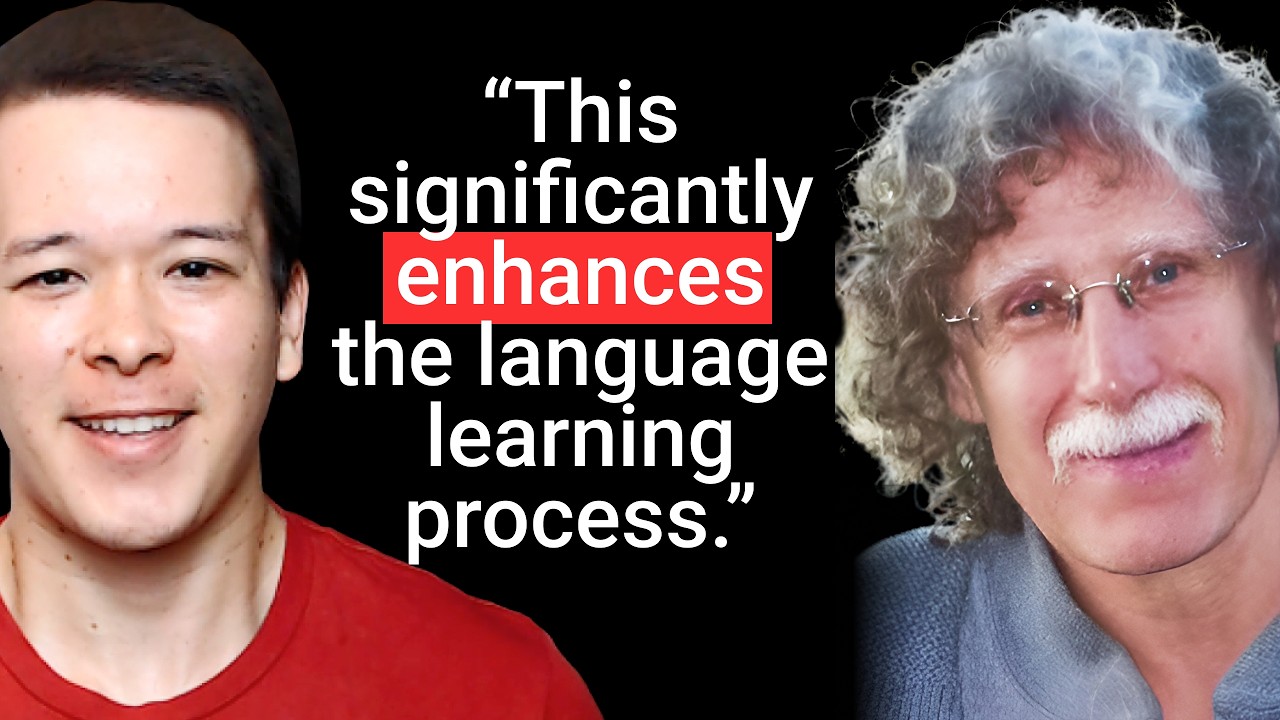
At about 30:30 he states that Krashen has been discredited. Note that this man is an expert in vocabulary learning.
Unfortunately university linguists tend to be quite poor at communicating their work to the general public, hence you really need to read university texts.
Evidently you did not read my earlier post.
I’ve probably read far more university level works on language acquisition than you. I gave a reference to one book earlier on. Krashen’s theory is just one SLA theory among a whole load. I call it junk science because he provided zero evidence for it, he simply said “This is how we learn language”. In truth research has disproven his hypotheses.