Hi,
I am using the Lingq app to learn german language.
My question is about two-part verbs in german language. When I import a text into the app, I couldn’t find a way to recognize these types of verbs and add them to vocabularies. For example “aufpassen“ is a verb that can be separated in two part in a sentence like “Ich passe das Kind auf.” In such case “passen” itself is recognized, but I cannot even manually set it as ”aufpassen” and add it to unknown vocabulary list. I mean regognize the second part in the sentence, say “auf”, together with ”passen”.
Is there anyway to do this?
4 Likes
Thanks for the feedback. Yes, German separable verbs are an issue on LingQ and we have never been able to come up with a good solution for dealing with them. In the end, you just have to learn how to notice them, save both parts and add a separate hint to both words which deals with the meaning when the verb is separated. Not to worry, this is not lost time. The time you spend creating these extra hints and noticing is very valuable and will help you learn. Hopefully, in future we will come up with a more convenient solution but it is a tricky issue for us!
8 Likes
Hi aftech,
the German language is “legendary” for doing this.
For example, even in the “easier” text passages of the German philosoph Hegel (well, “easy” for Hegel, not for regular people like me :-)), the basic sentence structure can be like this:
Infinitive: “hinzufügen” (to add)
Fictive sentence:
Fügen wir … word word word word word word word word word word word word word word word word word word word word word word word word word word word word word word word word word word word word word word word word word word word word word word word word word word word word word word word word word word word word word word word word word word word word word word word word word word word word word word word word word word word word word word word word word word word word word word word word word word word word word word word word word word word word word word word word word word word word word word word word word word word word word word word word word word word word word word word word word word word word, etc. hinzu 
This is difficult to digest even for native speakers of German who - as adults- have easily more than 100k hours of constant interactions / immersion in German under their belt.
Today, I’d consider this a “bad” writing style, but the underlying problem is still the same.
Reg. your sentence: "“Ich passe das Kind auf.”
Unfortunately, that’s not a correct sentence because the basic infinitive structure is
“aufpassen auf etwas / jemanden”. So the correct sentence in German is:
“Ich passe auf das Kind / den Hund / die Katze / das Auto / deine Juwelen, etc. auf”.
Basically, that’s a “collocation problem” (that is, highly conventionalized groups of words that frequently go together).
The only solution for language learning is that you should never (apart from the absolute beginner stage) learn single / isolated words, but always collocations / idioms or complete sentences. So you simply mark the whole (short) sentence in LingQ - and that’s your solution!
In short, LingQ has already everything you need to solve this problem by never marking or focusing on isolated verbs (infinitive or not)!
And that’s how native speakers learn their mother tongue as well:
- They never learn it like this:
aufpassen auf - Deine(r) - kleiner Bruder - kleine Schwester - müssen - eine Stunde - jetzt
- und.
- But like this:
“Martin, Du musst jetzt eine Stunde auf Deinen kleinen Bruder und Deine kleine Schwester aufpassen”.
Or to put it differently:
All native speakers are basically sophisticated forms of “parrots” that have acquired tens of thousands of such collocations.
Once we have internalized a few thousands of these “formulaic expressions”, free play with the language starts - and no parrot on planet Earth is able to match that.
But, of course, switching effortlessly between literal speech and metaphors, surfing networks of connotations and associations, etc. is also something that no animal can do. In this sense, human language makes as “special” compared to all other animals - and without it, we would still be the irrelevant primates that our hominid ancestors were…
BTW, if you think that the sentence structure “Fügen wir + filler words (xy times) + hinzu” mentioned above is bad, what about a nasty little variation of it?
“Fügen wir + filler words (xy times) + subordinate clause 1 with “weil” + continue with main clause - subordinate clause 2 with aber” + continue with the main clause + subordinate clause 3 (why not a relative clause here: der, die, das?) + continue with the main clause, etc."
German is also legendary for such nesting sentences (Schachtelsätze), but long-winded variations are usually considered “bad style” nowadays. However, if you want to know what such sentences look like: just read the books by Thomas Mann, for example
“Peter, I need a horror example for your last variation!”
Your wish - my command - here it is (you should probably use “deepl.com” for this cutie):
„Und jenseits des Wegknies, zwischen Abhang und Bergwand, zwischen den rostig gefärbten Fichten, durch deren Zweige Sonnenlichter fielen, trug es sich zu und begab sich wunderbar, daß Hans Castorp, links von Joachim, die liebliche Kranke überholte, daß er mit männlichen Tritten an ihr vorüberging, und in dem Augenblick, da er sich rechts neben ihr befand, mit einer hutlosen Verneigung und einem mit halber Stimme gesprochenen ‘Guten Morgen’ sie ehrerbietig (wieso eigentlich: ehrerbietig) begrüßte und Antwort von ihr empfing
URL: Zitate von Thomas Mann (210 Zitate) | Zitate berühmter Personen
Shocking?
Don’t worry, most Germans don’t write like that. Instead, we prefer “sweet and short” sentence structures nowadays.
But is Thomas Mann simply “bad”?
No, he is probably the greatest wizard of the German language that ever lived.
And that’s why he is one of the few Nobel laureates in literature.
In short, he’s simply “on another level”
5 Likes
If I come across a separable verb, I’ll often add another definition for the base verb and the separable part in parentheses. Or I’ll just add this separable verb form and provide the definition for it. If you look for other’s definitions for a given word, you may already see someone has done this.
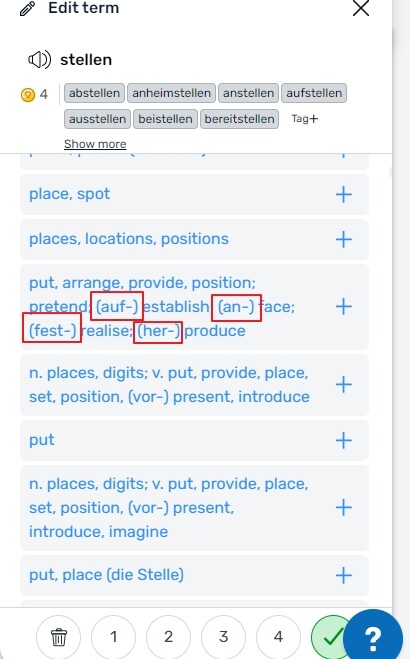
For example, here’s what someone did for the verb “stellen”. As you can see there are many separable prefixes for this word that change the meaning:
You’ll also see with LingQ’s autotagging that some of these additional prefixes for stellen appear in the tags area. If you click these, it will pop open reverso verb conjugation dictionary which also provides the meaning of these (this is auto done by LingQ though, so so far users can’t add this linking).
If the phrase is short, I might save the whole phrase as Peter suggests, but sometimes with very long sentences you may not be able to save the whole thing.
8 Likes
Hi Peter,
Thanks for your kind and complete reply, correction and advise.
For sure learning a word, apart if it is a verb, noun, adjective or adverb, should be done in a sentence to learn the application and grasp the meaning of it.
I would take your advise for sure.
2 Likes
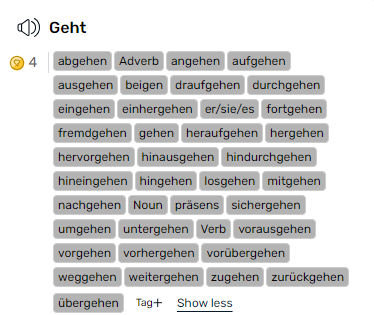
I have a suggestion here for the potential trennbar verb when the user add it to the lingq, he can have an option to select from the possible forms of this verb , something like the image
1 Like
You can already click on these tags and it takes you to the reverso verb conjugation where you can see the specific meaning and the conjugation. Or are you saying to have it actually create a LingQ for you automatically? (or something else?)
1 Like
I may repeat what I have written in another thread. As a native German speaker I don’t think that the approach of learning seperable verbs in such a manner is a good idea. And they are actually not much different from what you have in English for example, with the only difference that they are written together. It is the same approach we have with nouns that are formed out of several other nouns. In English they are kept seperate, but in German we write them together.
For some reason people assume that this makes them somewhat different, but that is a misconception. Most of them are just a combination of a verb plus a preposition, like in English.
Literal translations for some of the verbs in the above list:
- abgehen - go off/go apart
- angehen - go on
- aufgehen - go open/go up
- ausgehen - go off/go outside
- draufgehen - go onto/ go on top
- durchgehen - go through
- fortgehen - go away
In most cases the literal translation is pretty exact. In some cases you wouldn’t use the word go in English, but note that similar to English go denotes a movement both in the literal as in the pictural sense. draufgehen is a bit of an exception, because it is usually used in slang for to die. That one is hard to guess. 
So the main aspect isn’t to learn all those verb+suffix combinations, but to get a feeling for which ones are used literally and which are used picturesque. Something that will come over time via exposure to the language. Don’t make a rocket science out of something simple. 
3 Likes
Unfortunately, this is a big difference, or at least it was for my brain when I was learning German. It’s much easier in English because the shorter distance makes it easier to connect these particles as a single word and meaning. In German, on the other hand, the brain has to hold on to a possible meaning until the sentence is finished.
I think, but I don’t have any proof, that it’s just a question of a lot of exposure to the language, and step by step it becomes second nature. But, at least in my case, I needed more brain energy and a lot more exposure to nail that aspect. Slow exposure doesn’t work, a learner needs more intense daily exposure over a longer period of time to integrate this aspect into their portfolio.
And for some neurodivergent people, even more exposure over a longer period of time.
I don’t think it’s necessary to overcomplicate either.
IMHO
1 Like
But the meaning of the verb doesn’t only rely on the particle it is used with, but also the subject, object, actually the whole context.
So if we stay with the verb gehen, some of the above words don’t make sense if used together with a specific subject, for example. A person cannot angehen, aufgehen, eingehen, einhergehen or zugehen.
Fun fact: Just as I stare at that list again, I am pretty sure nobody says nachgehen. It’s nachkommen (but vorgehen). 
2 Likes
yes exactly, If I use a third party to track the words meaning, then I’m not using lingq , I want to keep all here tracked and monitored
2 Likes
To me it’s one click anyway…whether I click on the tag and it gives me the specific “popular meaning” or it opens the link to reverso conjugation (within Lingq) ultimately doesn’t matter to me…but I think your suggestion is interesting. Or how do you see it working specifically when you click on the tag?
BTW…for myself, I will click the tag which doesn’t open the aforementioned reverso conjugation dictionary popup. I sometimes then will create a LingQ with potentially the root meaning of the verb, along with another meaning for a particular separable verb so that I do have it all in one Lingq. Or I pick one that someone already did…usually someone has done this already.
1 Like