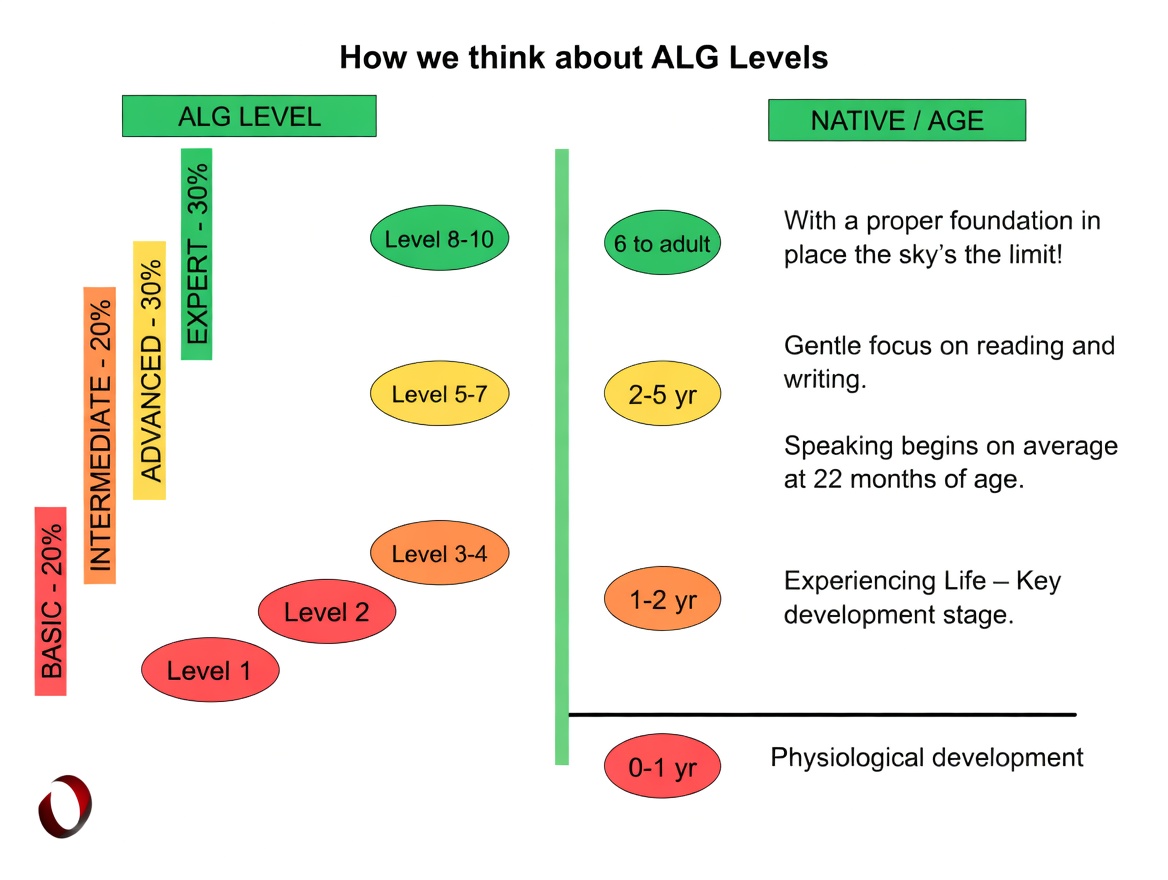
The idea is that language learning follows the same natural path as a child acquiring their first language. ALG breaks progress into 10 levels (roughly 200 hours each), grouped into Basic, Intermediate, Advanced, and Expert.
Instead of artificial “levels,” they focus on comprehensible input and let your brain develop naturally — just like kids do.
The quote from another LingQ user IMAT really stuck with me:
“Every 200 hours is like a level up, but every 1,000 hours is an evolution.”
Curious — has anyone else here thought about language learning in this more natural, child-like progression way?
I went to the ALG World website, and found pages that were incomplete and links that did not work.
I am suspicious of any SLA method that claims to be natural and immitate the way a child learns. That to me is no more than slick marketing.
We are not children, and there are real cognitive differences including much better semantic memory in adults. Then there are massive environmental differences. A child is immersed in the language, practices output routinely, has language partners, and gets level appropriate input. Research shows that we learn far better when the language directly relates to us i.e. we are involved. Children play, and that’s an ideal way to practice language, without any negative consequences. Interestingly play stops at age ten or thereabouts, and that is often cited as the cutoff age for acquiring a native accent and grammar.
ALG seems to be based on Comprehensible Input i.e. the discredited Krashen Theory. And it seems to stress not analysing language whereas children are known to analyse. Why is the sky blue? Why? Why? Why has daddy got no hair? Why? Why?
So I don’t believe for one second that ALG follows the way a child learns. That said, it might well contain some useful tools and techniques.
I’m sure we would all be interested to hear how well it works.
If we go by the current consensus in the field of SLA, it’s more balanced:
Comprehensible input is essential
Other things matter, too: output, interaction, attention, feedback, recall, etc
Adults don’t learn like children, and “CI-only” or ALG-style approaches aren’t really how children learn either.
The more dogmatic/extreme claims like “input alone is sufficient” (Krashen), or that “analyzing/learning” can harm potential (ALG) are not supported by evidence.
Appreciate the shoutout. The user that is referred to for the quote is @Imani . This chart is more of a framework in a numerical context. Theory wise, it would take a very long time in a class room setting, which is demonstrated in their youtube demo class for thai in Thailand.
The quote is a really good quote to stand by. It kept the motivation going personally.
Shouldn’t that be graded input with frequent repetition of words across multiple lessons? CI is a term created by Krashen as part of his theory and it comes with associated baggage. Most of the input I have been using for German was incomprehensible until studied, though the amount that is unintelligible is dropping significantly as I progress.
My intention was simply to say that input is widely considered necessary but not sufficient for acquisition, which contrasts with Krashen’s claim.
I recognize that what counts as comprehensible or effective input varies by researcher and that “CI” may imply Krashen’s i+1 definition. Still, some level of comprehension, along with other factors, is generally recognized as important. That is what I meant, input that is at least partly comprehensible.
We can all speculate on the effectivess of ALG. However, If you want to see if AGL actually works then watch Evildea’s youtube channel.
Evildea is a language enthusiast who runs community investigations into polyglot claims, covers general language topics and drama in the language space as well as running language experiments.He is an Australia who speak English and Esperanto fluently and is intermediate in Mandarin.He had to learn Mandarin as he has a Chinese wife and relatives.
Evildea is currently running an experiment where he is learning Spanish using only the AGL method .He only used the Dreaming spanish website , the Spanish boost gaming website ,and he has done some Spanish - English cross talk with the guy from Spanish boost gaming.Evildea does an insane amount of grinding of his languages.He releases a report on his Spanish language learning progress for every 50 hours of language imput using the ALG method.So far he is up to 600 hours .So if you really want to know the truth about how well ALG works check out Evildea’s you tube channel.
Babies are also surrounded by mostly in-comprehensible input (fans, AC, horns, sirens, microwave dings, tv, radio, adult chatter, pets, birds, insects, weather, storms and etc) and very little actual comprehensible input.
The core rule of ALG is the “Terrible One”: No thinking about the language at all.
That single rule replaces the entire old “Terrible Five”:
No forced early speaking/output
No taking notes
No looking words up
No asking grammar questions
No analyzing or conscious study
No grammar rules. No translating in your head. No overthinking anything.
The idea is that any conscious effort permanently blocks natural, unconscious acquisition. So the only thing you do is flood yourself with massive amounts of comprehensible input until the language grows naturally on its own.
Babies can, however, differentiate pretty well between what is most likely actual language and what background noise. However, your comment made me start an intersting chat with Mr. Chatty, here is the summary:
Summary
Summary of the Discussion
1) Innate sensitivity to speech vs. non-speech
Humans are not born with language-specific phoneme categories, but they do possess innate biases for processing speech-like signals.
Even newborns can distinguish:
speech vs. non-speech sounds
Early perception is tuned to:
rhythm
frequency patterns
temporal structure
Additionally:
Infants initially show universal phonetic sensitivity
→ they can discriminate phoneme contrasts from many languages
2) Development: perceptual narrowing
Within the first year of life:
Infants undergo perceptual narrowing
They become:
better at distinguishing native-language contrasts
worse at distinguishing non-native contrasts
This reflects:
experience-driven specialization of the perceptual system
3) Statistical learning as a core mechanism
Both infants and adults use statistical learning, meaning:
tracking transition probabilities between sounds/syllables
identifying regularities in continuous input
This enables:
word segmentation
detection of structure without explicit instruction
I don’t intend any rudeness or disrespect to you, but frankly the above is nonsense. It is Comprehensible Input which we’ve discussed here many times. All I will say is that my German progress was glacial until I adopted those five behaviours that you dismiss.
We’ll see. I’ll forgive you for not wanting to watch the entire video in order to become more informed on what it meant.
Never did I say stray away from comprehensible input, in fact that was the entire point of the ruleset. Just engage in comprehensible input without thought of the language.
People talk about natural language learning all the time. To me, it’s insincere marketing.
Babies learn without much else to do,
with a parent or two talking 10,000 words a daysome of it at them,
usually in a country that speaks the language,
lots of talk tailored to them,
without a established language and
aren’t all that eloquent 12 years later.
It’s completely different.
My Greek is noticably better for every 100,000 words I read (maybe 10 hours in a month). More progress in easier languages.
I don’t agree Krashen is discredited. Normal interpretations are that input is very important and most (not all) of what is needed to progress to a good level in a language.
Keating (2016) provides the clearest description of the role of output in language development: “Output hones a learner’s ability to access the implicit system with accuracy and speed” (p. 22). If our goal is to help learners develop communicative ability in the target language, then both input and output should have a place in our curriculum because they play important, yet different, roles in language acquisition and development: One builds the linguistic system, and the other helps with the skill of accessing that system. In other words, there is no need to declare whether you are “Team Krashen” or “Team Swain.” Saying that input is necessary doesn’t mean output is unnecessary. Of course, when it comes to teaching novice learners, if we are dedicating more time to output than input, then something is not right. How can you develop the skill of accessing a linguistic system when there have been little opportunities to develop it in the first place?
Henshaw, Florencia G.; Hawkins, Maris D.. Common Ground: Second Language Acquisition Theory Goes to the Classroom (p. 138). Hackett Publishing Company, Inc.. Kindle Edition.
I suspect you misunderstood my comment. I do not accept the Comprehensible Input approach. That is mainly because it simply did not work for me, but also because its tenets have been discredited as discussed elsewhere.