I could have reported your post as it is abusive. However, I prefer discussion. Others can make up their own minds.
There you go again trying to have it both ways. Your viewpoints aren’t abusive and are part of civilized discourse, but anyone who espouses an opposite viewpoint should be considered abusive and mean.
Similarly, you decry all the victimhood adversely affecting society but then constantly complain you are a victim of the woke left, of random people reporting your comments, of organizers of pride events, etc. Victimhood for me, but not for thee!
Calling someone a racist and a homophobe is abusive.
Suggesting that Black History and Pride should be assigned a day alongside Remembrance Day and Holocaust Day is not abusive.
I said no such thing.
I said no such thing.
I referenced a few of the countless prople who have lost their jobs after bullying by woke activists. And many of them subsequently went to court, and won a complete victory against their employers. Some are awaiting the start of court cases e.g. Amy Gallagher who is suing the NHS.
You reported my post, the report was rejected. I have no idea what the second part of your comment means.
I’m afraid I don’t understand your point.
I posted this and then headed off on vacation for a week. Talk about a stir! I didn’t expect this much drama, but I’m definitely entertained now 
3 Likes
It’s quite ironic, considering he claims ‘Stephen Krashen is right’ and preaches ‘input, input, input.’ He boasts 35,000 known words in a language, yet struggles to put a basic sentence together. I have a lot of respect for Steve—his advice is often helpful—but I find it disappointing when he narrowly defines language learning this way, especially since he didn’t actually acquire some of his own languages through pure immersion alone.
I’ve experienced this firsthand. As I mentioned, I’ve made more progress over the last three months in Argentina using an integrated approach than I did during an entire year of living in Austria and Germany. While on vacation this week, I happened to cross paths with some Germans and took the opportunity to engage in a basic conversation. I was pleased to find that I could understand a great deal of what they were saying.
Like almost every Language Learning video on Youtube.
In my view, it’s a recurring life pattern. It is far easier to make excuses or blame the world than it is to take ownership and accept that you are in your current position largely due to your own actions.
2 Likes
I agree with what you have presented so far. As someone with a background in Journalism and Public Relations, one of the first lessons we learn is that “absolute impartiality is unachievable”. It makes perfect sense; every piece of information carries an inherent bias, even when the news is presented without commentary or an explicit intention to be fair.
For instance, bias manifests in the hierarchical order of news, the selection of what to include, and even the specific lexical choices made. A classic example is: “Company X has fired 500 workers” versus “Due to inflation, 500 workers have lost their jobs”. While the core facts remain the same, the first focuses the blame on the company, whereas the second frames the situation to deflect responsibility or even target the government. There are a thousand subtle ways to manipulate ‘factual information’ through framing, even less noticeable.
3 Likes
I can see that what I wrote was abiguous so I must comment so as to be fair to Mr Kaufmann, What I meant was that when he is at a A2 to B1 level, he is quite happy to talk to someone, knowing that he has to search for words and make mistakes. In that position I would feel too uncomfortable. In other words, I was not making a criticism of him, on the contrary, I was applauding his self confidence. I have a feeling that that approach is one reason children learn languages so seemingly easily.
His methods do work well for him, countless people say he often speaks an L2 better than someone who has lived in the target country for ten years or more,
Obviously we agree that for us an integrated approach is more effective.
My German is now progressing, and I do see some overlap with Mr Kaufmnn’s approach. It’s really about pattern recognition and automatisation. I believe he looks up the grammar when he does not understand a pattern, but he does not memorise grammar tables, which is what most of us do. He describes that as not studying grammar, which I find a bit misleading. I need output to internalise the patterns.
German is an interesting language to study as it introduces many new concepts. I think if I started again from scratch, I would learn phrases, and not worry too much about the details. It would be a case of working out how to change the phrases to change the meaning, rather than building them from individual words.
1 Like
Very interesting. I am aware that various media only cover stories that suit their agenda, but yes I can see what you mean about framing, same key information, different emphasis. It sounds like I could benefit from reading a textbook on journalism.
1 Like
Since you are studying French and have expressed an interest in this topic, I highly recommend diving into the French School of Discourse Analysis. It takes Saussure’s structural ideas and applies them to power dynamics and subjectivity in the real world. Two authors particularly stand out:
-
Émile Benveniste – The ‘Father’ of Subjectivity: While Saussure focused on the ‘system’ of language (langue), Benveniste explored how we actually inhabit it (parole). His key concept is Enunciation. He argues that the ‘I’ only exists because language provides a space for it. If you want to understand how a journalist ‘manifests’ in a text without explicitly saying ‘I think,’ Benveniste is the essential starting point.
-
Catherine Kerbrat-Orecchioni – Subjectivity in Language: She is the most direct bridge to your interest in subjectivity markers. This was a pivotal concept I studied in both my Journalism and PR degrees. In her work, L’Énonciation: De la subjectivité dans le langage, she deconstructs how ‘subjective-emes’ (subjective units) function.
For example, choosing to label a protest as a ‘demonstration’ versus a ‘riot’ isn’t just a matter of vocabulary; it is a mark of inherent bias. Since you are studying French, reading her in the original language is a goldmine for acquiring advanced, nuanced vocabulary. I have only studied them in Spanish though.
3 Likes
The core issue is that we want the most qualified individuals to lead our governments, serve as our doctors, and staff our police forces. However, we have reached a point of absurdity where many countries have implemented ‘guaranteed quotas’ for trans individuals. As a result, competence, intelligence, and effort are being sidelined in favor of identity.
This was evidenced recently in Chile, where a woman won a political seat through the popular vote but was forced to cede her position to a transwoman purely to satisfy parity rules. Quite ironic that a man stole her position, btw. This is not just irrational; it is fundamentally harmful to the integrity of public institutions.
2 Likes
Comprehensible input –> trans quotas. Thanks, Leif Goodwin!
1 Like
As stated above, if people think that Leif and me had gone off topic too much, they could just ping an admin asking to move the discussion into a new thread. Otherwise it is just two discussions held at the same time. Happens at our company meetings all the time. 
1 Like
And to be fair. Initially Leif’s reply was that due to how YouTube works, someone who wants to learn a language and gets to watch a video of any of the CI supporters, will most likely get to featured a lot more of them. Thus the impression may arose that this is the “How it is done right” approach everyone in that field has agreed on, which might harm the success of the language learner. Especially as anyone can upload any nonsense there as there is no kind of quality control.
That the discussion has taken a more political route is caused by me presenting a counterperspective. So if you are mad, be fair and mad at me, too.


1 Like
It’s a mistake to think there’s anything new about this. Try reading ancient literature or scripture. It’s full of absurd hyperbole that we’re supposed to translate into our own (more credible) language. I wouldn’t blame modernity for it - it’s been with us forever.
Sales is, after all, the oldest profession.
Perhaps each generation adapts to the reality, but in Britain we have regulation of media, so that, for example, we know when we are seeing advertising. YouTube and other social media have broken that regulation big time in so many ways. I feel that America has a far more commercial culture, money has more say, Europe less so, and social media is forcing that American approach onto us Europeans.
To those who condemn all regulations, I say take a look at the obesity and diabetes epidemic in America and Europe.
@LeifGoodwin Rules aren’t of much help if people who disobey them don’t get punished hard enough or if those who are in charge of making sure certain journalistic standards are preserved are somewhat selective in applying them.
In regards to obesity, I don’t see how regulation or a lack thereof is to blame. There are tons of regulations on food here in Germany, including to explicitely declare the amount of sugar, fat, etc… People are just not bothering reading them, and they seem to lack the ability to taste. “Hhhm, sweet as hell, must be healthy.”
Sometimes the people themselves are to blame. In Germany we have a saying: “Wenn Dummheit wehtät, …”. Well, it does.
I don’t suppose that “the baby analogy” is anything more than just that — an analogy.
ALG uses it as a model: we acquire language naturally through massive comprehensible input, just like children. As adults our brains actually work differently, and Steve Kaufmann has pointed out this can be an advantage.
They break progress into 10 levels of roughly 200 hours each. It’s just good for gauging yourself relative to ground 0 and for motivation. It’s been proven to work.[1] [2]
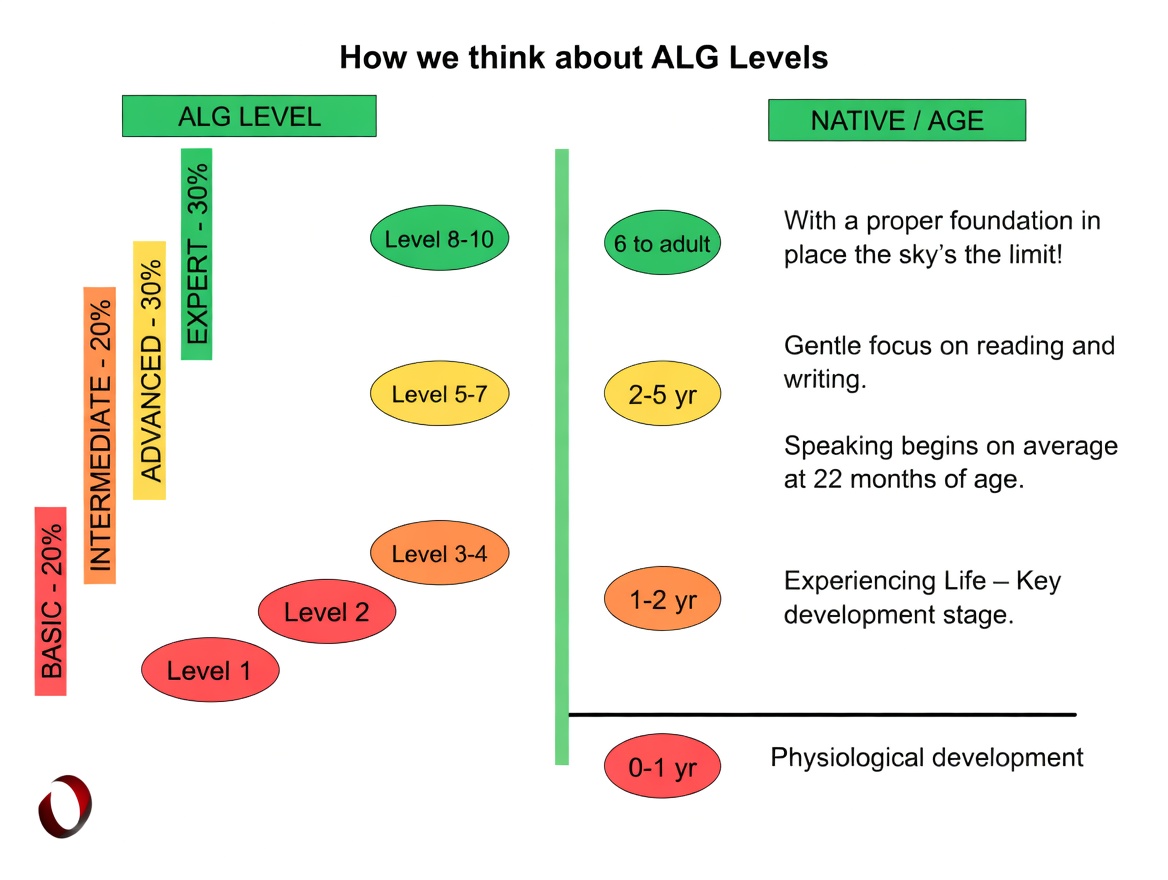
Some random dudes talking on YouTube claiming stuff is not the same as a prove, you know.
This statement itself is already problematic, as has been pointed out in previous discussions on the Krashen theory. First of all, it is completly vague what comprehensible input is supposed to mean. Secondly, even based on this vague term, you can assume that a big chunk of the input children get is incomprehensible to them. The majority of conversations they hear, what they hear when a TV or a radio runs (unless it is a program aimed at children in their age), books etc… cannot be understood by them. They lack the vocabulary, the grammar knowledge to understand complex sentences as well as the background knowledge of the topics they are confronted with. The main things they can understand is what is directly aimed at them, be it other children talking to them, adults simplifying what they say or programs or books designed for kids.
Thirdly, children take language classes in school in their native language, for years. The focus may differ depending on the language, but I had tons of grammar practices, for example. Not to mention that a lot of terms are taught explicitely. You learn what a cow is because your parents point at such an animal saying: “That’s a cow.” (Depending on how smart or dumb a kid you was, several times.) You learn special terms in Maths, Science and other classes. You don’t learn what magnetism is through comprehensible input, or the difference between an acid and a lye. You don’t understand the concept freedom of speech this way, nor anything else that is not very concrete in its meaning.
In everyday life you don’t need a lot of words to be able to make it through the day, depending on the language I heard numbers ranging from 2000 to 3000, and badly educated persons often don’t even know much more words. However, an average adult person knows ten times as much.
Not only that. We need the language for a much broader set of different tasks. What is sufficient for a children is far from sufficient for an adult. Not to mention that not everyone learning a second language do so for living in a country where that language is spoken. So there are, in return, aspects important for children that are part of their daily life, that don’t play a role for language learners. Most people nowadays learn English, but only a few plan to move to a different country. Some of them may need to be able to read papers or manuals in English, though.
3 Likes
Neither is some nobody on the internet discrediting everything and anything, to be fair.