There aren’t many rules about that in Canada. When it comes to limiting freedom of speech, we’re more focused on “hate speech”, which is basically calling for the extermination or subjugation of whole groups of people. That’s why some Americans can’t give speeches in Canada. They’d be arrested. In Quebec, the limits on advertising are more focused on protecting children from predatory ads. Generally, adults are expected to have basic media literacy. That expectation is unrealistic, though. Most people don’t.
1 Like
Yeah, kids can be annoying. I know, I work with 'em. However, it’s still free choice. Of course, we can decide whether we make life easier for parents. I just doubt that we need regulations for all of this, though. (As explained above)
You are right, I cannot assume the regulations to have no effect just because the numbers are stable. That beeing said, the reverse is true, too. That the numbers have stabilized doesn’t imply that some outside effect, like regulations, are the reason. All we could do is to compare different countries. But as those are different in many aspects that could have an influence, I am not sure this will give us much information. At least not easely.
We could reduce the regulations and see whether the issues get worse, though.
I am not denying that, although the government doesn’t pay any bills, as it doesn’t possess any money. They just distribute the money of the people, so the latter are paying.
This is, however, only an argument to deal with the issue - which I never objected to - and not necessarely an argument to apply even more regulations than we already have.
I am not. I’ve said “educate the people”, not that the government should educate the people. The latter sounds somewhat Orwell-esque. Improve the educational system, the education of the teachers, mix the different social groups stronger, so that less educated kids as well as their parents get in touch with higher educated ones, who can make them aware of the issue. (Besides this would be addressing other issues in society)
Teach children how to deal with food, how to cook and have a healthy nutrition from grade 1 on and make them aware of the problems they will get if they are having a bad diet over a longer period of time. Let teachers and school doctors address parents if they notice signs of a bad development in regards to pupils health.
There are tons of things that can be done without having the government regulating everything. They’ve tried regulations, in many areas, and to me it appears the downsides are bigger then the positive aspects. (In Germany doctors spend one third of their working time dealing with bureaucracy, thus causing long waiting times for patients) We still have ~25% overweight kids and ~10% obese kids in Germany, and your numbers indicate the situation is even worse in GB. Btw., we have ~17 million adult people living in Germany who cannot read above the level of a 4th grader. I am very much convinced that we have an educational problem, not a problem with big, evil corporations. (Not saying they are completely problemless. Nothing is.)
Which only works because a lot of the people don’t know what science is. Otherwise they would demand a proof. Btw. in western countries only ~50% trust in science. Probably because too many people say things like “Science says…”, “It’s a scientific fact that…” etc. before coming up with the greatest nonsense. People notice that, they just draw an incorrect conlusion.
On this we can agree, not only in regards to advertising. My point of view is that we are already overregulated, though.
Like that guy in the other thread was insinuating Leif and I were doing. 
Well, different countries, different rules. Some autonomy should be granted, imho. Everything else is up to diplomatic negotiations. If we want someone to follow our rules, or to apply similar or the same ones, we need to give them something in return, don’t we?
1 Like
I agree with much of what you wrote, so I won’t quote you. You suggest the issue is the availability of junk food and low educational attainment. It is a good point and no doubt has some validity. However, obesity is commonplace among well educated people. Perhaps studies have been carried out on the effectiveness of regulation, education via adverts and school education. I won’t pursue this as I don’t have any hard evidence either way. But I have no issue with dietary education at school, although its effectiveness would need to be proven, and in Britain school meals rather undermine that message. Much of this comes down to money. We want better education, better healthcare, better policing, better roads and lower taxes.
Incidentally, in Britain we do have a sugar tax, and it has succeeded in reducing the amount of sugar in soft drinks. I can see you shaking with rage as you read this.
I’m not sure I see a distinction between teachers educating school children in good dietary habits, and publicly funded educational adverts, or even warnings on foods.
Interestingly you have no issue with Big Sugar, Big Corn Syrup and Big Salt ‘educating’ people with countless forms of advertising, but you’re against that being regulated, and having publicly funded healthy eating advertising.
I really must stop calling for the extermination of people, it’s one of my least attractive habits. (Apologies for quoting Timmins out of context for humorous purposes.)
We have the same in Argentina

It makes no difference to me because I’ve always checked the labels anyway. As for my family, at least with these new front-of-package warnings, they’re finally aware of what they’re getting. Sometimes they assume a snack isn’t that bad, only to realize it actually is—though they usually end up buying it regardless.
I was chatting with a friend about why certain books, like Mein Kampf, are mostly banned in their original form. You can find them, but they’re usually annotated versions with notes in every chapter. It got me thinking: if we’re free, conscious adults, shouldn’t we be allowed to read whatever we want and decide for ourselves? My interest wasn’t about the ideology, but rather the political and economic history of that time.
My friend argued that these restrictions are like not allowing a 30-year-old to date a 15-year-old. He thinks human psychology is vulnerable and that we sometimes need ‘extra help’ or prohibitions, just like the warnings on food. I’m not so sure if that comparison actually makes sense, though.
Not even to mention the problem with cigarettes. Even when they are forced to put a picture of a baby and the word DYING… at least 22% of adults still smoking.

1 Like
No, I am fine with that. I am not completely against regulation or leading the people via taxes, if it is happening to a reasonable extent and if the benefits outweight negative side-effects.
Well, I guess one can have both. Although I am not sure whether an advert has the same effect on a child as an adult said child is emotionally tied to.
That’s not what I have been writing.
That one came unexpected. Thanks, now I need to think of a way to make my face stop grinning.
@martin_romangette I think you can access Mein Kampf in Germany for educational or artistic purposes. I once saw a black guy with one metre long dreadlocks sitting in an irish pub reading that book. That was … odd.  And we have a comedian of turkish decend that became famous reading that book on stage - in a satirical way. In an interview he once stated that after one show some neonazis approached him, complaining that he should have read it better. He responded: “It should have been written better.”
In Germany 30 year old are generally allowed to date 15 year old (except if they are their teachers or keepers or similar). That is not very common, though. That beeing said, when I was 16 years old I had a female classmate dating a 20 years older guy. Hasn’t done her any harm. She could have been dating a boy of the same age, but those can be pretty nasty assholes, too. So yeah, the comparision your friend made is odd. But it is also more of a cultural thing compared to how to deal with food advertising.
1 Like
In Singapore we have this nutri-grade labeling.
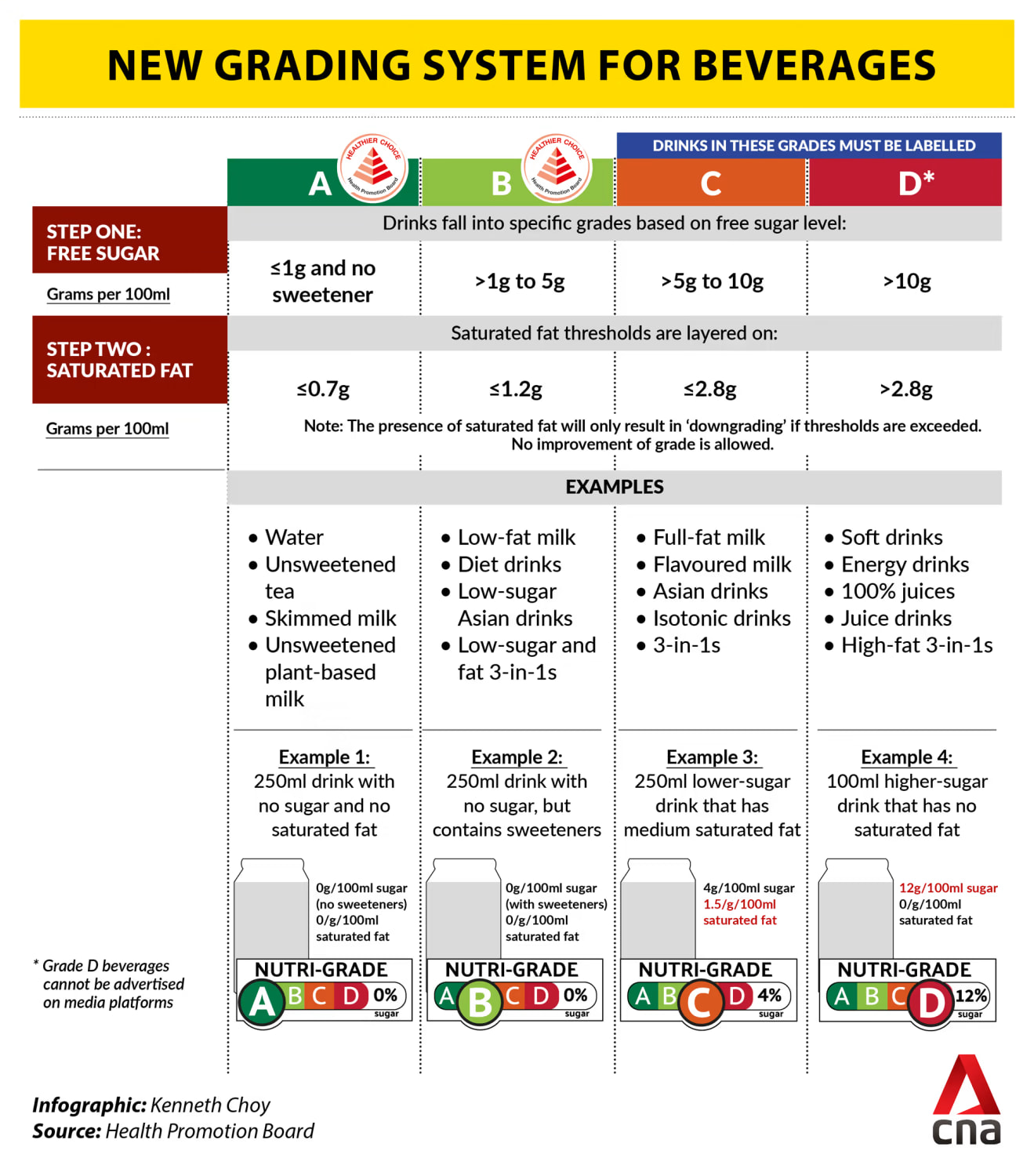
It does affect my choice when I choose something, but I am not sure of the success of it overall in the population.
2 Likes
We have something similar, called Nutri-Score. It features 5 levels from A~E, but they are not given based on treshholds but different ingredients of the product are counted in favor or against the score depending on the share it has. This means, however, that the score can be improved by adding something to the product that has a positive effect. In addition, putting the score on the product is optional, although many products have it.
Personally I find it easier to look at the table at the back telling me the exact share of saturated fat, salt and sugar compared to following a label whose calculation I cannot retrace easely. The one your country has makes more sense imho, although one could ask whether there aren’t other ingredients that should be taken into consideration, Sweetener is usually much more harmful to the body than sugar and there are plenty of drinks containing coffein and other ingredients one should probably not consume in too high amounts, especially kids.
2 Likes
Okay, that wasn’t the impression I got from reading your replies. Reasonable is a very subjective term though. If you’re saying it should be evidence based, then I agree.
We have a huge tax on cigarettes, and the evidence suggests that has helped reduce smoking. And we have banned BOGOF - Buy One Get One Free - deals on unhealthy food and drinks in large retailers. The problem is that food low in sugar is often high in fat and vice versa. A local coffee shop chain had some very good healthy vegetarian food, but stopped stocking it because it didn’t sell, people bought the unhealthy stuff full of artificial chemicals and sugar.
Scotland banned alcohol BOGOFs, and recorded a small reduction in the consumption of alcohol.
I have written quiet some wall of texts and at some point probably forgot how I started. I don’t think I have written anything that implies I would hold an absolute position in regards to regulation etc. Actually I don’t think I am ever 100% pro or contra something, for this I have been mistaken too often. But maybe my argumentation is missing some red line 
In regards to the terminology: Yeah, evidence based fits better than reasonable, and is in essence what I’ve meant.
In regards to unhealthy food I’d like to share a little anectode. In school, the food in the cantine was terrible. We had several automats and a cafeteria selling sweets and limonades. The thing is, we (the pupils) didn’t want that. We wanted to have more healthy, less sweet, fat or salty food, that we could buy in the cafeteria, for example. And tea or fruit juice instead of limonade. Never happened, though. So we went to bakeries in the surrounding of our schools, which is obviously quiet expensive and leads to this only beeing an option for kids who have money. If the pupil were to make the food in school themselves, it would probably taste good, would be cheaper than the one we got or buying it externally and would at the same time allow them to be taught how to cook and how a healthy nutrition looks like.
We have regulations on food for so long and still tons of unhealthy food, which exists for merely one reason - the people are buying it. My grandparents, who don’t live anymore (if they would they would be over 100 years old now) rarely ever bought any of this junk. They never went to McDonalds, rarely ate sweets (some bitter chocolate, maybe, which is not the unhealthiest thing to eat) and cooked their meals themselves. They had no desire to eat junk food. But they were educated completely different.
Long story short: I am not against regulation per se, but I think my approach works better. Give the people the means to draw proper conclusions and the right decisions.
1 Like
School food here is poor, despite a campaign to feed school kids with healthy food. Hospital food is bad too. If I die in hospital, the cause of death will most likely be starvation.
As you say, junk and unhealthy food sells because people buy it. Many prefer the taste of oversalted and oversweetened food. Cheap corn syrup, processed ingredients and artificial ingredients allow manufacturers to produce products at low cost with a high profit margin. The food itself is designed to be addictive and often unfortunately such food does not satiate the consumer as effectively as real food, leading to overconsumption. Obviously this was not the case 50 years ago because such foodstuffs were not available.
Ironically British farmers are struggling, with UK supermarkets often paying derisory sums for vegetables and fruit.
I would support a tax on unhealthy food products with the proceeds going to education e.g. TV and social media adverts for healthy eating. Or perhaps paying to support UK farmers somehow.
Some of the problem is lack of culinary skills.
Unlikely here in Germany, as the cost for staying in hospital doesn’t allow for long enough hospitalization times for most of us. (So only the rich will starve  )
)
That’s more or less how the Bioläden (bio stores) in Germany started.
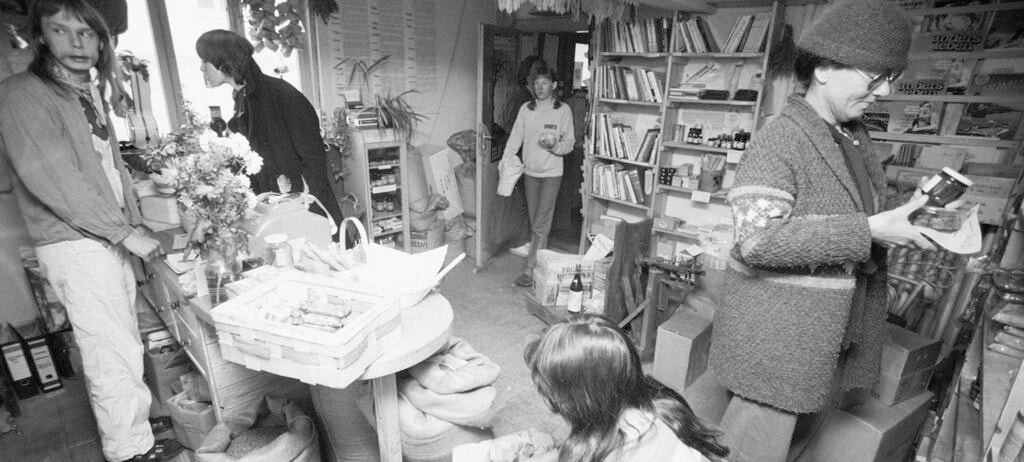
That picture is 50 years old. One of the reasons was unnecessary and unhealthy additions in food. Later on they often organized in so called “Genossenschaften”. In Great Britain you seem to have something similar, one among which is The Co-operative Group. (~6 million members of ~17 million organized in such structures all around GB). I don’t know how close those organizations are to each other in regards to the structures and the underlying law, but from what I could read at Wikipedia, the core principles seem to be the same.
If that doesn’t suffice, the farmers can join together, starting their own markets or trying to find young people who are willing to do take the risk starting an own company and spreading the message using social media, making the people aware of how important it is to pay fair prices not only for the farmers to stay in business, but also in regards to other issues, like environmental care.