Not sure about the efficiency of very high% unknown material, but I find working in sentence mode (if you aren’t already) very beneficial for difficult material. You are always one click away from a full sentence translation, so you can work both through the words and be able to keep up with and be engage with the story.
3 Likes
The most important is how it feels to you. Unknown words are just one aspect of how difficult a text is. Many times you might have those unknown words bunched up making it hard to get context, but otherwise text is easier. In this case I’ll just look meaning of the individual words as well as the translation of the sentense and move on. It’s more productive with sentences that you can get some grip on to. Sometimes higher unknown % text might have easier structures. Best might to have collections that are by the same author or have similar language/style so that even if it’s harder at the beginning, it gets easier over time. You know what you are getting into so it’s easier to binge content.
1 Like
This has all been discussed in earlier posts in this thread. People can read it and decide for themselves what to believe.
Comprehensible input is not spaced repetition. Please do some reading.
The research studies prove that spaced repetition is very effective.
Some people hate using it. Just do what you enjoy, that is the best way to learn.
I do a little SR alongside lots of listening and some reading. I cannot learn most words without SR.
He is a YouTuber who makes money from clicks on his videos and selling his advice. He certainly is not a learning expert in the sense of doing peer reviewed research, or having been trained in the science. Nor is he a recognised language expert. I’ve stopped listening to YouTube self styled experts, too many are trying to make a quick buck. There are some excellent videos by Loïs Talagrand who interviews numerous linguistics experts, although he has unfortunately also interviewed some Krashen disciples.
The studies suggest otherwise. It is also not my experience.
Adults learn very differently from children and are in a totally different learning environment. Studies in neuroscience have shown that children have better procedural memory than adults, and that might explain some of the differences.
Note also that as you progress in a language, your ability to learn new words improves. So we shouldn’t compare an adult learning new words in their L1 to an adult learning new words in an L2 where they have a B1 or lower level.
SR is not inefficent. Many people do find it boring.
1 Like
I get where you’re coming from, and honestly I’ve felt the same at points. Especially with languages where I’ve wanted to use them immediately. However, I can now say that I find this wrong.
It’s been around 2 years since I did anything serious with French. Yet most of the words, 70-90% I understand without any issue. Words such as desormais, no. I still need to re-learn it. But I believe what you’re struggling with is that even though a lot of the words you know in context. Some of them do not stick in a vacuum. But that said, the further you get, and as others have mentioned. The wider you read and the deeper you get with understanding. The more you’ll understand these words.
5 Likes
Unless I misunderstood, you are not using Anki to learn uncommon words in German? You are using it to learn common words and common grammar?
I’m mildly familiar with the model of declarative and procedural knowledge, but will read more about how it applies to language. A quick search didn’t result in a Wiki page, so I guess it’s not very well known, so I’ll skim some papers on it.
The word “need” here is obviously used figuratively as people have been learning languages long before the Leitner system and its first digital version of it - SuperMemo - were ever invented. Even L2s, L3s, L4s, etc. The Romans are classic examples in Western culture of learning languages for scholarly reasons, but you have the same in many other ancient cultures with ancient written Chinese and Sanscrit. You may find this of interest.
It all depends on definitions. The research refers to:
- the spacing effect (long-term memory is improved if you space study out your study sessions. If equal or increased spacing is better for long-term memory hasn’t been determined, as mentioned by @Obsttorte, but increased spacing is probably more time efficient is my guess)
- the testing effect (retrieving information increases long-term memory)
- the forgetting curve (memory decays as a power law)
- repetition of content increases long-term memory (aka rote learning)
Anki, SuperMemo, and SRSes are attempts to implement these four observed effects and theories found by research.
However, what they fail to take into account is that the research also shows that far transfer pretty much doesn’t exist and near transfer is often also quite weak. You are more likely to answer exam questions correctly if the question is verbatim to what you studied in your retrieval practice. In other words, you can get the answer correct, if it is presented in the exact same way as you practised, but out of that single context and wording, you struggle or fail to recall the information. When I used Anki back in the day, I noticed that I would fail to recognise a word in real contexts, but consistently get the mature word right on Anki. In other words, how most language learners who use Anki use it in a way that they are solely learning the word in one, single context and knowing the word in this context (a vocabulary word presented in the Anki interface or a sentence presented in the Anki interface) does not necessarily mean you know the word if you encounter it in other contexts (like in a different sentence when watching a movie or reading a book).
I’m not saying Anki is bad. I’m just saying that if you don’t take into account transfer, you are not guaranteeing you actually ‘know’ the word deeply (i.e. understand the word in a wide range of contexts). There are ways you can kinda do this in Anki, but it gets either annoying or complicated. Ideally someone designs a completely new SRS with language learning and transfer in mind because, as far as I’m aware, it doesn’t currently exist. In other words, if you are rote learning the word in one context, how do you expect to apply it to other contexts? Of course, there are other non-conventional ways to use Anki which may or may not get over this huge issue, but from how I’ve heard or read on how people commonly use Anki, almost no one uses Anki like this.
If the common outcome of using Anki is merely memorising the word in one context (one sentence within the Anki interface) before you need to go out and get variety from input anyways (ideally with a dictionary look-up option or sentence translations), at what cost are you doing this? What is the opportunity cost of this?
Though, depends on how exactly and what exactly you use Anki for. For example, from my understanding, @PeterBormann only uses Anki for L2 → L1 to practise production as it’s more flexible in a time schedule (and cheaper) than hiring a tutor, despite probably being less effective.
Justin Sung has some good points, like the paradox of how Anki users spend their time studying Anki cards to prepare them for a text, like about the election, instead of focusing on more frequent words first or considering that the opportunity cost of using Anki means not studying other words in a variety of contexts.
However, as @LeifGoodwin pointed out, we are L2 learners, not L1 learners. The arguments that people make that L2 learners should in some way mimic L1 learners are ridiculous.
The comprehensible input theory is simple to debunk. I mentioned a simple case study of Swiss Germans above which debunks it. Furthermore, if you are using LingQ, you are not applying the (false) comprehensible input theory. Looking up words in the dictionary has nothing to do with the theory. It’s all about guessing definitions from context to learn new vocabulary and grammar. If you are doing anything other than this, you are incorrectly applying the theory. In my opinion, relying on solely guessing from context is one of the slowest ways to learn languages, hence is one of the reasons why children take so long to learn a language (adults learn faster than children for the first few years of study). If you allow yourself to look things up in the dictionary, you are speeding up the time of waiting eons for the perfect i+1 sentence where you have the opportunity to guess the meaning of the unknown word. Using sentence translations like in Sentence Mode or YouTube dual subtitles or by reading bilingual texts is also not applying the comprehensible input theory. Steve Kaufmann doesn’t understand the theory, which is why he consistently incorrectly cites it and propagates misinformation and the myth of comprehensible input.
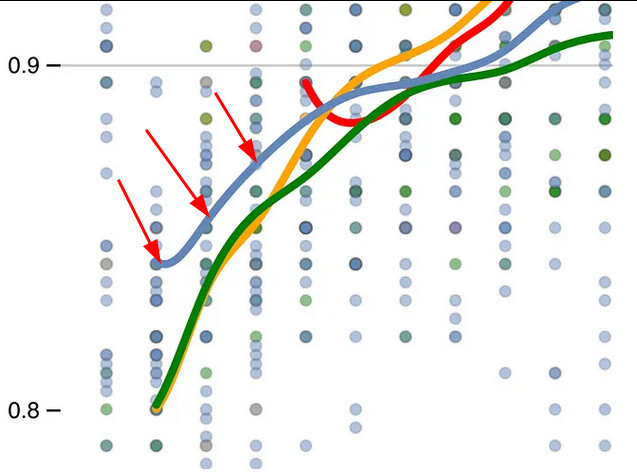
Edit: this is from the above-linked article. The blue line is the top quartile of 20+ year olds (the top quartile is used as a way to attempt to control for hours studied per year, as adults are busy people). You can see that adults do better than children for the first several years of study - yellow = 5-9 year olds, green = 10-19 year olds. Arrows pointing to years of study 1, 2, and 3.
4 Likes
I don’t think we need to be puritanists here. You are right that it’s not exactly the same, but what would you then call then? To me it still is closer to actual comprehensible input. I for one don’t look the translations first (if I even look it up) and many times meaning is quite obvious from the context. Even looking up the meaning doesn’t always help and it’s only when you see it in the right context that it suddenly sticks. Also like I said in the earlier post, translations aren’t always that accurate. You only get the actual meaning through context over many times. I would still call it comprehensible input. Does it even have a fixed definition? I don’t think it changes the comprehensible input part even if you compliment it with something else. It is also the times when you don’t necessarily have new words, but have to figure out what “known” words mean in that context.
Yeah, I agree that all these things are made more confusing as there are no agreed-upon definitions for all these words we all use. I’d say that the term ‘comprehensible input’ refers to something related to Stephen Krashen though. At least that’s how I usually think about it. I guess it’s often easier for communication if we aren’t referring to his theory to just refer to ‘input’ or describe exactly what we are doing.  I swear that quite a bit of the debates on the forums here are due to no well-defined definitions of some words.
Definitions do also change based on how it’s applied, similarly to words. Or can include variations in the definitions. Term itself fits well with lingq style of imput based approach. You could use term “imput based approach”, but I think comprehensible does define it more accurately.
I could not agree more.
How common a word is in actual German is not the issue, what matters is how often I come across that word in the input that I use. Thus a word might be seen as common by a native German speaker, but I might see it once a week or less. And I find that reading does not test my knowledge, unless I cover up each L2 sentence in turn, and attempt to translate each one to the L2, and then check each answer. In fact I can and do improve the effectiveness of input by doing exactly that.
I use Anki to learn the case system and other bits of grammar. This doesn’t mean that I can use the case system naturally, rather it means that when I come across input, I can understand (deconstruct) what is said or written without having to resort to a grammar book. And gradually over time I start to internalise it, and it becomes natural. Thus Anki acts as a stepping stone. Some people write out grammar tables as a quick reference, which serve a not dissimilar purpose.
I also use Anki with French. In that case it is more about getting precision. I am especially bad with prepositions, and Anki helps me learn the correct preposition in compound nouns, and with verbs. Input alone is not sufficient, at least not in my case. For one thing, in recorded spoken language the preposition is often inaudible, whether or not it would be inaudible in live speech I know not.
It is rather academic, I came across it in a university level linguistics book, with. University of Somewhere Library stamp in the front. There are a lot of SLA theories.
We might be in closer agreement than you think. I am sure that we both agree that one cannot memorise a language, In other words, just memorising word definitions and grammar rules will not lead to fluency.
For me language learning is essentially a process of conciously (explicitly) learning something (in one’s L1 or the target L2), followed by automatising that knowledge i.e. making it unconscious (implicit). A tool such as Anki is useful for explicit learning. In other words, it can help you put a piece of knowledge into long term memory. However, that memory is stored in declarative memory, and retrieval takes a noticeable amount of time. Language, if it is to be natural, requires that information to be in procedural memory otherwise you will have to stop and think while you retrieve the word. In practice words do naturally move from declarative memory to procedural memory over time as you become familiar with them through input. In this scenario tools such as Anki, or explicit study, prime the brain so that it can develop a natural understanding of concepts. But for that information to become language proper, rather than meta-language, you need to use it, through input or output.
In general I divide words, and short word phrases such as compound nouns (which I will refer to as words for brevity), into two broad groups.
The first consists of words with a simple meaning. The names of birds is a good example. Thus buzzard is not ambiguous, it’s a nice concrete concept. Some verbs fit into this category. The French word entraver is an example. It can be used in the concrete sense and figuratively, but the figurative meaning is pretty unambiguous. I find that such words and word phrases can be learnt as is using Anki. For example, the buzzard and la buse would make a good flash card pair.
The second group consists of words where the meaning is more complex. Thus the French verb sortir seems simple enough, but it can be used in many ways.
a) J’ai sorti mon chat. - I took my cat out.
b) Il sort un nouveau produit. - He brings out a new product.
c) Je suis sorti ce matin. - I went out this morning.
Thus there is no direct one to one mapping. This is very common with frequently used verbs and nouns. The meaning changes according to context, prepositions etc. I find that memorising such words on their own is not of much use, even though many ready made Anki decks and flash cards do contain such words. The way around this is to memorise short phrases. Of course each phrase only demonstrates one way to use that word, but I suspect that is how we learn the words in our L1 i.e. we learn each usage.
It’s a good point, and I certainly would not recommend Anki (or similar) taking up anything other than a small part of one’s study time e.g. 10 to 15 %. Most language learning occurs subconsciously, when we absorb input for example.
I agree that Steve Kaufmann does not understand Krashen’s theory. The theory is based on false premises.
There is a myth that children learn their L1 effortlessly. In truth children have to work very hard to acquire language. And children do not always succeed with an L2. A friend tried to raise her children as Welsh speakers, but they refused, saying that it is too hard. She is a native Welsh speaker, as are her parents and her sister, So much for children learning languages naturally and effortlessly.
As an aside, Duolingo is a variation on Anki, as it based on a system of rote learning one to one translations, which is why in my view it is a very poor way to learn an L2.
2 Likes
Interesting to note that the late great, philosopher of language, Ludwig Wittgenstein, described philosophical problems arising from misunderstandings caused by the use of words taken out of context. I.e. the same words can have radically different meanings in different “language games”.
Seems to me that there’s a lot of this happening on this tread.
2 Likes
Children also refuse to do chores. It’s hardly a proof that it’s difficult to learn a language. Ofcourse there also needs to be will to learn. Friends are usually better motivation to learn a language. Immigrant children usually pick up the language fast. It just needs right conditions. Heck, many immigrants even forget or find it akward to speak their mother tongue. It’s type of self preservation and assimilation to speak only the language that is spoken by the majority. Similarly to adults conditions and motivation are the main factors in learning a language.
2 Likes
I don’t disagree with your post, but I was making the point that contrary to popular opinion children don’t learn their L1 overnight, it takes a long time and considerable effort. nfera commented on this in her post, and I agree with what she wrote. I assume they don’t notice how hard it is because it is a central part of their life, and they enjoy talking and listening. There are also suggestions that they have cognitive advantages over adults, although I believe the research is sketchy.
On a personal level, I find language learning hard. YouTubers who claim you can learn a language in three or six months ‘naturally’ are completely full of it. And most of them are on the make. What makes it hard for me is learning words and their meanings.
Well ofcourse not. They don’t even have everything ready to learn to speak and have many other things to learn aswell. And it’s not like they are spending alot of time in direct contact with the language. Children that are learning their L2 a bit later do learn a new language relatively fast (They can be moved to normal education usually within months), even without any conserted effort to study it. If conditions are right; they are immersed to the language and have motivation (usually friends) for which to pay attention to the language they are hearing.
Well it is. It always takes time. Why children have it so easy is probably because they don’t understand or care how much they still have to go. As an adult it’s harder to let go of the control and not to get discouraged by every detail you still don’t know. Rather look for benefits of the current level. Claims that you can learn a language in X months are ofcourse BS, but with enough time invested it is still possible to get “inside” of the language in relatively short time.
The word need was a bad choice, rather one can use additional tools.
This comes down to what we mean when we use terms. Although she refers to reading texts, she also states that the ancient Greeks and Romans used parallel texts, and memorised the L2 texts. So we’re not using the term reading in the LingQ sense, or I suspect in your sense. In this context it overlaps with using tools such as Anki. And I assume we are talking about members of elite groups.
I listened to an interesting podcast on the Huns and Rome. According to this podcast, the Romans would take a son of a conquered leader, and educate him in Rome so that he learnt Latin and the Roman ways, before he returned to his homeland. I don’t have any scholarly references for this practice so caveat emptor.
Incidentally there is a very good interview with Dr Dickey on YouTube, although I suspect you will not learn anything new.
It’s an issue I also felt uncertain about and kept on again/off again forcing myself to use flashcards and sign up for additional courses (on top of LingQ) as I realized the “Known Words” doesn’t = Reality. Flashcards & language courses with tests are quite efficient at actually forcing your brain to memorize specific definitions but it’s exhausting and it’s very specific definititions you’re learning which you’ll initially feel proud about knowing but will realize later, you’re pouring way too much time into again and again and again practicing content you either hate, won’t use most of the time, and if you do use it, it will probably be used incorrectly as you memorized it for a very specific context which you made a flashcard for or learned it in a specifc themed chapter. ANYWAY, the LingQ method of highlighting, indexing, tracking new/previously seen words is just a great way to really get a sense of how much exposure you’ve had to the language, pre-measuring the difficulty of content, tracking if you are actually putting it your reps, and getting access to tons of user input data. All I know is that it’s my most effective tool for getting from Point A (total beginner) to Point B (I have a clue of what’s going on). That’s been more effective than anything else, just don’t go around claiming you know 2000 words and do a seperate exercises to improve your active recall (speaking/writing).
4 Likes
Surely children do spend a lot of time in contact with the language, along with countless contextual clues. But yes you are right very young children also have to learn fundamental linguistic concepts which adults have already got.
I wonder if nfera’s learning graph applies to distant languages such as English people learning Japanese? In that case the adult might have less of an advantage.
From what I have read that is true, although as nfera pointed out, adults can progress more rapidly as measured by hours of study, perhaps because they are better at getting down to studying, whereas with children it is more haphazard. I wonder if the study gave reasons?
I agree with the above paragraph, you made some good points.
Not if you compare to adults. As an adult, you can spent 8 hours a day directly engaged in the language, but for children it varies. A lot of the time there is no contact (for example when they are playing) or there are just very brief exchanges. Children might watch programs or parents read them bedtime stories, but it’s not nearly the main thing they do. My inclination is that the actual contact with the language is measured in minutes rather than hours for small children. It’s only when their native languege starts to be developed that they also get more contact with the language. At that point they also learn L2 fast if the conditions are correct.
Yes, but also might be how progress is measured. Like I said, children might not care that much if they make mistakes. They can progress faster in communication, but are slower in learning grammar or vocabulary. But I also think that this way is more constant road to getting actually native level fluency. Adults many times might be little more apprehensive about their mistakes and trying to communicate in the language. In theory they might have good level and understand well, but making the final steps aren’t as easy.
1 Like
I read daily, mainly in Greek and a little in French.
I mark known words early and generously.
I don’t know them deeply but
-some I know peroperly and can use
-some I recognise
-some I understand later
-some I need more work on.
Each month, there are more words in each cateogry.
So I keep reading.
2 Likes