Language Learning and Exhaustion

Has anyone else experienced this or is am I unusual? What I want to talk about is how strange my body reacts to learning intensely.

Since August 2024 I have attempted to learn Japanese as much as possible all day everyday, NEET style. For the first 9 months or so I was able to active read and active listen in the sentence view mode for 4-5 hours per day with usually 1-2 hours break in-between each hour. I would always feel exhausted, but still able to continue. (I was in good health as well)

At around 7 months my ability to continue took a nosedive. In the morning I would become so exhausted and nauseous that I would need to go back to sleep after just an hour or two of being awake, even with zero studying. Holding a conversation in English for even just 10 minutes would make my head feel like it was about to split. My working memory would be so poor that I couldn’t even read a sentence in Japanese without forgetting what came at the start of the sentence, making studying literally impossible. I wanted to keep studying, but I was forced to take days off and even once I started back up again I could only study for at most 2 hours per day, or else the next day I would feel sick. It seems there is only a certain amount of studying one can do per day without building up a debt of exhaustion overnight.

After taking some week/multi-week breaks as well as going lighter (1-2 hours per day) for several months, I recovered. I was able to do my original intensity from January - March, however, now I’m starting to fall back into that exhaustion.

I wanted to study as much as possible, but I was only able to average about 3.3 hours per day of actual studying if you don’t include breaks, which doesn’t seem like that much really. I am sure if I focused on listening or passive listening then I would have been able to do more, but I’d say about 90% of my studying time was active reading focused.

My final question I’m left with is how do full-time language learning schools/learners claim to teach/study for 8 hours per day for up to 88 weeks (FSI). Surely, they’re including breaks in that 8 hour period, no? Or maybe their learning materials/class sessions are much mentally lighter than just continuous active reading and listening. I wonder if there is anything I could have done differently. I did nearly nothing besides study and rest so it seems there’s no possible way I could have done more.

I realize I’m bragging a bit but hopefully some people find my experience interesting.
2 Likes

You probably experienced a burnout, and if this is the way your brain operates, I strongly suggest you pay attention and avoid it, because it could become much worse.

In any case, for languages, the brain needs breaks, because there are periods where you learn, and periods where your brain needs to metabolize what it has learnt. Don’t force your brain too much but learn to anticipate those moments.

There are no superheros as far as I know, and if they exist, you never know when they pay the price, and how. We are all different, don’t compare yourself to others but to yourself only, and we have all different characteristics as well.

You can also go very, very light, enjoy a 98% comprehension reading, or stop altogether for a bit. Even weekly. Give your brain some rest. You cannot grow if you don’t rest. It is like that for the body, and it is like that for the mind.

Good luck.

10 Likes

I think that 2-3hrs /day of active learning is great, you can spend the rest of the time to enjoy the language, play games, movies and etc in the language or read stuff below your level. For most people the main point of learning language is to enjoy using it.

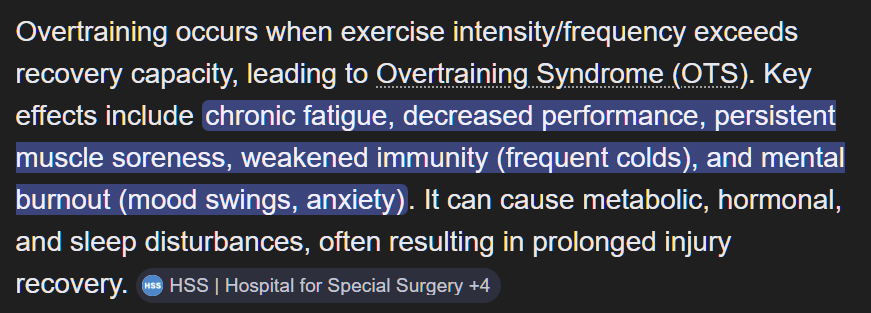
Since you are feeling physical symptoms like nausea, feeling sick, mental exhaustion, memory issue, I think you are getting some kind of over training effect, your brain is telling you something. Similar to sports people who train too much. I get those type of symptoms if I am overworked, deadlines and etc due to work, stress or too much coffee and lack of sleep.

I think you have eventually found your limit, which seems to be between 2-4hrs. You could stick to 2hrs/day to be safe and slowly build up/tweak from there. You could do zero active studying on weekends (only do passive or nothing at all)

You don’t have to worry that you are not learning during your breaks, because breaks are important for learning too (or muscle growth for bodybuilders).

6 Likes

It seems you binge-studied yourself.

In Hungary, kids in school and adults in language schools learn in 45 minutes “hours” (called lesson in English). And kids don’t usually have 8 lessons a day, maybe if they have PE too that day. When I was a kid, in elementary I had 6 lessons a day, in high school 7.

Also, I assume your learning efficiency is better then those in school. So your 5 hours could be 8-9 hours equivalent to theirs.

3 Likes

Your symptoms indicate acute mental fatigue from sustained high-intensity cognitive effort. Prolonged active language processing exhausts cortical reserves, causing nausea, headache, and working memory collapse.

Institutes achieve “8-hour” days via frequent breaks, mixed activities, and lighter input.

Try 45-min Pomodoro cycles with 10-min walks. Alternate how long you walk with how long you study. Enforce 8+ hours sleep and daily exercise. Build tolerance gradually. This prevents relapse and sustains progress.

6 Likes

My go-to solution for information overload is power napping.

Try 15-30 minutes of sleep when you are feeling foggy or overwhelmed. Something happens during the nap period that refreshes the brain, and it’s much easier when you return to your information-intensive task. If you’re not getting enough sleep at night, or not feeling well, pausing every couple hours to nap can really turn things around.

A binaural beats program with headphones can work a lot like power napping, and lets you select the exact sort of sound that works with your current mental state. I have had good results using the iOS app “BrainWave–Advanced binaural programs”.

It is also helpful to take walks in a natural, information free environment for an hour or so every day if you can.

Sometimes in the evening when my brain is tired I find that mindless exercise on the machines at the gym is suddenly easy and fun. The best physical resets for the brain for me are swimming, massage, and yoga/stretching.

Drawing has also become much easier for me since entering an information overload stage of life, especially drawing from life, or sketching in nature.

If physical activity isn’t appealing or possible, you might try this 40Hz audio from MIT that people are hoping will slow down the dementia process. I find the sound contributes to mental clarity-- though not as much as a camping trip in the mountains with evenings full of insects and wind.

“Exact 40 Hz Gamma Brainwave audio used by MIT to prevent Alzheimer’s” – YouTube

FDD - “Fun Deficit Disorder” – catches up with all of us eventually!

5 Likes

Are you people able to sleep when power napping? Or is it more a foggy state?
Because I’m unable to power-nap. I can do a sleep cycle, and it could around 2 hours. But a short one leaves me worse than before. Just out of curiosity!

2 Likes

你学习的素材是你感兴趣的吗,我也学日语,并且已经学了5年,如果你找到喜欢的素材,会对阅读乐此不疲,如果没有兴趣,单纯为了学习语言而学,那很快就会倦怠

You basically need to chill, haha. No, seriously, there is a huge difference between active and passive learning. From what you have said, 8 hours of active learning is unhealthy. Both the brain and the body need to reset in order to process and grow. I recommend a maximum of 4 hours of active learning; for the rest, you can do different things, whether it is reading something you enjoy, listening to music, or watching a movie-whatever you can engage with, but in a passive way. I am not sure about your eating habits, but that is important too, as is getting at least 7-8 hours of sleep. As somebody said, try to use the Pomodoro technique, since it is highly recommended to have breaks every hour or so. I would also not study 4 hours in a row. Sometimes less is more; keep that in mind and enjoy the process. There is no need to compare yourself with other when you don’t even know the intensity with which they learn, the content, etc. Do not forget to go for a walk or working out (without music and languages). Your brain and body need stillness.

Take care!

3 Likes

How long is your short nap ? I think it has to be not more than 20mins, to prevent going into other stages of sleep.

Also when I was in School we had 2x months long break in June and December.
I remember there was also 2x week long breaks in between those 2 month long break. Plus there was the weekend breaks and holidays.

So we have 104 weekend days + 60 days-16 weekends (June and Dec) + 14 days -4 weekends (2 weeks) + 13 public holidays = 171 days.

Actual days spent at achool 365 - 171 = 194 days.

I think that the only thing that was working was some sort of Yoga Nidra guided meditation. I guess there has to be a time window to stay on for working. My mind doesn’t switch off in 20 minutes, it takes more time and that put me into a sleep cycle, which is more than 2 hours, considering the time decompression period.
But they say that a power-nap needs to be short, in between 15-30’.

2 Likes

Yea it hard to make the mind quiet down. I just try to focus on my breathing when I took those 20mins break. I rarely take naps these days, because I sometime I end up sleeping all the way lol.

When having to work long hours on my pc, my concern is more on RSI. I use this Workrave tool for that.

2 Likes

I have mentioned in another discussion here that I was raised Mormon and went through the church’s two-month intensive language program when I was in my early twenties, 45 years ago. This was how they approached it — with mixed activities, though we were expected to speak only our target language between formal classroom sessions.

As missionaries, we were also expected to memorize a set of multi-page lessons in our target language by heart, which we would supposedly be teaching in our destination country — a major challenge in its own right for a new language learner.

For those willing to make the effort of following the program 100% it was extremely challenging. Because it was basically an “every waking moment” program, (and not just eight hours), each group who studied together for those two months had multiple part-time language teachers who worked in shifts, from morning until night.

Unfortunately at that time we didn’t have access to any modern technology to aid in our studies — not even the sound recordings, video tapes, or films available in the neighboring Mormon university language programs or other language schools. That probably would have helped to break up the monotony. Obviously online learning wasn’t available to us then either.

We did get breaks for meals, of course, and an hour for physical activity, but were expected to speak our target language during those times unless we were interacting with staff who didn’t speak that language.

While those few of us who followed the program 100% during that time did experience a degree of mental and physical exhaustion, the real burnout happened when we got to our destination countries, where we were hounded by church leaders night and day to go out and annoy people in their homes and in public. It was very much like an MLM high-pressure sales gig with no vacations or even full days off.

We worked 60-hour weeks, mostly outdoors, weather be damned. We got half a day, one day a week, to do our laundry and shopping, write letters home, etc. The country was one where people had a history of resenting religious interference in their lives, and we were told by church leaders that we were wicked because we weren’t teaching more missionary lessons, and converting those extremely uninterested people to Mormonism.

I did meet some really nice, and interesting people there — even if they weren’t interested in what we were selling. I’d highly recommend long-term stays in the countries where people speak the languages you are studying, but not under the exact circumstances that I did. The two years that my wife and I spent studying Mandarin and teaching English in Taiwan 40 years ago were a very different experience. It really helps to interact with natives daily under varying circumstances.

Anyway… yeah, mixed activities with breaks is a good way to avoid burnout, with appropriate downtime to allow the brain to recover, and sufficient sleep to allow the brain to convert short term learning into long term knowledge. You can be self-disciplined without being a self-sabotaging fanatic.

7 Likes

Thanks for sharing. during your 2 months program were there breaks or less intensive period during weekends/sundays ?

The Middlebury program also seems to be about 2month-ish. It is probably safe to go intensive in short 0.5 - 2 months burst.

1 Like

“the real burnout happened when we got to our destination countries, where we were hounded by church leaders night and day to go out and annoy people in their homes and in public” - I really get how crazy that is and many suspect this may be a deliberate way to invoke a feeling of tribalism in the members by giving them a feeling of these “others” being so unappreciative and ungrateful of people who are actually trying to save their souls.

I remember how absolutely cringe and unfair I felt it was when these clueless teenagers or very young adults would approach me, a grown man with an extensive education who had lived in different parts of the world and learned several languages and try to convert me in a broken version of my own language. It’s kind of like trying to send your little border collie out into the ocean to herd a pod of minke whales.

3 Likes

I think each autodidact/learner has to figure out what their limits are. It seems you gradually, slowly but surely emptied your gas tank so to speak and didn’t notice the burnout coming because it was too gradual, until it was like falling off a cliff.

I don’t think I can know what would be right for you, because again, I think you need to figure that out. It’s not always easy to figure out when you are being “lazy” and when you are taking the appropriate amount of rest, or when you are being properly ambitious and when you are driving yourself into a wall.

I find my motivation and attention varies greatly. I have certainly had periods where I am sick of language learning and sick of using LingQ. I think at the height of it, I used to spend about 6 hours a day learning French in LingQ, this was a period of 3 months or so I think, when I had just discovered LingQ. Now I rarely spend more than an hour a day on LingQ, although I will watch youtube videos in languages which I’m already fairly advanced in along with LingQ. Sometimes, even now when I don’t spend as much time learning, I feel I can’t remember anything from any language and it’s all become spaghetti in my head. I think one advice I saw someone give here and I think is good, is to sometimes just allow yourself to binge on very easy stuff. You actually do learn and nail things into your memory when you repeatedly listen to or read material that is really easy for you.

6 Likes

Mormons have a lot of church meetings on Sundays, so it was a different schedule from the other 6 days. When our son went to their language school to study Finnish it was for 3 months, since it’s a tougher language for native English speakers.

If I were going to run a language program that lasted several months I’d have a lot more less-intensive activities to keep from causing burnout and people dropping out of the program early. While I was there I gave up an hour of sleep each morning to spend more time studying, but that was definitely unusual since the program was fairly exhausting.

I’d never heard of Middlebury before, but that sounds like another good reason to retire to Vermont, (though my wife hates snow).

2 Likes

A big part of the reason that they insist that young men and women become full-time missionaries for two years is to create a stronger emotional tie to the church, my mission president told me as much himself.

That’s because those young people have sacrificed/invested so much time, effort, money, and emotional energy into the church. That can make it really hard for many people to walk away when they start having doubts. When people do things for emotional reasons they are willing to go through all kinds of mental gymnastics to preserve the worldview that offers them comfort and familiarity.

Tribalism is a huge part of it, as you say. I have been shunned by most of the Mormons that I grew up with, but some good friends have also left the church. I paid a huge price for the French that I learned, and the church didn’t even do a very good job of teaching it. Most of what I know of the language was from seeking out learning materials, putting in endless hours of study, and having the nerve to make a fool of myself talking with native speakers until I got better at it.

1 Like

They seem to be taking advantage of sunk cost fallacy. Happens quite often with investors.

2 Likes