Native English speakers commenting about how difficult English is to them is something I have seen very often. So I am tempted to consider this something not specific to LeifGoodwin.
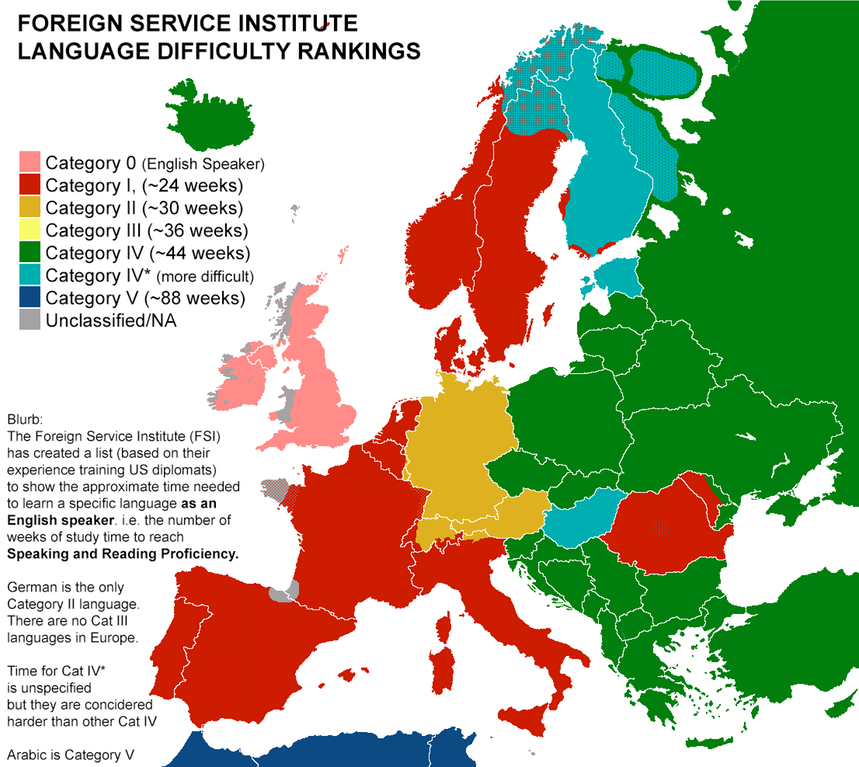
This is actually seconded by the Foreign Service Institute.
The choice of colors is a bit unintuitive. Yellow marked countries are Germany, Austria and parts of Switzerland as well as a minor part of Northern Italy (Tirol me thinks), so it represents German.
Unfortunately, there is no such data available for native speakers of German, so it is hard to compare. There is a general consent that the linguistic closeness between your mothertongue or other languages you know and the language you want to learn plays an important role, but that is basically it. From my personal point of view I would raise to hypothesises.
The language learning effort is asymmetric. This means, the difficulty for a language A native speaker to learn language B doesn’t need to be equal to the difficulty for a language B native speaker to learn language A. I think that the language pair English-German is a good example. Note that the properties of the language itself isn’t the only aspect to take into consideration[*].
It’s a difference whether you look at a language from the perspective of a native speaker of language A, or someone who is a L2 speaker of that language, even if at a high level. [**]
[*] Many older persons living in Eastern Germany consider English comparably difficult. This is based on two aspects, I think. First off they learned Russian as a first language in school and secondly and more important their major cultural influence besides national culture was the cultural influence coming from the east, especially Russia. They’ve grown up with russian fairy tales, movies and the like. They don’t watched them in Russian most likely, but a language and the culture of the countries the language is spoken in are connected, too. Younger people in Eastern Germany who’ve grown up with western movies and music mainly in English don’t have that issue.
[**]As this has been brought up. That I am able to use the english language at a somewhat high level doesn’t change the fact that I am a native German speaker. Research clearly shows that the areas in our brain that is used for the language(s) we learn in early ages and those we learn later on differ. So even though learning a new language may influence our thinking and approach to certain thinks, like new languages, the impact our mothertongue has is probably, if not stronger, of a different kind.
Some of those words might have a relationship to their english counterparts, though it isn’t obvious and I am speculating here just for fun.
benötigen comes from Not, which is rather close to need ernähren, which is similar in meaning to nähren and means to nourish verloren (the past form of verlieren) which is close to lose ent-scheiden is de-cide, note that ent and de have the same meaning (de is Latin) angreifen : greifen means to grip, grasp
etc..
It is much easier to build connections between those words, even if they may be imaginary only, if you leave away the prefix on the seperable verbs and look at the root verb only.
As I’ve said before, and we’ve discussed, I do break down German words into the components, and I can sometimes get a rough idea of the meaning. Whilst this helps, it’s not something I can do while listening to German. Perhaps others are better at this. I need to see the word written down. Another complication is that German words sometimes have many meanings, as determined presumably by the context. Einstellen is an example. French, and I assume other Romance languages, tends to have a specific verb for a specific context. I find it frustrating to look in a dictionary and find many quite different meanings.
As regards the FSI language difficulty ratings, those are based on their experiences teaching students to a conversational level, and as such they will be an average. I’ve heard some people say that French is hard, and the negation system is far harder than that in German. I find French straightforward and logical, and the negation system is very simple. So perceptions vary i.e. there is a spread around the FSI average. Of course emotions come into it. If your favourite bands sing in Klingon, you will probably feel more motivated to learn it.
A year ago went to give blood, and I mentioned to the nurse a famous comedy sketch. She said “I am German, I do not have a sense of humour”. Sometimes stereotypes come true! What struck me was her flawless English, with a beautiful cultivated accent. She grew up in East Germany, learning Russian at school, and came to England as an adult.
Another point is that each language has its own challenges. In French it is the pronunciation, listening and spelling, In German it is the case system, word order and (in my case) vocabulary. Progress in a given language will vary. Many people say that German is hard at the start, but gets much easier, and that French is the opposite. My experience, for what it’s worth, is that the German case system is non trivial, but not a big deal. Word order tricky too is. Genders are not as hard as many think, because the gender of a word is usually if not always determined by the root. Thus Antrag, Vertrag and Beitrag are all masculine, as are Vorteil, Nachteil and one form of Teil. And of course once you have learnt the roots, the meaning of compound words can sometimes be guessed.
In regards to verbs in romance languages, I haven’t learned French but spent some time learning Spanish in the past. When I looked up verbs I usually get up to 20 or more different translations possible. So I assume verbs can be very different in meaning in romance languages, too, but maybe the core idea of the root of the verbs in French and English for example line up more better.
Of course everything in regards to how difficult or not something is based on a characteristic of a set of people can always only be seen as an average. Btw., the citation of that german woman reflects german humor pretty well
In regards to gender:
der Vorteil, der Nachteil, der Anteil (all masculine)
→ die Mitteilung, die Beteiligung (feminine)
→ das Abteil (neuter)
The ending of the words is probably a good indicator, too.
Breaking down words like this is obviously hard to do on the fly, so when under time pressure like when listening. Btw., not everything I say as a response to a post of yours or in reference to it is necessarely directly aimed at you. I always assume others to read them, too, and there are a couple of people here learning German. And I tend to forget things.
I don’t know Spanish, so cannot comment, but I haven’t noticed that in French. It is possible as you say that the concepts underlying corresponding English and French verbs line up better, no doubt due to Norman Conquest and his friends.
That was my fault for a lack of clarity, by root I was referring to the right most component of the word. So yes obviously words ending in schaft and ung for example are feminine irrespective of the other bits.
You haven’t provided any sources either. Lexical similarity calculates rate of change similarly to molecular clock. The % might not be as high the more words you compare, but it doesn’t change as much either. Not as much as you like to think. Also that calculator compares words with exactly the same meaning, which is why it also underestimates number of cognates if language rather uses another word for same meaning. For example it would compare dog vs hund, and disregard that hund is cognate to english hound. It’s not like you have to think long to make the connection yourself, right?
No, it’s you who is mixing etymology and lexical similarity. Ofcourse I have to mention it as it’s the base of your argument.
As little as you. Btw he didn’t contradict what I said. He said they don’t go 1 in 1, which is same as what I have said. They rarely lead you astray even if the meaning isn’t the same. And it’s not like the use of prepositions in english always makes sense.
They aren’t no more similar or different as with german cognates. You can’t just start to listen and pick out as you go. You need to have some base before you can do that. Even then you likely misunderstand meaning quite often. That is part of CI, but you can’t say retrospectively that it wasn’t a big deal. You only remember the last time you remembered that and so you don’t actually remember how it was when you started.
Yes I’m, but are you? I didn’t answer to question about how it is to learn german as native english speaker, but to your false claim that german would have less cognates with english than french. Like I have said many times (which you for some reason ignore), I didn’t say your experience is wrong, only the claims you make based on those experiences.
It’s just that early level that has the most cognates. I just showed you a piece from that level full of cognates, most of which are clear.
You could similarly list words in french, but ofcourse you can’t do it anymore as those have become natural to you. That’s why you can’t see how different they are. Happens to me many times with spanish or swedish that I try to find what is the english counterpart to some words before I realize that there isn’t. Those spanish or swedish words have just become so natural that I automatically expect that there must be some connection to languages that I have known longer.
I never memorize words. I try to recognize words. That’s why it helps to see if there is anything familiar. Mostly there is enough familiar to directly lingq them to 2-3 and after few more times move to known. Quite often directly to known if they are universal latin/greek etc words or basic germanic words.
You have spent now many years to read 500k words and you already had spent earlier what 18 months to read some 200k words in german. That is hardly enough repetition to learn anything fast. You could have done same in month or 2 if you want to progress fast. Why you think it’s not just simple lack of time spent, but instead has to be some outside reason? I’m sure you didn’t learn french by spending similar amount of time to read similar amount so how do you think you can compare them side by side? The more you read the more familiar it becomes and the more you loose the feeling how much trouble you had at the start.
I meant that more generally as I see in tandem and other apps adults starting to learn english. In my case it is also usually from latin america where the base education maybe isn’t the best. Like if you manage to get to adulthood and you have completely missed pronunciation practises at school or they are poor in quality like it might be the case in France for example. I remember when I was in english language school in New Zealand and I had a french roommate who started practically from zero. So he was always carrying dictionary and looking for words that he could butcher. Eventually he did learn good level in 9 months, but had very strong accent still.
English has mostly loaned for more specific uses whereas french words has more wider, albeit related meaning. Quite often french has also lost that original meaning or meaning has changed in english.
Spanish base verbs can be used very liberally, but it’s not that different from how english uses phrasal verbs. I suppose all langueges have the tendency, but it’s hard to see how nonsensical some uses are if you are a native speaker. What I have noticed that many languages use words for “throw” and “hit” quite liberally.
Besides those common verbs, I don’t know if the verbs are used in that many different way. Often they might be very localized uses. But it seems that at least spanish and probably other romance languages have wider vocabulary than germanic languages (besides english). Or germanic languages use more compound words. For example norwegian/danish huslån, literally house loan. Same is the case with german often.
Except I did. You also have access to search engines, which you could have used.
Wrong.
You are constantly referring to French, for example. And yet a knowledgeable person has told you that unlike English, latinate words in German are mostly restricted to specialist areas e.g. science and medicine, whereas in French they are par for the course.
And yet he did as he agreed with me. “It doesn’t neglect your point though, there is indeed no 1-1 mapping between German and English”.
Wir warten auf sie - We wait for you.
Ich trinke beim Kochen - I drink while cooking. Beim Fußball spielen zwei Mannschaften gegeneinander. - In football, two teams play against each other.
Er interessiert sich für Autos. - He is interested in cars.
Ich reise nach Berlin. - I travel to Berlin.
Sortiere die Karten nach Thema. - Sort the cards by theme.
Es riecht nach Käse. - It smells like cheese.
Es schmeckt wie Käse. - It tastes like cheese.
Es steht auf dem Fensterbrett. - It is on the windowsill.
Wir achten auf den Lehrer. - We pay attention to the teacher.
Ich habe meiner Schwester zu ihrem neuen Job gratuliert. - I congratulated my sister on her new job.
Your problem is that you do not know enough German to realise your error.
Well, if you don’t care about accuracy, sure, anything goes.
That’s bad grammar, and meaningless.
That’s bad grammar, a basic mistake. We would say “Yes, I am,”.
I can’t understand that, the grammar is too poor.
You continually tell me that my experience is wrong, and yours is correct. You continue to ‘explain’ why I am wrong in this post.
Of course A1 has the most cognates, that’s consistent with the lexical similarity calculation using a 100 word Swadish list. You’re seeing the most common words, which are the oldest. The example extract you have was very basic language. Go to the front pages of Die Welt and Le Monde, and the situation will be quite different.
Your problem is that you studied German at a low level, and saw that there was a high degree of similarity to English. And of course the creators of these courses deliberately throw in similar words, to make it easier for the beginner. So you’ve gained a false impression of German.
Go instead to a B1/B2 level, and that illusion disappears.
And you are Finnish, you don’t have the vocabulary of a native English speaker, which means you are lacking a large number of latinate words, such as rébarbatif, réclusion and abrogation.
So in short, you have insufficient knowledge of German and English.
I have been studying French again for over three years, and made huge progress using mainly audio input, because I could pick up words on the fly. Sure I have to look up occasional words, and sometimes the grammar is unclear. But with time and hard work it comes together.
After almost three years of German, I still cannot do that. I have had to significantly change the way that I study. I have to study texts before listening to them, then I listen, and then I revise texts I studied earlier. I also use word analysis, breaking a word into its components, which takes time, and cannot be done on the fly. And that is because at the B1/B2 level, cognates are fewer, and when they do exist they are more hidden. So I cannot rely on picking up the general meaning of a word from audio. I have a poor memory, and have to focus far more on getting words into my memory, even before I can start developing a deeper understanding.
Overall German is probably on a par with French, for a native English speaker who wants to get to a B2/C1 level, but not for the reasons that are usually given. Once the student has a good basis in German i.e. upper B1, they will benefit from compound nouns and less genders to remember, since the right most component of a word determines the gender. French gender is somewhat arbitrary, and there are less compound nouns e.g. die Babyflasche versus le biberon. And I have the impression that it is easier to recognise the words in spoken German compared to French, where enchaînement and a more even stress pattern are significant obstacles to comprehension.
No doubt you will confidently tell me why the previous paragraphs are wrong and why my subjective impressions are wrong.
We do it to annoy you. Honest. Unfortunately it annoys us as well. We need a spelling reform to maek lief eezeeuh.
I have corrected the grammar, as there were quite a few errors. An English person not understanding an Australian would be very unusual. That said, it could arise. I sometimes albeit rarely struggle to understand an American, and I am more at ease with Quebec French than many French people.
I am not sure why you both are fighting, though. I mean, a lot of English natives in this forums brought it up several times that they consider German hard. Yet I never saw a single German native making a similar statement in regards to English.
The Foreign Service Institute made the observation over a long period of time with a lot of people, that German takes a considerable longer time to learn than other germanic languages. Of course, the training is somewhat specialized, but still it stands out a bit.
So whether this comes down to lexical differences, the grammar or other factors not directly associated with the language, the empirical effect is clear: Native English speakers will in average need more time to learn German compared to other germanic or romance languages.
I had a lot of fun with that, though. I must say, I often agree with @LeifGoodwin on most topics.
As a native Spanish speaker, German has been the most difficult language for me so far. I don’t think I have that much experience since, in addition to Spanish, I only speak English and Portuguese.
As I have previously mentioned, immersion in Austria did not work at all. Ironically, I have improved my German way more in Argentina than I did there. I started studying grammar alongside CI, but I also repeated and wrote numerous chapters, rewriting them as stories and so forth, in order to advance with the language. I have never been as motivated as I am now. I am planning to return to Austria in December.
Just to give an example, an excerpt from “Die Welt” (a german news magazine). The translation is done using google translator, cognates are marked bold. I made annotations for cursive words.
Im Kriegsfall braucht es nicht nur Panzer und Bunker, sondern auch eine stabile Gesundheitsversorgung. Pharmamanager Simon Goeller sieht Europas Medikamentenmarkt nicht ausreichend für den Ernstfall gerüstet. Er warnt vor der Abhängigkeit von China und den unabsehbaren Folgen, sollten Antibiotika ausgehen.
In the event of war, not only tanks and bunkers are needed, but also a stable healthcare system. Pharmaceutical manager Simon Goeller believes Europe’s drug market is not adequately prepared for such an emergency. He warns of dependence on China and the unforeseeable consequences should antibiotics run out.
Krieg: I think the word Blitzkrieg is used in English, too. So an English speaker might know that one. But as it is tied to WWII, it might be too specific to assume everyone to know it. (Does every native English speaker know what “Fire in the hole!” mean?)
Versorgung literally means supply.
We use the word pharmazeutisch in German, too. So one could also say Pharmazeutischer Leiter, too.
Pharmamanager is Denglish, see above.
Medikament is rather close to medicine et. al., so probably guessable. Although I don’t think anyone says medicine market?!
Ernstfall literally means serious case. Martin Lawrence would say: “Now shit’s goin’ bad.”
System exists in German too. However, Gesundheitsversorgung ≠ Gesundheitssystem.
adequat is a word that exists in German, though rarely used. I know it more in the context of clothes and manners, so behave adequately, wear adequat clothes. Something like that.
Konsequenzen exists, too, in German, and is commonly used.
Of course the translation could be altered here and there, and the original phrasing could differ. But that would not heavely increase the amount of cognates and most like sound unidiomatic.
I assume you have started learning English before German? In that case, you would have had an advantage already when learning German. And you can, in either case, compare both languages, as they are both germanic.
I certainly did learn English before German, and it is a clear advantage. My point is that I have focused on each language differently; I didn’t (and still don’t) study these three languages the same way. I think that is my main takeaway, or what I have been trying to convey in other posts: I disagree with the ‘just focus on CI’ approach and the 1,000,000 videos about ‘how to learn a language’ that just peddle the same BS over and over.
English and German are both Germanic languages, yet in my experience, they are indeed quite different. As you mentioned, being able to compare them and associate certain structures is helpful. Furthermore, just because languages share the same root—like Portuguese and Spanish—it doesn’t mean you will truly master them without effort. Most native Spanish speakers who claim to speak Portuguese (and viceversa) only know a few patterns. However, Portuguese has more vowel sounds, a tense that doesn’t exist in Spanish (the personal infinitive), and many ‘false friends.’ If you don’t study grammar or practice writing, you will inevitably end up speaking Portuñol, unable to differentiate between the two. Portuguese uses different tenses for things I would never express that way in Spanish.
Just so you know, my post was affirmiting what you have posted before, but maybe I was a bit unclear, so let me rephrase it.
What I meant is that even though you knew English before it still wasn’t of much help learning German, as you stated yourself. This underlines the point already made by Leif and myself that there is a significant difference between those two languages at the level it is used in everyday situations. So them both beeing germanic languages is only of limited use, even though it makes German probably easier to learn than Russian or Mandarin or so.
I would even restrict my earlier statement, that English is easier to learn for Germans than vice versa, to people who have a somewhat high education, as they tend to know a lot more Latin-based vocabulary.
When it comes to your view on the “CI only”-approach, we are on the same page here. I consider it a nice marketing gag.
I thought you said Germans don’t have a sense of humour?
Would you mind explaining briefly the methods you use for each language and how you arrived at each approach? I find it interesting that you explicitly say that you use a different method for each, rather than developing a one size fits all approach. I think you study Spanish, English and German.
I do wonder why there are so many ‘you don’t need to study a language’ videos. It’s worse than the American measles outbreak, and that’s due to the 1,000,000 ‘vaccines kill’ videos.
Ah yes, I believe your etymology is correct. Thus der Notfall is roughly speaking the need case i.e. emergency. Again, das Notruftelefon is roughly speaking the need call phone i.e. the emergency telephone. Such an interesting language! No doubt latin is the same.
I realised today that schaft roughly corresponds to scape, thus die Landschaft is the landscape, where scape kind of means scope or extent, although we don’t seem to use this suffix much in English.
I’m reading a book on cognitive linguistics, and prepositions embody concepts, which I think are often if not always embodied i.e. relating to our physical relationship to the world. They are then extended by metaphor to abstract concepts e.g. time. Unfortunately language courses tend to explain them by giving the English equivalents, which is sometimes unhelpful. Of course it is impossible to predict which preposition to use, but an understanding of the underlying concept can help.
I think the main difference between English and German when it comes to both verbs and nouns is, that we tend to write everything together. So for an English native learning German the challenge is getting used to untangling the words into its components, whereas for a German native learning English the challenge is finding out which words belong together forming a semantical unit. I guess both approaches have their advantages, although the german approach is obviously the correct one
In German there is also the word schaffen, which means to create as well as to accomplish. It seems the suffix -schaft either corresponds to a set of related things or a state, sometimes as a result of what people did. Other examples are: Mannschaft (team), Herrschaft (rule), Liegenschaft (property), Verwandschaft (family), Rechenschaft (justification), Freundschaft (friendship), Wissenschaft (science), Kundschaft (customers), Belegschaft (workforce)
The english ending -ship seems to have a similar meaning, too.